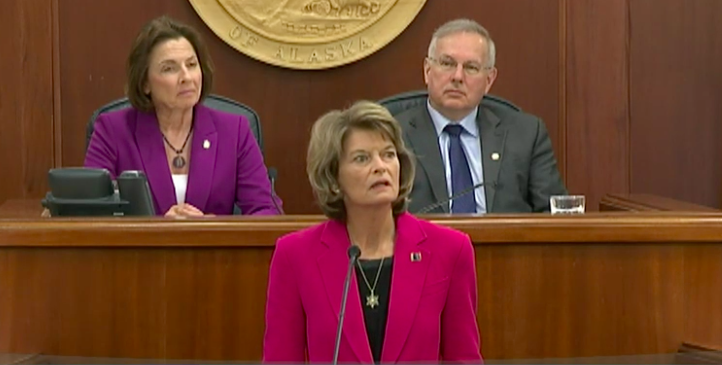
Sen. Lisa Murkowski and President Donald Trump have had an uneasy relationship, but now it’s officially on the rocks.
Trump wrote on Twitter today that he intends to campaign against Murkowski in two years when she is up for reelection.
The very public slam came after Murkowski said today that she had doubts about being able to support the president, and added that comments made by Gen. James Mattis had given her the courage to speak up.
“When I saw General Mattis’ comments yesterday I felt like perhaps we are getting to a point where we can be more honest with the concerns that we might hold internally. And have the courage of our own convictions to speak up,” Murkowski was quoted.
Murkowski has long held Trump at arm’s length, and politicos have remarked that she shows distaste for the president. But voted to acquit him during the impeachment trial this winter.
However, her remarks today came during a particularly divisive time in the nation, when rioters have torn cities apart over the perception of police brutality, sparked by the police murder of George Floyd. And leftists have blamed Trump for creating division in the nation, rather than knitting it together.
When asked if she would be supporting Trump, Murkowski waffled:
“I am struggling with it,” she said. “I have struggled with it for a long time.”
There’s no certainty that Murkowski will actually run in 2022, or that Trump will be president then and have the political muscle to use against her.
Murkowski became a senator in 2002, after her father, Sen. Frank Murkowski, won the office of governor of Alaska and then appointed her to fill out his term. She is among the more senior of senators and could become chairwoman of the Appropriations Committee next year, depending on the outcome of elections and the fortunes of other senators such as Sen. Susan Collins of Maine, who is facing a tough reelection battle this year and ranks at the bottom of popularity for senators facing reelection. Murkowski ranks eighth in seniority among Republican senators.
ALASKA’S SHAPE-SHIFTER CANDIDATES FOR HOUSE, SENATE
Alaska Democrats are still beta testing the use of “great pretender” candidates – ones who say they are independent of a party, but who have only Democrat backing and are using Democrat campaign resources — and who will appear on the Democratic primary ballot.
The Democrats have been working the “fake independent” strategy with some success at the legislative level. They’ve got State Rep. Daniel Ortiz, an indie-Democrat, representing them in Ketchikan, which is normally a deep-red community. Ortiz is a popular retired school teacher, and although has no party, has been a reliable vote for the Democratic caucus. A dozen other stealth Democrats are making a run for state office across Alaska this year under the guise of “independent.”
Now, they’re also making a bold run for U.S. Senate and U.S. House with these shape-shifter candidates who declare to some voters that they are nonpartisan, while feasting at the table of the Democratic fundraising machine, and toeing the Democratic platform line.
Al Gross is the shape-shifter for Alaska Democrats for one of two Senate seats in a state where a large majority of voters are fiercely independent, but also prone to thinking that an independent-labeled candidate must be just like them – not actually tied to a party.
Gross is trying to game the voters. But when he appears on the ballot in November, it will be clear that he is a Democrat, as the ballot will tell voters how he managed to advance to the General Election — on the Democratic Party ticket.
Gross is a millionaire doctor who is able to self-fund his campaign, but has convinced the Democratic Party to give him access to the Democrats’ tools, such as the Act Blue fundraising app, and lists of donors and voters. They’ve inked a deal, that much is clear.
It’s going to be tough for Al Gross to beat Sen. Dan Sullivan, however. Sullivan is known as a hard-working Republican and Marine reservist with a sharp legal mind and good political instincts. He commits few unforced errors.
Gross, on the other hand, comes out of the far left as a small-town doctor who made a fortune as an orthopedic surgeon in the government stronghold of Juneau. He’s a gentleman fisherman, which means he has a commercial fishing permit and a nearly pristine gill netter that he takes out now and then from his idyllic Norwegian-burg port of Petersburg. Gross supports the expansion of Obamacare under the “Medicare for all” banner, and he is not shy about his complete distain for Republicans. He’s promised to “flip the Senate blue.”
Gross hired David Keith as his campaign manager last year; Keith is a political operative with a trail of behavioral problems serious enough that the Alaska Young Democrats wrote a letter to party leadership expressing dismay about his “inappropriate conduct and abusive behavior” while he worked for the Congressional Progressive Caucus Political Action Committee.
The Alaska Young Democrats demanded to know “details on the hiring process of the campaign manager, with a justification for the hiring decision in the wake of such serious and public allegations.” They also wanted to see “a copy of the Progressive Caucus PAC Human Resources Investigation Report on said allegations.” To date, there has been no satisfactory answer given to the public.
As for the other Al — Alyse Galvin — she’s the shape-shifter independent who is also endorsed by Democrats, who uses the same Democrat talking points, and the same Democrat fundraising tools on her second attempt to unseat Dean of the House Don Young.
When she ran against Young in 2018 as a Democrat, Galvin famously scolded Young for shaking her hand too hard after a debate, a moment in Alaska political history that has became iconic — at least in Republican circles.
Now, she’s going the independent-Democrat route, hoping that something will happen to Don Young, who turns 87 this week. If lightning strikes, and voters forgive her liberal gaffs, the second time could be a charm.
Galvin’s campaign manager is Malcolm Phelan, another hired gun from out of state who for a short time was the campaign manager for a far-left Democrat running for Congress: Wendy Davis of Texas, who is a nationally famous abortion advocate trying to unseat Republican Rep. Chip Roy.
Both Senator Dan Sullivan and Congressman Don Young, on the other hand, hired lifelong Alaskans as their campaign managers — people who know and understand Alaskans. For Sullivan, it’s his former press secretary Matt Shuckerow, and for Young, it’s Truman Reed.
PALMER TOP COP’S ‘HATE GROUP’ COMMENT DIDN’T AGE WELL
Black Lives Matter, a leftwing organization that has risen to national prominence over the past half decade, is now calling for the defunding of the police. The demand is unequivocal:
“We call for a national defunding of police. We demand investment in our communities and the resources to ensure Black people not only survive, but thrive. If you’re with us, add your name to the petition right now and help us spread the word,” the group posted on its website on Thursday.
The #BlackLivesMatter group has been front and center in raising the conscience of the nation as it pertains to the treatment of African-Americans in the criminal justice system. The group characterizes police killing of blacks as “genocide.”
Tucker Carlson, conservative commentator on Fox, begs to differ. He says that in 2019, only 10 unarmed African-Americans were shot and killed by police in the United States, far fewer than unarmed whites.
According to the Washington Post’s data, 2019 was the safest year for black suspects in police custody since the Post began tracking the data.
On the other hand, the number of police officers killed last year was 48.
PALMER POLICE CHIEF IS UNDER THE GUN
The “defund the police” campaign comes at a time in Alaska when the police chief of Palmer, in the heart of the Mat-Su Valley, is in hot water over comments he made on Facebook two years ago, when he referred to Black Lives Matter as a hate group. Chief Dwayne Shelton wasn’t the police chief back then, but was a uniformed officer on the force who had risen through the ranks.
Chief Shelton was placed on leave this and the City of Palmer issued a statement on Facebook: “The City of Palmer (City) rejects the ideas contained in the past inappropriate social media postings by Palmer Police Chief Shelton who is currently on administrative leave with pay. Instead the City recognizes and respects the diversity of our society and promotes the principles of tolerance and equality embedded in the Constitutional underpinnings of our Nation.”
RIGHTEOUS CAUSE OR HATE GROUP?
The Southern Poverty Law Center, which classifies groups as hate groups, says that Black Lives Matter is not a hate group. The SPLC has, however, also said that Antifa is not a terrorist group.
According to Influence Watch, Black Lives Matter is a group that is funded by George Soros through a group known as the Democracy Alliance. The group has connections to radical left-wing organizations.
“It is estimated that groups associated with the BLM Movement have taken in $133 million since 2013. Organizations associated with liberal billionaire George Soros are said to have provided at least $33 million to various BLM movement groups since 2016,” Influence Watch says.
“In 2015, the fundraising club Democracy Alliance, led by liberal donors like George Soros and Taco Bell heir Rob McKay, recommended “its donors step up check writing to a handful of endorsed groups that have supported the Black Lives Matter movement.” BLM Movement groups which received support from the Democracy Alliance were the Black Youth Project 100, the Center for Popular Democracy, the Black Civic Engagement Fund, Color of Change and the Advancement Project.
Ford Foundation and the Borealis Philanthropy created the Black-led Movement Fund, a funding vehicle for the Movement for Black Lives, the coalition of groups responsible for the extremist “Vision 4 Black Lives.”The fund has received “pledges of more than 100 million dollars from liberal foundations and others eager to contribute,” Influence Watch says.
Sen. Lisa Murkowski of Alaska gave strong support for the words of General James Mattis in an interview with reporters, telling them she’s not sure she can support the president any longer. Her remarks have her trending on Twitter once again.
Mattis criticized the president for saying he would use the military to quell riots, if necessary. “Donald Trump is the first president in my lifetime who does not try to unite the American people — does not even pretend to try,” Mattis wrote in a scathing statement.
“Instead he tries to divide us. We are witnessing the consequences of three years of this deliberate effort. We are witnessing the consequences of three years without mature leadership. We can unite without him, drawing on the strengths inherent in our civil society,” Mattis continued.
“This will not be easy, as the past few days have shown, but we owe it to our fellow citizens; to past generations that bled to defend our promise; and to our children,” Mattis wrote.
“I was really thankful,” Murkowski told a Politico reporter. “I thought General Mattis’ words were true and honest and necessary and overdue.” She told the reporter she is “struggling” over whether she can support Trump.
Murkowski is Alaska’s senior senator, and attracts a strong following from Democrats, liberals, and moderate pro-choice Republicans. Conservative Republicans in Alaska have had trouble reconciling her stances on various issues with their own values time and again, but she pulls broad support from the middle of the political spectrum.
“When I saw General Mattis’ comments yesterday I felt like perhaps we are getting to a point where we can be more honest with the concerns that we might hold internally. And have the courage of our own convictions to speak up,” Murkowski was quoted.
BUT NO BEAR PAW FESTIVAL ALLOWED FOR EAGLE RIVERIN JULY
9 amUpdate: A union representative says this event has been canceled.
While Eagle River has been denied permits to have the Bear Paw Festival in July, due to concerns over COVID-19, the Municipality of Anchorage has allowed the Alaska Public Employees Union to have a solidarity picnic on the Delaney Park Strip a month earlier on June 14.
Critics say it is yet another example of how Mayor Ethan Berkowitz has used his emergency power unevenly across Alaska’s largest city, as the community tries to come back to normal after being shut down during the pandemic scare.
Last week, the municipality also allowed protests to occur where people were not socially distanced.
For the Alaska Employees Association Picnic, the union promises games for the kids, live music, and free food.
Protests may go on across the state, but the Municipality of Anchorage won’t be giving permits to the Eagle River Bear Paw Festival — not for a July festival, anyway.
“We are announcing that we are pressing pause on the festival,” the organizers wrote tonight. Concerns over COVID-19 and the festival’s heath management plan being a match for the virus led to the decision to not proceed with the July 8-12 event, which draws thousands of people to Eagle River each summer.
The festival organizers are hoping to move the date to August, but has to coordinate with festival partners Golden Wheel Amusements and Anchorage Markets, as well and the municipality’s own reopening schedule.
Those flying into the state of Alaska will need to get a COVID-19 test and have those results in hand before boarding their Alaska-bound jet.
If they don’t have their test results with them from tests taken in the previous 72 hours, there will be testers at the major airports to administer the swab tests. These tests will be administered in Anchorage, Juneau, Sitka, Fairbanks, Ketchikan and to some extent Petersburg and Wrangell.
Those who don’t want to take the airport COVID-19 test will be asked to self-isolate for two weeks after they arrive.
Gov. Mike Dunleavy said that officials are trying to minimize the impact on people’s lives, and to try to avoid destroying the economy, but that flying is a part of the Alaskan way of life. The new testing rules begin Friday and replace the mandatory 14-day quarantine that has been in effect.
Travelers buying tickets online will be advised by airlines about Alaska’s testing requirements, and will also be advised during check in. They’ll be directed to an official State of Alaska travel website for more details.
The state will also have a social media campaign to get the word out about the testing program, which will be conducted by contractors.
Travelers must be:
Tested within 72 hours to five days prior to departure:
May enter Alaska upon showing negative PCR test result for COVID-19
May not enter Alaska if they tested positive
Tested on arrival:
– Upon arrival in Alaska may be tested for COVID-19 and register with the testing site
– Must maintain quarantine at their own expense until test results are known
– If positive for COVID-19, must isolate for duration of illness at their own expense
Critical infrastructure workforce:
Must abide by their company’s community protective plan on file with the state
None of the above (no prior test result, decline testing, and not a critical infrastructure worker)
Must undergo 14-day quarantine at their own expense
Travelers will be asked to minimize in-person interactions for an additional 7-14 days after arrival and will be offered a follow-up test. Travelers must complete and sign the Alaska Travel Declaration form and present a negative COVID-19 test upon arrival.
Travelers are strongly encouraged to wear masks, practice social distancing and good hygiene, be respectful of the health of Alaskans, and to stay home if they are sick or at risk for COVID-19.
The Anchorage Assembly voted 9-2 on Tuesday night to allow Mayor Ethan Berkowitz to retain his emergency powers through July 31.
The powers allow him to move the municipal workforce around as needed, without having to get permission from the unions. It also allows him to keep homeless people housed in the Sullivan and Boeke Arenas, which are being used as temporary shelters during the COVID-19 coronavirus pandemic.
Afraid of looting and vandalism, Nordstrom has boarded up The Rack in Anchorage and sent workers home.
The move at the Midtown Mall came after riots in Seattle and elsewhere caused extensive damage to Nordstrom stores. The protest that took place on Saturday in the parking lot near the Anchorage Nordstrom Rack was peaceful, in contrast to extensive damage to the Nordstrom store in Seattle.
“We continue to be heartbroken by the senseless deaths of George Floyd, Breonna Taylor, Ahmaud Arbery and too many others, and the deep pain and division we’re seeing across the country,” Nordstrom wrote.
“Our priority is always the health and well-being of our employees, customers and communities. To help keep everyone safe, we made the decision to temporarily close our stores yesterday. Some of our stores were impacted by gatherings in our cities this weekend, and we wanted to take the time to assess the damage, repair and reopen those stores so we can continue serving customers as soon as possible. The situation is evolving quickly, and we encourage you to check our website for the most up-to-date information on your store’s hours.”
“Thankfully, none of our employees were injured in these events, and we’re communicating regularly with all of them on the actions we’re taking and the ways we will continue to support them. We’ll also pay employees for any shifts they may have missed as a result of these unexpected closures. We’ve heard from so many employees asking for ways they can help, and we’re working to connect them to the nonprofits in their communities that are providing valuable resources, information and support in these difficult times.”
“The events of this weekend are one more painful reminder that injustice remains in our world. We can fix the damage to our stores. Windows and merchandise can be replaced. We continue to believe as strongly as ever that tremendous change is needed to address the issues facing Black people in our country today. We strive to be a positive force for change in every community we serve.”
The main Nordstrom store in Anchorage closed in the fall of 2019 as the economy grew dimmer in Alaska and the store suffered headwinds driven by shopper preferences moving to online stores.