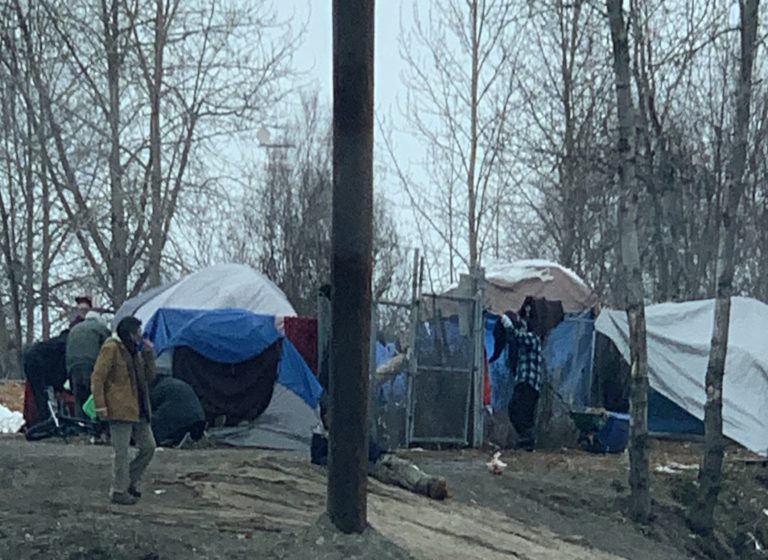
A car dealership on Tudor Blvd. near the site of one of the mayor’s chosen locations for vagrant services had five of its vehicles vandalized last night. The manager of the dealership had last week given impassioned testimony about the overwhelming amount of crime and vagrancy near the dealership.
And then the vandalism came, with hundreds of thousands of dollars of merchandise destroyed. A coincidence? Possibly.
Save Anchorage, a new community grassroots group, is a lead group on a protest against lawlessness and the lack of support for police officers in Anchorage. Actually, they’re protesting the general disintegration of the social fabric in Anchorage of late.
Citizens will gather at New Seward Highway at Benson Blvd., near where the new Carrs grocery store is located, from 4-6 pm.
Sources within the group said they’re standing up against the mayor of Anchorage and the municipality’s lack of support for law enforcement, the mayor’s attempt to force vagrants and drug abusers into centers to be located in family neighborhoods, and the new ordinance by Assembly member Meg Zalatel to tie the hands of police officers when it comes to their duties to keep people safe.
So will Zalatel’s “use of force” ordinance, referenced above.
The Assembly will also consider Chair Felix Rivera’s proposed ban on counseling for those who have gender confusion issues. Rivera’s ordinance prohibits any sort of “sexuality conversion therapy” for those who want to attempt to overcome homosexuality or other sexual variations.
The Assembly will consider an ordinance prohibiting evictions of people who do not pay their rents, offered by Rivera.
The Assembly will hear Mayor Ethan Berkowitz’ proposal to establish an Office of Equity and Justice in his office.
I first arrived in America from the former Soviet Union on Feb. 1, 1978. An agent of the Immigration and Naturalization Service greeted me at John F. Kennedy Airport in New York. He gave me $8 for travel expenses, a small booklet titled Introduction to a New Life, a packet titled United States Refugee Program, and wished me “Good Luck!”
On that same day, I traveled to Philadelphia, where my new life began as an immigrant in America. The concept of “white privilege” certainly was unknown in 1978, so I apparently underestimated how my skin color was going to make my transition to a new country so easy.
I arrived in the United States at the age of 25 with two suitcases and a guitar. Several days later, I was shoveling snow by hand in Philadelphia for $25 per day and later did many odd jobs in order to pay for my living expenses.
Initially, my assimilation and integration into American society was rather complex and bumpy. Nevertheless, within a few years I managed to get my second MA degree in Anthropology from Brown University and was enrolled in a Ph.D. program in Anthropology at Bryn Mawr College.
Forty-two years after my arrival in the New World, I feel proud of my accomplishments as a father, an educator, scholar, author, social activist, and contributor to my community. My daughter was born in Juneau, Alaska, and I always was a good provider for her, including a college fund for her education.
Today, I enjoy my modest and comfortable retirement lifestyle in Juneau. My accomplishments in the United States are the results of my personal discipline, applied intelligence, hard work, and opportunities that this country made available to me.
My experience in the United States was in many ways similar to that of nearly 80 million legal immigrants who arrived in our country from different corners of the world from the 1950s to the present. Eventually, most immigrants succeeded in the New World.
I love our constitutional republic and will always defend and protect U.S. federalism and our constitutional freedoms.
I am very disturbed, however, that in today’s social environment in our country I am now considered a “white privileged” individual by “progressive activists” who know only the color of my skin. What exactly is my “white privilege?”
I and millions of other immigrants faced challenges not encountered by people born and raised here—learning English as a second language while competing for education and career, learning and adapting to a whole new culture, living half way around the world from my family and support network, being easily recognized as a “foreigner” and in many cases suffering discrimination because of it, just to name a few.
Few immigrants complain about such challenges, but they certainly do not experience them as privileges.
I came to our country as a poor man, worked hard, educated myself in the excellent U.S. universities, paid my student loan in full, did not abuse any social programs, have been a loyal citizen to our country, contributed to our society in many different ways; and now I and many other Caucasian immigrants are supposed to be ashamed because we are white? I am offended by this racial slur—or stereotype.
I feel very privileged to be a United States citizen, but it has nothing to do with being “white.” In fact, the “white privilege” accusation, which is based entirely on a person’s skin color, is clearly a racist accusation that has no legitimate place in a country founded on the idea of “equality for all” regardless of race and ethnicity.
Alexander Dolitsky is an author, anthropologist and historian who lives in Juneau. Born and raised in Kiev in the former Soviet Union, he received an M.A. in history from Kiev Pedagogical Institute, Ukraine, in 1977; an M.A. in anthropology and archaeology from Brown University in 1983; and attended the Ph.D. program in Anthropology at Bryn Mawr College from 1983 to 1985, where he was also a lecturer in the Russian Center. In the U.S.S.R., he was a social studies teacher for three years, and an archaeologist for five years for the Ukranian Academy of Sciences. In 1978, he settled in the United States. Dolitsky visited Alaska for the first time in 1981, while conducting field research for graduate school at Brown. He lived first in Sitka in 1985 and then settled in Juneau in 1986. From 1985 to 1987, he was a U.S. Forest Service archaeologist and social scientist. He was an Adjunct Assistant Professor of Russian Studies at the University of Alaska Southeast from 1985 to 1999; Social Studies Instructor at the Alyeska Central School, Alaska Department of Education from 1988 to 2006; and has been the Director of the Alaska-Siberia Research Center (see www.aksrc.homestead.com) from 1990 to present.
Anchorage Assembly member Meg Zalatel offered has offered an ordinance to limit the ability of police to use force.
Under the Zalatel no-deadly-force plan, law enforcement officers would be prohibited from using the following tactics in response to noncompliance or resistance:
Warning shots.
Shooting at or from moving vehicles.
Shooting when innocent bystanders are near the line of fire so as to create a substantial risk of harm.
Drawing and pointing weapons, unless deadly force is authorized by police department policy.
Use of firearms to destroy animals.
Unless deadly force is authorized, necessary, and objectively reasonable under the circumstances, and only used as long as needed to protect others and separate the arrestee from others:
Any chokeholds, with or without a device, that restricts a person’s airway or flow of air.
Any vascular neck restraint that restricts the flow of blood by compressing the carotid arteries on each side of the neck.
Striking a person’s head or neck with an impact weapon or object.
7. Sitting, kneeling, or standing on the chest or back of a person in a manner that compresses the diaphragm for longer than reasonably necessary to restrain the person.
“Under no circumstances shall deadly force be authorized against a person in handcuffs or restrained to similar extent by any device. Non-deadly force may be used to prevent imminent bodily harm to officers or others, prevent escape, or physically remove an arrestee/detainee,” Zalatel’s ordinance reads.
The ordinance was introduced, but the Assembly has since been preoccupied by Mayor Ethan Berkowitz’ plan to house and treat vagrants in hotels and other buildings around Anchorage.
Now, a letter from the Anchorage Police Department Employee Association has expressed concern about the Zalatel plan.
The group says that shooting from a moving vehicle is already prohibited, but the APD policy provides for extenuating circumstances.
“For example, the policy would allow officers to fire at a person driving a vehicle who at the same time was shooting at citizens or officers. APD’s policy allows for officers to bring their training, experience, and critical analysis to bear in such a situation, with the understanding that an extreme amount of scrutiny will be used in determining if the officer placed themselves in a position where the vehicle could be used against them.”
The APD policy also has language prohibiting shooting when it could create a substantial risk of harm to a bystander.
“While our current policy has language similar to this, the policy again allows for extenuating circumstances where the ordinance does not,” APDEA wrote.
Under the current policy, the officer is allowed the discretion to decide, based on the totality of the circumstances, whether discharging his/her firearm would constitute a greater risk to innocent human life than the subjects’ actions would.
“There are any number of ways such a situation could arise. For example, when officers are dealing with an active shooter, or with a suspect who is taking action that threatens the lives of hostages, officers may have to make the difficult decision to use deadly force against the suspect even with bystanders or hostages near the line of fire to save the lives of many.”
The police group also pointed out that if Zalatel’s ordinance is understood literally, it prohibits shooting when innocent bystanders are near the line of fire, even if the officer has no knowledge that a bystander is present.
The drawing and pointing of weapons section of Zalatel’s ordinance is also problematic. The ordinance would change the police department policy, which now says that officers may not point their firearms at or in the direction of a person absent an objectively reasonable determination that the situation may escalate to the point where deadly force would be authorized. The ordinance prohibits drawing and pointing weapons unless there is justification for use of deadly force.
“APD officers are trained to deploy with their weapons in any number of situations where deadly force would not be justified. For example, drawing and pointing weapons is allowed on felony traffic stops, building searches, K9 tracks, etc. When guns are drawn in these circumstances, the result is the potentially hazardous situations never reach the point of becoming appropriate for the use of deadly force.”
The group wrote that science backs up this training, because there is a lag time for the brain to recognize a threat, make a decision based on what an officer is perceiving and then take action. When an officer sees a threat of death or serious injury to themselves or another person, a suspect can fire three to four times before the officer can fire once.
The officers also wonder why use of firearms on animals would be prohibited. The ordinance differs from current policy, which allows use of deadly force against an animal that represents a threat to the public or to the officer. It authorizes police to dispatch an animal that is gravely injured, such as a moose that has been struck by a vehicle, for humanitarian reasons.
As for using deadly force, such as chokeholds, or striking a persons head or neck with an impact weapon or object, the proposed ordinance would be different from current policy Officers are now only allowed to use impact when a subject is actively resisting, such as kicking, biting, punching, pushing, barricading, or pulling away.
“Sometimes officers aim for the leg and hit the hip, aim for an arm and hit a shoulder, all inadvertently. In the ordinance, an officer could be punchiest for using an impact weapon in a situation of active resistance if the weapon strikes the person’s head or neck, even if it was not the officers intent to strike the person in either are.
Finally, the officers say that the ordinance section saying that “under no circumstances shall deadly force be authorized against a person in handcuffs or restrained to a similar extent by any device, is already in current policy. There are extenuating circumstances if it’s objectively reasonable to prevent bodily harm to the officer or another person or persons.
The officers have asked for greater communication with the Assembly to help them understand current policy and to share with them feedback they have received from their association members.
The Anchorage Assembly finished hearing the fifth night of testimony, which went overwhelmingly against the mayor’s plan to rezone a large swath of Anchorage so that vagrant services and shelters could be sprinkled throughout the neighborhoods, from Geneva Woods to Heather Meadows to Spenard.
In the end, the Assembly voted unanimously to table AO 2020-58, the ambitious rezoning plan that would be the foundation for the rest of the mayor’s vagrant services program and would allow homeless shelters and drug addiction services near schools, homes, and playgrounds. It will take six votes to pull the ordinance off the table.
The members of the Assembly were clearly exhausted. Assemblyman John Weddleton apologized to the public for what he said was a “not well-thought-out” ordinance, adding that bypassing the Planning and Zoning Commission was “really wrong.”
Assemblyman Kameron Perez Verdia also apologized to the public for combining multiple items of legislation, and said he felt badly that people thought the Assembly was trying to “sneak” important legislation through or that the Assembly was trying to operate “behind the scenes.”
Wednesday’s testimony echoed the previous four nights, with the majority of people opposed to the plan. Some, like Ron Alleva, had waited for 20 hours to testify.
Larry Baker, a former Assembly member, sat through all five nights and was one of the final speakers of the marathon, explaining to the Assembly that he had never seen such community engagement in all his years of civic activity. He agreed to help residents who approached him for help in the face of what looked like a freight train coming at their neighborhoods.
Still on the docket for Monday’s meeting is the other part of the mayor’s plan — to use CARES Act money for the purchase of four buildings for services for vagrants and addicts. The Golden Lion Hotel near 36th and New Seward Highway; America’s Best Hotel in Spenard; the Alaska Club on Tudor Blvd; and Bean’s Cafe downtown would be purchased with $22 million of money from the federal government meant to help communities cope with the economic effects of COVID-19.
How that would work without the underlying zoning change is uncertain.
Mayor Ethan Berkowitz urged the Assembly to support his plan.
“We do not have the luxury of later. We have to expend these funds by the end of the year. If we cannot provide shelter, people will die,” he said.
For the past four months, America has taken part in a grand experiment. Unemployed Americans have received an additional $600 a week in unemployment insurance.
It’s our nation’s sudden and accidental leap into universal basic income, an idea that has been pushed by many thought leaders from the Left, including former presidential candidate Andrew Yang, who ran on the platform of giving a $1,000 monthly check for every man and woman over the age of 18, all paid for by companies that would owe a new tax to the federal government.
Mark Zuckerberg, founder and CEO of Facebook and one of the most influential persons in the Western world, supports UBI, as it is known.
Proponents say that a universal basic income would take the stigma out of getting a government check, and Zuckerberg said that such a program would “make sure that everyone has a cushion to try new ideas.”
We’ve now outdone Yang’s aspirational basic income by more than double, and we see the results. The “new ideas” aren’t pretty.
First, employers are struggling to entice people back to the workforce. With the $600 many receive as relief checks in addition to the basic unemployment insurance checks they are entitled to, many now admit they’re making more money staying home.
One business owner in Anchorage says that one of her drivers asked her to lay him off because he could make plenty of money if she did, and have a nice summer to fish the rivers. She refused, because as a waste disposal company, she provides a regulated service and is not allowed to stop picking up the garbage just because her workers don’t want to drive their routes.
But a large number of laid off workers are indeed bringing in nearly $1,000 a week in combined cash benefits, and they qualify for free health care under Obamacare, while federal and local moratoriums on evictions are still in place, and mortgage companies are under orders to allow forbearance.
It’s easy to live a modest life in most places in America with such government largesse. One could, of course, use the time to take online classes, learn new skills, and prepare for a recovered economy by positioning oneself for a fresh start in one’s career.
Unfortunately, there’s no indication that some Americans have used their down time in any productive or proactive way, although there may be a few more better-tended vegetable gardens in the suburbs.
Some in the Northwest liberal strongholds are reaching new skill levels in Fortnite Battle Royale during the day, and then donning homemade battle gear to engage in street revolution cosplay at night — all paid for by the U.S. Treasury, which just keeps printing the money and sending it in the mail.
And that brings us to the second unintended consequence: The wave of social unrest that has swept our cities. The violent-but-localized Black Lives Matter protests quickly spawned widespread BLM-Antifa riots, the defacing of public and private property, looting, and the destruction of cultural and education monuments.
In Portland and Seattle, a revolution is underway against what are the most tolerant governments in the world. Even the mayors of Portland and Seattle are now under attack by the Left for not being “enough.”
Mayor Jenny Durkan of Seattle, who chided the president for not appreciating democracy, found her own multi-million-dollar home in a gated community surrounded by protesters from the Democratic Socialists of America. She called for police protection of her property.
Mayor Ted Wheeler of Portland joined a violent protest against the federal government and found himself tear gassed, but then heckled by his fellow protesters, who said he was not doing enough to resist federal intervention in Portland. Federal officers had been sent there to protect the federal courthouse, which has been under siege for 56 days, as rioters attempt to raze it on a near-nightly basis.
Over the past two days, two black Americans who support President Donald Trump have been attacked — one murdered and one stabbed. Americans who support the president are afraid to put “Trump” signs on their lawns, for fear their homes will be torched. Political radicals have struck such fear into homeowners that they are now afraid to post an American flag in front of their homes — the radicals see that as a symbol of hate.
Third, crime in our cities has spiked as mayors stopped supporting law enforcement and started supporting the “defund the police” platform of Black Lives Matter. Violent crime, robberies, rape — the numbers are skyrocketing in urban centers. In New York, the homicide rate for the first half of the year is up 23 percent over 2019, while Chicago murders are up 39 percent over last year, and Los Angeles is experiencing a 250 percent jump in homicides this summer.
The societal devolution is paid for by this new universal basic income, that no-strings-attached payment to those who now have no incentive to work and who are getting into more than mischief and mayhem. Their basic needs met, they are now tearing the fabric of the productive society that supports them.
Alaska has had a form of universal basic income for decades with the Alaska Permanent Fund dividend, the royalty share from the oil wealth of the North Slope. This year, it equated to a mere $82 a month, and yet it is lauded by proponents of universal basic income as the model for the nation.
It is not a model to replicate. The Alaska Permanent Fund dividend has caused more unhappiness and strife in Alaska in recent years because state legislators have siphoned off some of the dividend that statutorily belonged to the people and used it to pay for government services that are used only by half of the people.
The lesson of the Alaska Permanent Fund is that what government gives, government can also take away.
UBI doesn’t yield happier, more creative, or more productive people. We’ve seen what it does — it pays for the socialist, possibly communist revolution. Our government prints more money daily and distributes it to Biden voters who are burning and looting their way to the November election.
We are paying for the revolution. The bill just won’t come due until after Nov. 3.
Alaskans for Dan Sullivan has announced four Alaskans are the Statewide Campaign Co-Chairs for U.S. Senator Dan Sullivan’s 2020 re-election campaign: Former Gov. Sean Parnell of Palmer, Gail Schubert of Nome, Jim Dodson of Fairbanks, and Julianne Curry of Petersburg.
“It’s an honor to have the support of these accomplished Alaskan leaders; each of whom bring significant knowledge, experience and wisdom to our campaign team,” Sullivan said.
“This is a co-chair team with a demonstrated track record for advancing Alaska’s best interests, and their leadership and thorough understanding of our state will be invaluable as we work together with Alaskans to build a stronger, more resilient state,” he said.
The co-chairs represent a diverse group of Alaskan leaders, with political, geographic, cultural and professional backgrounds.
Sullivan 2020 Campaign Co-Chairs will serve in key advisory and surrogate roles as the Sullivan campaign continues to expand and strengthen its grassroot networks across the state.
Sullivan is running for the second time after being a first-time candidate for any elected seat in 2014, and winning against incumbent Sen. Mark Begich, a Democrat.
Schubert is CEO of Bering Straits Native Corporation, Dodson is CEO of Fairbanks Economic Development Corporation, and Julianne Curry is a fourth-generation Alaska fisherman and commercial fisheries advocate.
Mayor Ethan Berkowitz tightened the reins in Anchorage with new rules for bars, restaurants, gyms, bingo halls, and more. Berkowitz is putting Anchorage’s economy back on ice by limiting the number of people that can be together in any commercial setting.
Starting Friday at 8 am, new restrictions will be imposed on Anchorage establishments, limiting the size of gatherings at indoor businesses.
Emergency Order EO-14 returns Anchorage to a modified version of Phase Two in the Safe Anchorage: Roadmap to Reopening the Municipality of Anchorage plan. It’s the mayor’s 14th emergency order, coming as the number of COVID-19 cases in the state surge and as hospitals in Anchorage begin to see beds filling up.
Meanwhile, State workers who are in communal areas where they cannot socially distance will be wearing masks, Gov. Dunleavy announced today.
“We want to continue to contribute to cutting down on possible spread,” he said. “And we want to do everything we can to keep our workers safe and those who come in to do business safe.”
He said that state workers are still working remotely, in many instances, and that would not apply to them, or to those who are working in enclosed offices.
But Gov. Dunleavy said that a statewide mandate on masks is not appropriate for Alaska. He used the example of the community of Hyder, which has not had a case of COVID-19.
It doesn’t make sense for Hyder to be under a statewide mask mandate. He said that most communities in Alaska are in that category of remoteness, while in the Railbelt communities, the local governments can target their mask mandates as appropriate. He asked Alaskans to not politicize the mask mandate issue, as some have done.
An additional death with COVID-19 occurred since yesterday, bringing the total to 19 since the outbreak reached Alaska in early March.
Another 92 cases were diagnosed in the past 24 hour reporting period, with 109 total having been hospitalized with COVID-19 since March, and 34 currently hospitalized, with one on a ventilator. There are 1,360 active cases in Alaska.
The speakers kept coming late into the night on Tuesday and the Anchorage Assembly will take more testimony tonight about the mayor’s plan to house vagrants and treat the drug-addicted in hotels and other facilities across the neighborhoods of Anchorage. They were passionate, prepared, and undaunted by the sometimes hostile questions of Assembly members Chris Constant and Forrest Dunbar.
If public testimony on A0 2020-58 ends tonight, the Assembly will vote on the plan to rezone a massive area of Anchorage to allow vagrant services in family neighborhoods, without having to go through the Planning and Zoning Commission. The meeting is at the Loussac Library at 5 pm.
That’s just the first part of the ambitious plan that few have actually seen. Two more ordinances involve purchasing buildings and starting a major social service undertaking, all paid for with federal COVID-19 funds.
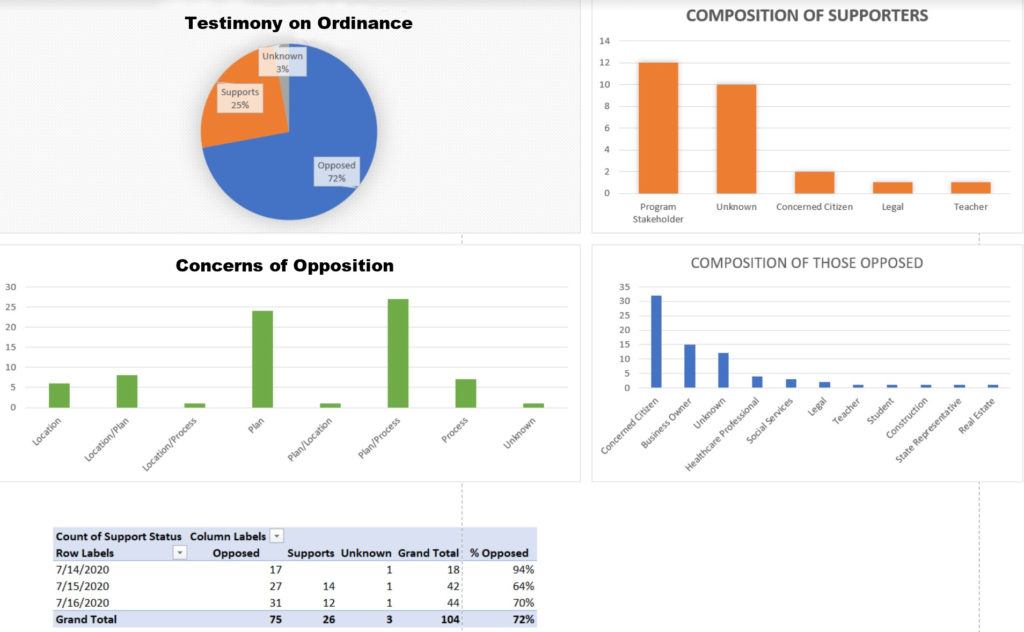
The vast majority of speakers have opposed the plan, in spite of a concerted effort by the city to get social service sector workers to testify in favor of it.
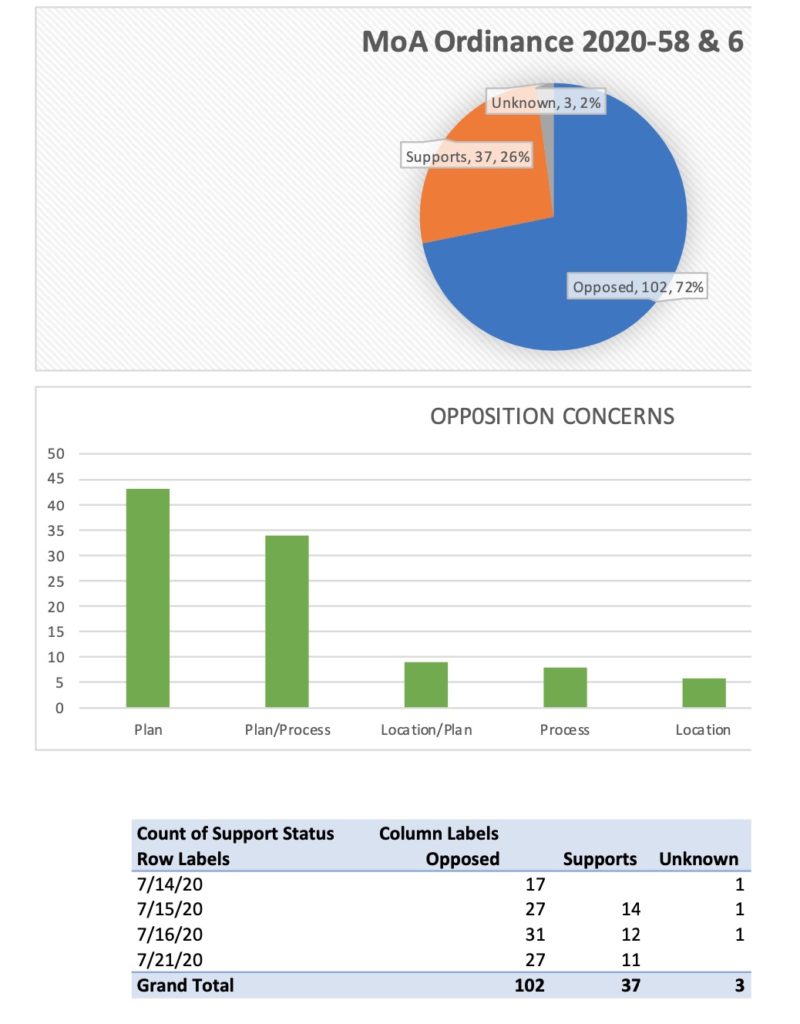
Prior to Tuesday evening, the breakdown on the testimony was 75 percent opposed:
Mayor Ethan Berkowitz is not taking this opposition lying down. It’s his last eight months in office and he wants to deliver something on his promise to solve homelessness.
On Tuesday night, there were more social workers and nonprofit representatives testifying in favor of his vagrant plan, although they were still heavily outnumbered.
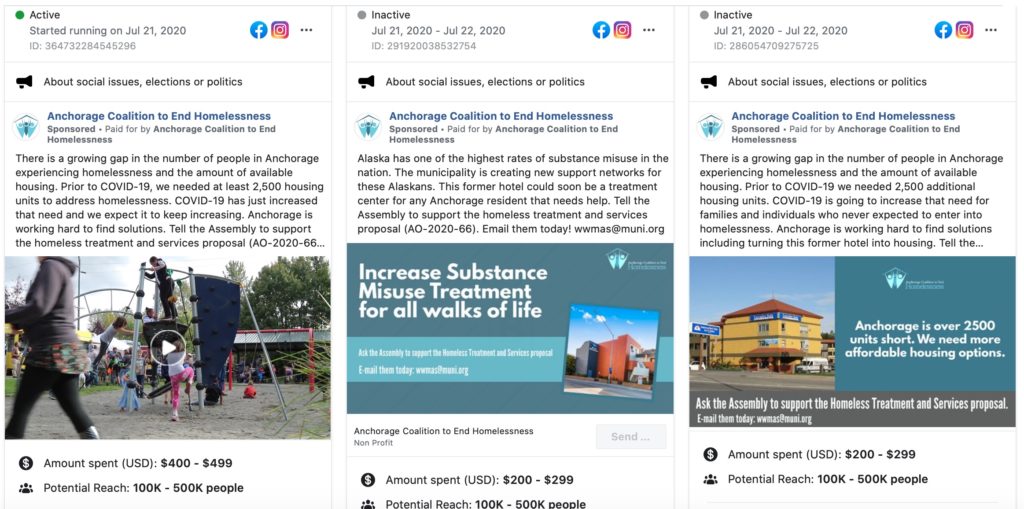
The Mayor’s Office and the homeless coalition have been spending dollars to try to bend the curve of public opinion, pushing Facebook messages to people they think will come and testify on the mayor’s behalf.
Ad buys on social media are now in the thousands of dollars: A sampling of the ads that are currently running on the Facebook feeds of hundreds of thousands of Anchorage “likely” respondents shows that the spend on these three ads alone is likely over $1,000. Other ads similar to these are now retired, but have run in recent days.
The optics are awful. Some Anchorage residents, and members of the Facebook Group called Save Anchorage, are hopping mad that the municipality would lobby social workers to testify in favor of the mayor’s plan to spend $22 million in CARES Act money on four buildings to use for homelessness services close to homes, schools, and daycare centers.
A few social workers did speak in favor of the plan on Tuesday evening but 90 percent of those favoring the plan appear to be employed by the “Homeless Industrial Complex.”
One man who spoke did not identify himself as an employee of the Rasmuson Foundation until he was questioned by Assembly member Jamie Allard about his employment status, when he admitted he works for the foundation. It was an awkward moment for the gentleman.
Another social service worker who spoke was actually in opposition to the plan.
Sherrie Laurie, executive director of the Downtown Hope Center, told the Assembly that around her facility, human and drug traffickers gather, and that those conditions can be expected to arise in family neighborhoods if shelters are placed there.
Laurie also responded to a question from Assembly member Allard, saying that she had not been notified about the plan to buy two hotels, an old Alaska Club on Tudor Blvd., and Bean’s Cafe, even though she runs a shelter that houses 70 women and her clientele would be affected.
When asked why she was not notified, she demurred and said she did not wish to speak about it publicly.
But Downtown Hope Center was at the center of a controversy when it would not allow men dressed as women, who call themselves women, to enter the facility and lay on the floor mats next to the shelter’s women clients, many of whom are traumatized by men.
The city’s Equal Rights Commission heard a complaint against the Downtown Hope Center to force them to take transgenders. The center, represented by now-Attorney General Kevin Clarkson, won that case. The mayor and Assembly member Chris Constant in particular are not friendly toward the faith-based center for women.
The Juneau Assembly mandated face masks be worn in all public places. The mandate, effective immediately, will expire in 90 days if not renewed as an emergency ordinance by the Assembly.
Examples of places where people are now required to wear a mask in Juneau include:
Grocery stores, pharmacies, and all other retail stores.
Restaurants, cafes, bars, and breweries – including food preparation, carry-out, and delivery food operations. There is a limited exception for customers while they are eating or drinking in one of these settings.
Buses, taxis, and other forms of public transportation when passengers are present.
Personal care facilities.
Child care facilities.
Communal areas of offices where people from multiple households are present.
Elevators and indoor communal spaces in other buildings.
The penalty for violating the ordinance is a civil fine of no more than $25. Any individual who’s issued a ticket and believe the ticket is issued in error can submit an appeal, similar to appealing a parking ticket.
Exceptions include:
Any child under the age of 2 years. These very young children should not wear a face covering because of the risk of suffocation;
Any child under the age of 12 years unless a parent or caregiver supervises the use of face coverings by the child to avoid misuse;
Any child in a child care or day camp setting, although such settings may provide their own requirement for use for children age 2 years old or older;
Any individual for whom wearing a mask or cloth face covering would be contrary to his or her health or safety because of a medical condition or mental health condition, and any individual unable to tolerate a mask due to a physical or mental disability;
Individuals who are speech impaired, deaf, or hard of hearing, or individuals communicating with someone who is deaf or hard of hearing, where facial or mouth movements are an integral part of communication;
Any individual who has trouble breathing or otherwise unable to remove the face covering without assistance;
Before the ordinance, Juneau required masks in several public facilities, like the public libraries, pool, and on Capital Transit. Businesses also required masks, although not every business did so.
The Juneau School District last week also requires masks or similar facial coverings for all persons on Juneau School District grounds, at District facilities, or at District sponsored events.
This school property mandate covers people of all ages, from infants on through elderly, without exceptions, except ones granted by the Superintendent.