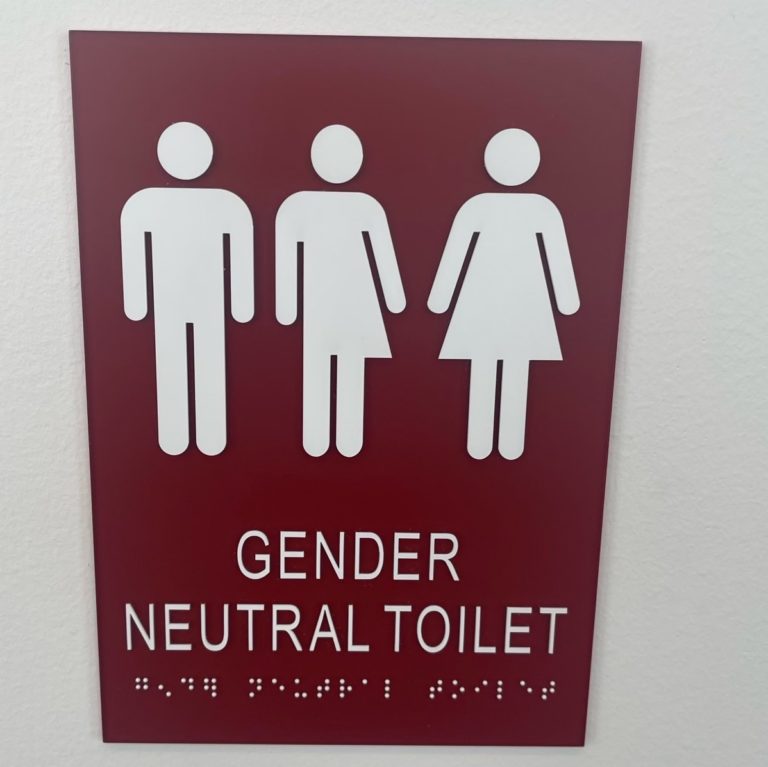
A state superior court judge has upheld a Matanuska-Susitna Borough School District policy that restricts “transgender” students from using bathrooms and locker rooms aligned with their confused ideas about their sexual characteristics.
The ruling was issued Thursday by Alaska Superior Court Judge Tom V. Jamgochian, marks a defeat for the ACLU of Alaska, which brought the case early last year on behalf of an elementary school student and his parents. The lawsuit had argued that the district’s bathroom rule violated the student’s constitutional rights to privacy and education.
At issue was MSBSD Policy No. 5134 BP, adopted in October 2022. The rule requires students to use restrooms corresponding to the sex listed on their birth certificate or to use a single-occupancy restroom as an alternative.
The judge determined that the policy does not infringe on rights guaranteed by the Alaska Constitution, citing the availability of a private restroom option as a reasonable accommodation. That finding rejected the ACLU claims that the rule discriminates against the plaintiff.
The policy serves an important governmental interest in safeguarding student privacy in intimate settings, and the means selected, sex-based access to restrooms and locker rooms, with gender-neutral alternatives, bear a substantial relationship to that interest. Although the policy results in differential treatment of transgender students, the record does not support a finding that it is motivated by animus or that it imposes an unconstitutional burden. The policy does not compel disclosure of gender identity, restrict gender expression, or deny access to restroom facilities,” Jamgochian wrote.
“No court order can fully satisfy all interests of all litigants, and any outcome may impose hardship on some individuals. Questions regarding policy are appropriately left to elected officials and the public. The court’s duty is more limited: to interpret and apply Alaska’s Constitution. For the reasons that follow, the court finds that the challenged policy does not violate the Constitution of the State of Alaska,” the judge ruled.
The ruling leaves the policy in place and means the student must continue using either the girls’ restroom or a designated single-occupancy restroom.
The case, filed in Palmer Superior Court, could next be appealed to the Alaska Supreme Court. The ACLU of Alaska has not yet indicated whether it will pursue further legal action.
Also this month, the US District Court for the District of Idaho, Sexuality and Gender Alliance v. Critchfield, allowed Idaho to enforce its grade-school bathroom privacy law. That ruling followed an order from the 9th Circuit Court of Appeals that denied a broader challenge to Idaho’s laws protecting privacy and safety of children.
“Separating restrooms by biological sex has been common for centuries…And for good reason—there are biological differences between men and women…Those biological differences are deserving of privacy and S.B. 1100’s segregation of restrooms based on sex is related to that interest,” the court ruled.
Costco will not dispense the abortion medication mifepristone at its more than 500 pharmacies nationwide, a decision celebrated by conservative and faith-based groups that had lobbied the retailer for over a year.
Mifepristone, approved by the FDA in 2000 for terminating pregnancies up to 10 weeks, is used with misoprostol and now accounts for nearly two-thirds of all US abortions. Mifepristone-misoprostol account for nearly 586,000 abortions annually, according to data from the pro-abortion Guttmacher Institute, which says there are about 930,000 abortions committed annually.
Federal regulators eased restrictions in 2021 by dropping the in-person dispensing requirement and, in 2023, allowed certified retail pharmacies to provide the medication.
The announcement follows a campaign launched in August 2024 by Alliance Defending Freedom and Inspire Investing, a Christian investor group, urging major retailers not to sell mifepristone. The coalition’s letter, signed by some 6,000 members, was sent to Costco, Walmart, Kroger, Albertsons, and McKesson, warning that customers might take their business elsewhere if the companies offered the drug.
ADF Legal Counsel Michael Ross praised Costco’s decision not to pursue certification to sell what he called the “life-ending mifepristone drug.”
“We applaud Costco for doing the right thing by its shareholders and resisting activist calls to sell abortion drugs,” Ross said. “Retail pharmacies exist to serve the health and wellness of their customers, but abortion drugs like mifepristone undermine that mission by putting women’s health at risk. We’re honored to work alongside the many like-minded partners who made this moment possible.”
Costco’s position mirrors that of Walmart and Kroger, which also do not carry mifepristone. By contrast, CVS and Walgreens are moving forward with certification and currently offer the drug in states where abortion is promoted.
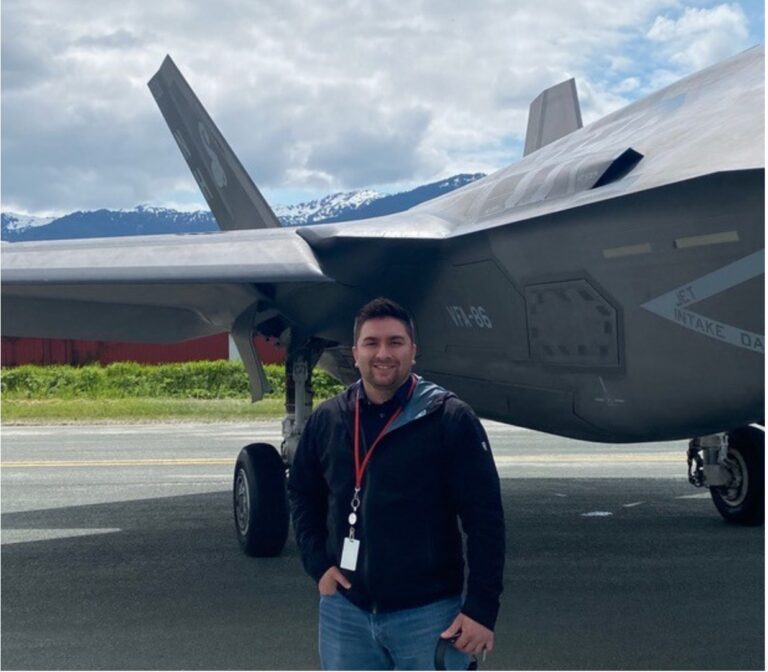
The Juneau International Airport Board of Directors chose Andres Delgado as the airport’s new manager, filling a leadership vacancy created by the retirement of longtime Airport Manager Patty Wahto earlier this year.
Delgado was officially appointed during the board’s Aug. 14, meeting and begins his new role on Monday. His annual salary will be about $170,000.
A familiar face at the airport, Delgado has served as the maintenance and operations superintendent since July 2022. Before joining the City and Borough of Juneau, he worked as assistant operations manager and marketing program manager at the Bakersfield Jet Center in California. He holds a bachelor of science in Aviation Administration from Utah Valley University.
Wahto retired in 2025 after years of overseeing the airport’s growth and operations and the airport board had been struggling to identify a successor before ultimately choosing Delgado.
Two recent columns by a progressive activist, associated with the California Innocence Project, grossly misrepresent not only the prosecution of former Ketchikan Police Chief Walls but the integrity and role of the Department of Law. The author’s narrative omits critical facts and paints a picture of misconduct that simply doesn’t align with the evidence or the process that unfolded.
The witnesses’ testimony during the grand jury is clear – Chief Walls was dining with his wife and another patron, a tourist, bumped into their chairs twice during the course of the evening. After the second time and as the tourist walked away, Chief Walls “thr[e]w his barstool back” and “t[oo]k off on a dead sprint” across a restaurant, and slammed the tourist from behind, headfirst into a rock wall. He then “jump[ed] on top of him” and placed the man “in a UFC type chokehold” as “the guy was bleeding” from his head. The chokehold was so severe it took two employees to pull Walls off the tourist. At no point did Walls, who was off duty, identify himself as law enforcement or issue a single verbal command, like “Stop, police, you’re under arrest.” That was not policing—it was violence.
We recognize that Chief Walls had a long career and a history of service. But past accomplishments do not excuse present misconduct. Upholding the law means applying it equally, even when it’s uncomfortable. Public trust in our justice system depends on prosecutors and law enforcement holding ourselves to the same standards we expect from everyone else.
The article’s author leans heavily on a memo written by a paid expert hired by Walls’ own defense attorney. That’s not an independent analysis, it’s a piece of a legal defense that Walls could have presented at trial. He chose not to. Instead, he accepted a settlement. The idea that prosecutors hid or ignored that memo is false; it simply never entered the courtroom because Walls avoided one. The author also uses other cases, such as Thomas Jack Jr., as support for his narrative but fails to disclose that Jack Jr. was unanimously found guilty of repeatedly sexually abusing his preteen foster daughter by a jury of his peers in his own community.
The Department of Law does not have the authority to investigate criminal cases. This case was referred to our department by law enforcement officers who investigated the incident and believed the use of force was excessive. That’s how the process works. We reviewed the evidence provided by law enforcement and followed the facts.
As for the grand jury process: three grand juries were held because of procedural rulings by a judge, not because of any misconduct. In each case, the court asked that additional information or clarification be provided. The author claims that this back-and-forth between the prosecutor, defense attorney, and a judge proves bad faith or corruption. It actually shows something quite different: a system that works – with checks and balances, where a judge decides areas of genuine disagreement between the parties. Ultimately, a misdemeanor assault charge was allowed to proceed, and that’s the charge the prosecutor pursued. Such a charge was found to be lawful and appropriate.
The credibility of law enforcement is the foundation of our justice system. We are proud of what our department has accomplished with the help of law enforcement agencies around the state. Crime rates are hovering around 40-year lows, and violent crime is down almost five percent. In 2024 alone, the department successfully prosecuted 223 drug crimes and our law enforcement partners seized 99,853 grams of fentanyl off our streets. That work matters, and it only carries weight if the public trusts that we apply the law fairly.
When someone in uniform or authority abuses their power, that conduct must be addressed. The rule of law doesn’t work unless it applies to all of us. We took this case seriously, because that’s what the public deserves.
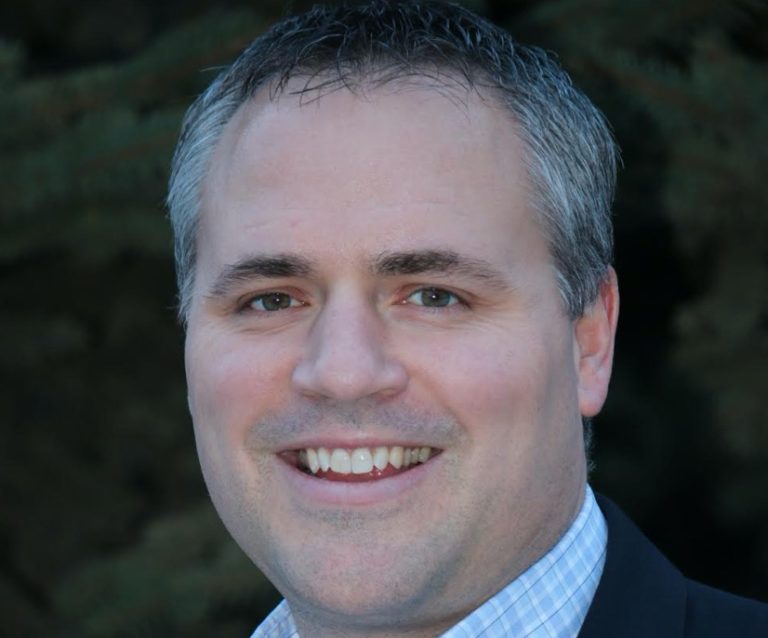
Treg Taylor has served as Alaska’s Attorney General since 2021, following two years as Deputy Attorney General overseeing the Department of Law’s Civil Division. In that time, he has guided the state’s legal work to defend Alaska’s sovereignty, protect public safety, and preserve the freedoms and opportunities that define life in the Last Frontier.
Alaska could become one of the next states to loosen restrictions on psychedelic plants and magic mushrooms.
On Thursday, Lt. Gov. Nancy Dahlstrom certified a ballot initiative that would legalize and regulate the therapeutic and traditional use of certain natural medicines — including psilocybin mushrooms, mescaline (but not from peyote), dimethyltryptamine (DMT), and ibogaine. Supporters now must gather signatures to get the matter on the ballot.
The measure, titled 25ANMA would allow adults 21 and over to legally access, cultivate, and use these substances under a regulated framework. It would also formally protect indigenous and traditional spiritual uses.
“This certification reflects the constitutional and statutory requirements for citizen-led initiatives in Alaska,” Dahlstrom said. “While voters will ultimately decide the merits of the proposal, the application meets all legal criteria for form and content.”
According to the National Institutes of Health, the psychological effects of psilocybin use include hallucinations and an inability to discern fantasy from reality. Panic reactions and a psychotic-like episode also may occur, particularly if a user ingests a high dose. Common side effects are nausea and vomiting, muscle weakness, and poor coordination.
If approved at the ballot box, the initiative would:
Create a Natural Medicine Control Board to oversee licensing, regulation, and public education;
Establish a Traditional Use Council to safeguard cultural and spiritual practices;
Decriminalize personal possession, cultivation, and non-commercial sharing;
Authorize licensed facilities and facilitators for therapeutic services;
Protect certified traditional practitioners and clients from criminal penalties.
The Alaska Department of Law reviewed the measure and found it met constitutional and statutory standards.
Supporters must gather signatures equal to 10 percent of the votes cast in the last general election, with representation from at least three-quarters of Alaska’s House districts.
Sen. Forrest Dunbar has been unsuccessful in getting legalization of clinical use of magic mushrooms through the legislature.
With legalization of marijuana cultivation and regulated sales in Alaska, a black market has grown in the state, as unregulated markets undercut the retail storefront sellers. Usage of marijuana among minors has increased as the various forms of cannabis have become more commonplace and accessible to children.
The 2025 Alaska State Fair kicked off its first weekend in Palmer with sunshine, packed roads, and a performance by “Weird Al” Yankovic that drew thousands.
Traffic heading toward Palmer backed up for miles as fairgoers streamed into the Alaska State Fairgrounds, eager to enjoy rides, games, and exhibits under unusually warm and clear mid-August skies. Longtime fair attendees noted that good weather is not always guaranteed at the annual event, making this opening weekend a bonus for those who ventured out early.
Yankovic’s Sunday concert was a highlight, blending parody music and comedy for an enthusiastic crowd. Other fair staples filled the grounds: giant vegetables, livestock displays, food booths, and the carnival midway.
Sunday, Aug. 17, 2025 at the Alaska State Fair.
The 2025 Alaska State Fair runs through Sept. 1 at the Palmer fairgrounds. Gates are open daily from 11 am to 10 pm, with closures on Tuesdays and Wednesdays. Full schedules, including concerts and special events, are posted at the Alaska State Fair’s website.
The massive Ukrainian flag unfurled across the Delaney Park Strip on Friday didn’t simply appear out of nowhere. It was part of a coordinated effort by outside groups that converged on Anchorage to influence the optics surrounding the high-stakes meeting between President Donald Trump and Russian President Vladimir Putin.
A Must Read Alaska review found that the pro-Ukraine protests downtown were not purely grassroots. Instead, they were bolstered by national organizations with long-standing ties to Ukraine advocacy, including Razom for Ukraine and United Help UA, some with historical connections to George Soros-backed initiatives and formerly funded by USAID.
Razom, a US-based nonprofit headquartered in New York City, confirmed that its team was on the ground in Anchorage. In a public post, Razom media advisor Ostap Yarysh said the group helped connect international journalists with members of Alaska’s Ukrainian community and assisted with media coverage of the protests.
The media was very cooperative and gave the protest massive coverage, just as planned by the Outside groups based in New York.
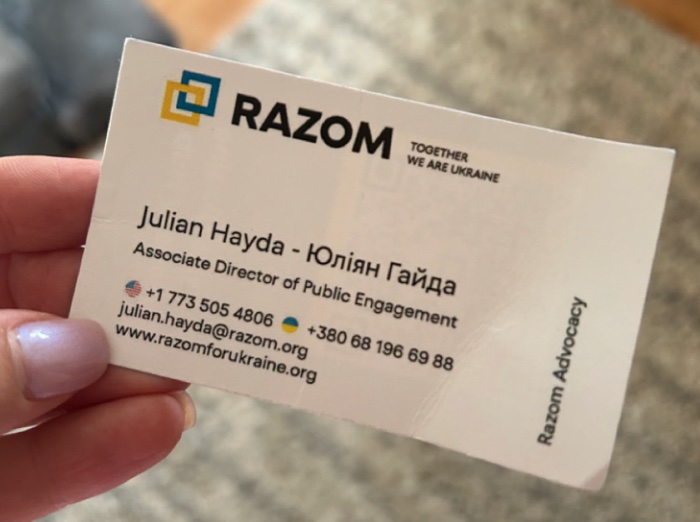
At the pro-America rally on Saturday, Razom representatives approached gubernatorial candidate Bernadette Wilson and told her that they were with “Norwegian media,” asking for an interview. As they left, they handed her a business card that had Razom’s name and logo on it.
The so-called journalist who approached Bernadette Wilson was actually the associate director of public engagement for Razom.
The woman and the photographer had infiltrated the pro-America rally under the guise of “journalism.”
One of the world’s largest Ukrainian flags flew up to #Anchorage today courtesy of our friends at @UnitedHelpUA. Some delegates are believed to be staying at the hotels downtown, and the international press corps has a view from above the near convention center. pic.twitter.com/PUi5hVZaqm
— Razom for Ukraine 🇺🇸🤝🇺🇦 (@razomforukraine) August 15, 2025
Razom’s CEO Dora Chomiak is a longtime pro-Ukraine leader whose nonprofit has become one of the most prominent voices for Ukraine in the United States. Under her leadership, Razom has raised more than $100 million in humanitarian and medical aid for Ukraine since Russia’s 2022 invasion. Much of their funding has come from USAID. TIME magazine named her to its 2024 TIME100 Health list for strengthening Ukraine’s health system during wartime.
Chomiak, a native New Yorker and Princeton graduate, worked in Kyiv for the Soros Foundation’s International Renaissance Foundation in the 1990s, helping launch independent media outlets during Ukraine’s transition from Soviet control. She later managed a $7 million US Agency for International Development (USAID) grant. Her professional background also includes roles at McGraw-Hill, Thomson Reuters, and other media and marketing firms.
Razom was not the only outside group behind Anchorage’s demonstrations. The enormous blue-and-yellow flag that stretched across downtown during the summit came from another nonprofit, United Help UA. Razom acknowledged the contribution on social media, writing: “One of the world’s largest Ukrainian flags flew up to #Anchorage today courtesy of our friends at @UnitedHelpUA. Some delegates are believed to be staying at the hotels downtown, and the international press corps has a view from above the near convention center.”
It’s likely that other signage and flags were provided by the same or like groups from outside the state.
Alternately, an Aug. 15, a pro-peace event took place in Anchorage, with Trump flags and American flags, all of which was an organic and locally organized event in contrast to the pro-war, pro-Ukraine events that had outside coordination.
In Alaska, we have debated education funding for decades, yet our results remain near the bottom nationally. The discussion too often centers on how much money we spend, not on whether our kids are learning. While politicians argue about budgets, the price of oil continues to fall, and the PFD shrinks, thousands of Alaska’s children are graduating without the skills they need to succeed in college, careers, or life. It is time to reframe the conversation away from partisan politics, and even the money, and focus on a single, urgent question:
How do we give every child in Alaska the chance to succeed?
Our education system is not failing for lack of money. Alaska already spends more per student than most states, yet our reading, math, and graduation rates lag far behind. The problem is structural. We have built a system that serves adults first, whether bureaucracies, unions, or entrenched interests, while students are left waiting for the scraps of improvement. We cannot keep counting “success” in dollars spent, contracts signed, or jobs saved; we must count success in students who can read, solve problems, and compete in a fast-changing world.
Parents in Alaska are already making their own choices. Both Anchorage and Fairbanks neighborhood schools have lost many students in recent years; many to homeschooling or charter schools, some to private schools. These families are not abandoning neighborhood schools lightly, they are seeking environments where their kids are challenged, supported, and prepared for life. This is not an ideological movement, it is a parental one. It should cut across party lines, income levels, and zip codes.
Governor Dunleavy has rightly called for policies like Education Savings Accounts, charter school expansion, and allowing funding to follow the student. These generally cost neutral tools give parents the power to choose the environment where their child will thrive. But choice alone is not enough. We must also address inefficiencies, such as duplicative administrative structures and outdated district boundaries, that drain resources from classrooms. We must ensure that every possible educational option for our kids is available and held to high standards for results.
Other states are showing us both the possibilities and the pitfalls. Vermont’s recent restrictions on its long-standing tuitioning program, and Illinois’ decision to let its Invest in Kids scholarships expire, are warnings. In both cases, entrenched interests fought to limit options for families, and, just like in Alaska, students paid the price. Alaska cannot afford to continue to follow that path. We must protect and expand choice in ways that fit our state’s unique geography, culture, and communities, and budget. It is hard to justify huge education system expenditures if the kids can’t get to school, or the school is falling down because we have used DOT money to fund education.
This means recognizing that what works in Anchorage may not work in Bethel, and what works in the Mat-Su may not work in Barrow. Education reform cannot be imported wholesale from another Alaska school district or even another state, whether it’s Texas or Vermont. It must be built here, district by district, by Alaskans, for Alaska’s children. That means more local control, more flexibility for rural and urban communities, and a focus on outcomes over systems.
We have an opportunity right now to set aside the stale funding-versus-cuts debate and work together on what really matters: preparing Alaska’s kids for the future. That requires bold reforms, honest evaluation, and the political courage to put students ahead of special interests. It means measuring our success not by how loudly one side “wins” in Juneau, but by how many of our children can read at grade level, graduate ready for the workforce, and step confidently into the next stage of their lives. Those are the wins we need.
The stakes are too high for half-measures or partisan point-scoring. Alaska’s kids deserve better. And if the legislature and others are willing to put them, not the system, at the center of our decisions, we can deliver it.
Can we finally talk about the kids and their education?
Rep. Kevin McCabe serves in the Alaska Legislature on behalf of District 30.
Friday’s meeting between Donald Trump and Vladmir Putin surprisingly made Alaska a setting of great importance for the Russo-Ukrainian war. While Alaskans seemed generally pleased with all the attention, what is potentially overlooked by many were some clues in the meeting to a vital question: What exactly were the original Russian goals for the invasion of Ukraine?
Was the objective a countrywide assault and then an occupation of Ukraine by Russian forces? Or were the goals more modest, and the continued comparisons to Hitler’s invasion of Poland in 1939 just a method to stoke fear of the Russian Bear again on a rampage for world domination? Perhaps as is often the case in politics, the answer is more nuanced.
Following the Alaska meeting, unofficial sources quoted in Reuters report that Putin proposed to stop the fighting in exchange for Russia permanently taking the eastern Oblasts of Donetsk and Luhansk. If this proposal is eventually confirmed as true, it may well signal what the original Russian invasion plan was.
Having researched Russian Federation military operations for different media outlets and one “think tank” in three separate conflicts, I have learned to discount most of what I read of these engagements between post-Soviet republics and Russia. This is true in political goals, but also in many other areas of the conflicts, such as casualty figures and military equipment loses.
I first saw this phenomenon in the Ossetian War during the Russian invasion of the Republic of Georgia in August 2008, when I had a short-term contract as a reporter for the English language newspaper Georgia Today. In that instance, the exaggerations were the Georgian figures for civilian loses during the Russian occupation of the city of Gori and accusations of Russian war crimes during the occupation.
Another example was during Russian operations in Syria in support of Assad while covering the beginning of the Syrian Civil War in 2012 on the Lebanon-Syrian border. Which brings us to what Russia named the labelled the Special Military Operation in Ukraine.
Put simply, Russian casualty figures may well be overblown to discredit Russian efforts. Mind you, I have not supported Russia in any of these operations. We don’t know for sure how many Russian or Ukrainian soldiers have been killed in this conflict. Because, put simply, both sides have proven themselves untrustworthy.
The Armed Forces of Ukraine puts Russian casualty figures at 1,067,100 as of early August, 2025. By contrast, BBC Russian Media Services and Mediazona records Russian casualties at somewhere slightly at 119,154 in mid-July. Official Russian government press releases stopped releasing casualty figures early in the war. The Russian Ministry of Defense stopped reporting losses in September, 2022 with slightly less than 6,000 killed to that date.
Ukrainian losses are equally hard to pin down. The Russian news source TASS reported that Ukraine had reached the 1 million casualty mark in late December, 2024.
Interestingly, there was some rare questioning of these figures during a recent Al Arabia panel discussion. In it, the issue was that Russia officially began the Ukrainian invasion with 1,300,000 soldiers in uniform. In the broadcast, Dr. Elie Al Hindy, a Security and Global Affairs expert, makes a valid point that the casualty reports as stated may be in fact be inflated, as to have lost that many soldiers would be massively disruptive to Russian military operations.
Yet, all that aside, the question of whether Russia intended to conquer and occupy all of Ukraine at the outset of the invasion remains that unanswered, at least in most western sources.
When trying to formulate an answer to this question, it must be understood that the relationship between Russia and Ukraine is a long one. And before traveling to Ukraine during this war I never realized it is much more complex question than I ever imagined.
To illustrate this, I had an about two-hour conversation with a Polish computer technician named Vasily who sat next to me on the plane out of Warsaw about this exact issue. And while he admitted he was surprised that the invasion had even occurred, he was not as dismissive of Russian methods and goals as you might think. More than once the concept of being Russian as not just a nationality, but instead an ethno/spiritual state of being, was expressed by Vasily to me.
So, with that being said, I would rather comment on some specifics and throw in a little speculation that I will state to some extent as fact, due to personal observation while in the Ukraine.
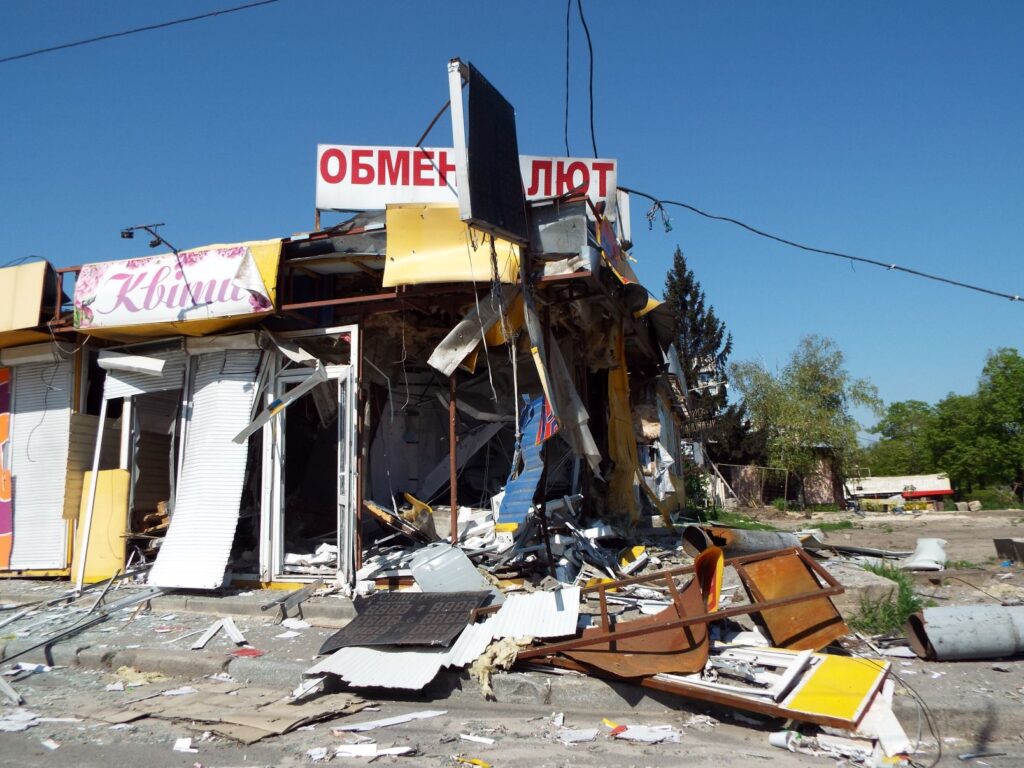
War damage in Ukraine. Photo credit: Ernest Sipes
It needs to be noted that the only evidence that Russia was bent on a Ukraine invasion and subsequent occupation apparently came from a single source, “The Royal United Services Institute for Defence and Security Studies.” This British think-tank stated in late November 2022 that it had obtained a series of documents signed by Putin that outlined a plan to subdue Ukraine in a 10-day period, then execute the leaders of the country and force uncooperative Ukrainians into what appeared to be Soviet-style “reeducation camps.” The documents have never been shown to anyone outside the organization. Even today the RUSI website states “As the underlying source material for much of this report cannot yet be made public, this should be understood as testimony rather than as an academic study. Given the requirements for operational security, it is necessarily incomplete.”
Putin has never disclosed exactly what the goals of the invasion were, besides stating in 2022 it was “denazification and demilitarization” of Ukraine. Interestingly, a Moscow Times article on January 23, 2025, reported that “unnamed sources” recounted that Putin stated that Russia had achieved its key objectives in the Ukraine Special Military Operation.
So, what are we to believe were the actual Russian goals for the invasion of Ukraine?
It appears to me Moscow (and I am choosing to use Moscow to refer to the Russian Federation governing mechanism, as to me it’s a bit simplistic to refer to one man as the leader of a nation with a representational body as is the Duma) always had a fixed series of goals in this war.
And those goals were for the most part accomplished by the third week of the invasion. Now we could argue over whether the Duma truly represents the people of the nation, but for this article that would be pointless.
I perceive Moscow’s goals from the outset of the Special Military Operation as:
A permanent route to the Black Sea.
The unification of areas perceived as belonging to Russia and whose citizens (a majority at least) desire to join Russia.
A notice to the world that the lands that once formed the Soviet Bloc are still under the guidance of Moscow at some level.
To discourage surrounding nations from joining NATO/EU.
To illustrate that all of Eastern Europe is still under the influence of Moscow.
If we approach the situation with these points in mind, Russian actions (and sometimes lack of action) begin making a lot more sense.
If you accept that a decision had been made by Russia to only accomplish a relatively small set of specific goals as outlined above, it is easy to see that this is why there has been no out-and-out destruction of the infrastructure of Ukraine when it is well within the ability of Moscow to do so.
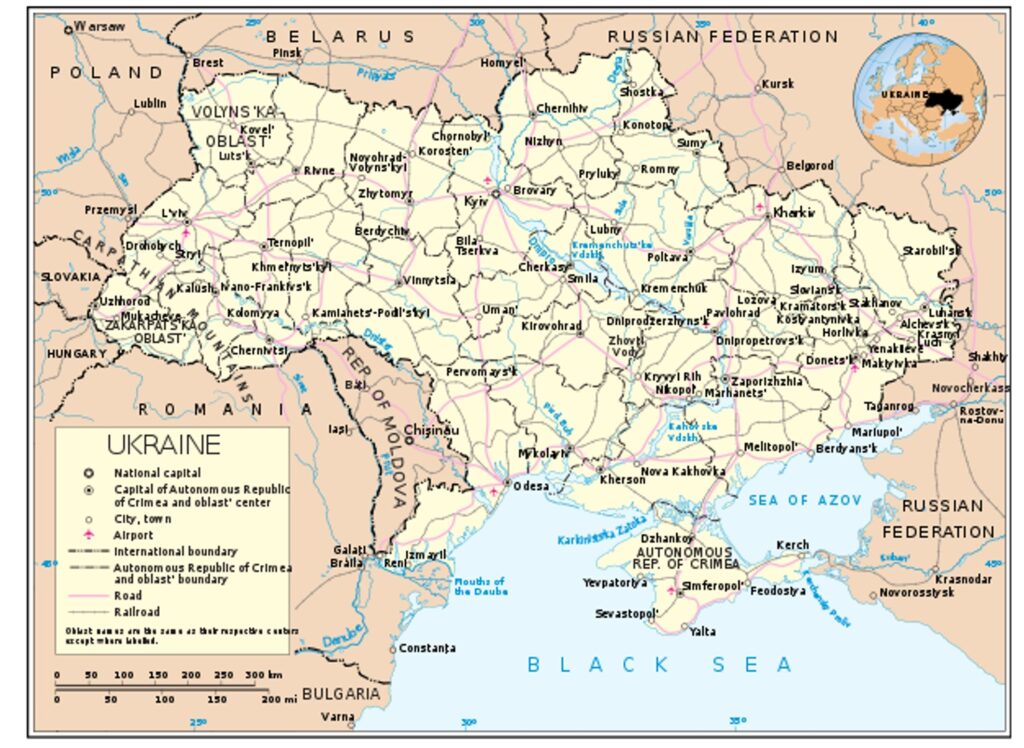
While riding on trains and buses through the Lviv, Ternopil, Khemelnyyskyy, Kiev, Chernihiv, Sumy, Poltava, Kharkiv and Dnipro Oblasts as I did, I realized it doesn’t take a military genius to realize that the topography of Ukraine makes it very vulnerable to aerial bombardment. Additionally, the country suffers from antiquated transport facilities and rolling stock, particularly in regard to railroads. And railroads are still vitally important in Ukraine, as road maintenance is frequently overlooked by municipalities. Additionally, a large percentage of the rolling stock is still of Soviet vintage. And not as antiques for tourists to ride in mind you, but for the actual transportation of goods and military equipment.
Below is a map of Ukraine to illustrate this point.
I ask reader to examine it before and after they read my points.
If the goal of Moscow were to simply invade and occupy Ukraine, then the following would be their logical course of action to pursue:
Strike and destroy bridges over the Dnipro River at Kiev, Cherkasy, Dnipro and Zaporiza using mass Shahed drone swarms as was used in the Donetsk, Sumy, and Chernihiv regions on 13 August.
Destroy the key Dnipro-Holovnyi railway yard using a combination of the RS-28 Sarmat solid fuel ballistic missiles and/or the Iskander-M/KN-23 ballistic missiles. And, while it would be risky for aircrews, fighter bombers such as the Sukhoi 34 and the Tupolev 160 could participate as the less than 180-mile distance to Russian controlled airspace means loses could be manageable.
Basically, rinse and repeat the above for the highways systems M06 and MO3 at Kiev, the M12 at Kirovgard, the MO4 at Dnipro and the M20 at Kharkiv.
Send in any suitable aircraft to simply shoot up the rail and road systems after the above was completed.
Moscow could accomplish all of the above in approximately one week’s time. While aircraft losses would admittedly be high, the effect of cutting off the eastern Oblasts would arguably be worth the losses if simply conquering the country was goal of Russia. There is evidence that Moscow does indeed have the manpower and the aircraft to withstand what losses would occur if this strategy.
If such a series of steps were taken by Moscow, the following would happen:
With the bridges knocked out, roads made impassable and railroads not functioning, no fuel, military equipment, food or goods would move west to east.
Communications would be severely disrupted.
Refugees would be swarming the bridge sites on the eastern side of the rivers, which would impede movement even more and produce almost an almost unimaginable humanitarian crisis. This would only be intensified if the attacks occurred in the winter months.
Virtually no military equipment or reinforcements could be moved into the eastern areas in Donbas, Odessa etc. to reinforce to already taxed Ukrainian defenders.
With the eastern part of the country cut-off, after a few weeks Ukrainian forces in the eastern Oblasts would be facing overwhelming Russian infantry pressure due to not being adequately supplied.
The Kremlin always had an end game for Ukraine; they just didn’t tell us.
And Russian ground forces have already accomplished these goals.
Since the outset, Moscow has been fighting the war it wants to fight.
The evidence is that the holding back of Russian aerial forces is part of an evolving plan, so that when the inevitable peace negotiations begin (as we may have just witnessed the beginning of in Anchorage on Friday), it will make it easier for both parties to come to terms.
However, if we begin hearing that train stations, railroad tracks, bus station, bridges, road junctions and electrical stations in western Ukraine are being systematically destroyed by Russia, then this may very well indicate there has been a change of plans by Moscow in terms of goals for this invasion.
My take is everything is being run on a timetable, with some obvious setbacks for Moscow. From the evidence I see, the Ukrainians and Russians are stubbornly dug in at pretty much the same static front lines in the eastern Oblasts that have existed since mid-2022. And if you can look at it dispassionately, brave Ukrainian soldiers are vainly throwing themselves upon Russian defensive lines even as I write this.
But do not believe what you are being told in the western media, that Russia is aiming for a WWII, Battle of the Bulge-style breakout to encircle Kiev and then force a surrender of the Ukrainian government.
As there is little evidence that this was ever Moscow’s plan for the Special Military Operation.
Ernest Sipes is former OCONUS contractor and reporter, most recently for the Berlin-based media organization Associated Reporters Abroad. He has eleven years of Middle East experience while working in Saudi Arabia and the Sultanate of Oman. In his position as a reporter, Mr. Sipes has visited and reported on Ukraine, Russia, Iraq, Kurdistan, Lebanon, Syria, Egypt, Oman, Republic of Georgia and Somalia. He has published one book in Canada and authored numerous articles in a variety of journals, including USA Today and the Washington Times.https://www.linkedin.com/pub/ernest-sipes/10/702/aa6