

By Rep. Kevin McCabe (R-Big Lake)
This article was first published on the author’s personal Substack, September 13, 2026, under the title “Seven Instructions. Two in Bold. Zero Warnings.”
I pulled up my own sample ballot this week. House District 30.
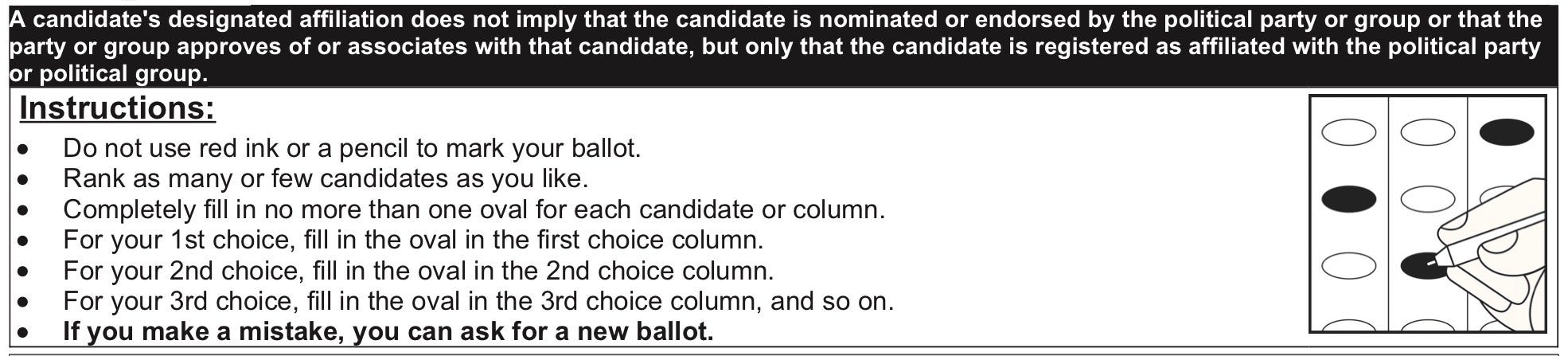
There are seven instructions at the top.
- Do not use red ink or a pencil to mark your ballot.
- Rank as many or few candidates as you like.
- Completely fill in no more than one oval for each candidate or column.
- For your 1st choice, fill in the oval in the first choice column.
- For your 2nd choice, fill in the oval in the 2nd choice column.
- For your 3rd choice, fill in the oval in the 3rd choice column, and so on.
- If you make a mistake, you can ask for a new ballot.
That is all of it.
Seven instructions and not one tells you how your vote dies.

Then there is the Division of Elections website, which has a section called “What are mistakes to avoid?” It has four examples with pictures.
Skip one ranking and your next ranking moves up.
Skip two in a row and everything after the skip is dead.
Give two candidates the same number and that ranking and every one after it is thrown out.
Rank the same candidate twice and it still only counts once.
Four ways to wreck a ballot. The state knows all of them. It drew pictures.
But NONE of that is on the ballot.
That website will not be in the booth with you. Neither will the video or the rack card. You get a pen, a piece of paper, and seven bullets telling you what you may do and never what it costs.
The bullet about mistakes says ask for a new ballot. That fixes a stray mark. It does not fix stopping too soon, because you will never know you did it. Nobody hands you a new ballot for that. You find out in a tabulation room in Juneau in late November, if you find out at all.
But here is the line that bothers me.
The Division asks the question half of Alaska is asking right now. “What happens if I only vote for one candidate?”
The answer: your vote is counted in round one and your vote stays with your candidate throughout tabulation.
True. But it leaves out the part that really matters.
It does not say that when your candidate is knocked out, your ballot quits counting in every round after. It does not say your ballot dies or gets knocked out with your candidate, And it does not say exhausted or inactive. Search that page for either word. They are not there.
Those words live in the tabulation reports, published after the election, when it is too late to help you.
Two sentences on the Division page are in bold.
You do not have to rank all the candidates.
If you make a mistake, you can ask for a new ballot.
That is it. Those two.
Both say “Relax. You do not have to do this. If you get it wrong, we will fix it.”
But here is what they don’t say; what is not in bold.
Ranking more candidates keeps you in the game after your favorite loses. Plain text. That’s the whole reason proponents wanted ranked choice voting in the first place, and it gets no emphasis at all? Really?
All four mistakes and all four pictures. Plain text. Zero consequences.
And the sentence sitting right under the bolded one, that your second choice is only counted if your first choice is eliminated. That’s the whole ballgame, and it is plain text.
The two lines they emphasized both tell you to do less.
The Division cannot tell you to fill in more ovals. That would be the state coaching your ballot and they are right to refuse. So they write neutral. Neutral comes out sounding like permission, or even encouragement.
We built a voting system that needs a warning label the state is not allowed to print.
Every other ballot in America handles this. Overvote warnings. Stray mark warnings. Notices that a bad mark will not count. Those work because the mistake is mechanical and the state can name it without taking a side.
Under ranked choice voting, the mistake that kills your vote is your decision about how far down the page to keep writing. So the state goes quiet and you are on your own.
Nobody is cheating. It is a design problem. Under the old system one oval was one vote for one person and there was nothing to warn anybody about. That is a good reason to vote YES on Ballot Measure 2.
But Measure 2 does not change the ballot in your hand this November. These are the rules you have.
Rank straight down. One, two, three. No gaps.
Never give two candidates the same number.
Never skip two rows in a row.
Do not stop after one name unless you are fine having no say in who wins.
Look at my ballot. District 30 has two Republicans and one Democrat. Senate District O has two Republicans and one Democrat. Governor has three Republicans and one Democrat.
Same trap, three times, on one piece of paper.
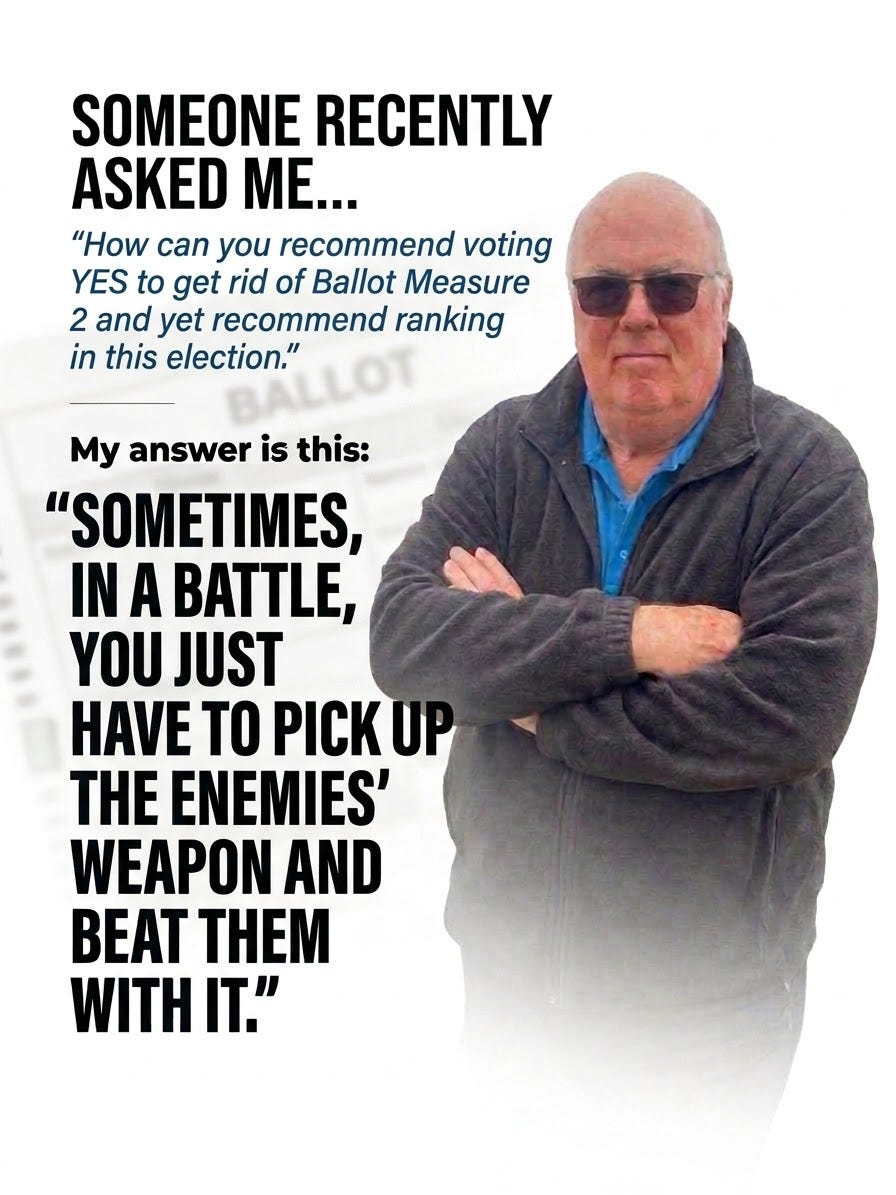
The state will not warn you. So I am. Ranking all candidates is an insurance policy against your worst candidate. Your worst nightmare. You don’t have to agree with the system to use it. Use their own weapon against them.
Seven instructions. Four ways to ruin a ballot. Never on the same piece of paper. The state instructions fail.
PS. Beat them at their own game then vote Yes to end the Mess. Vote YES on Ballot measure 2!
More Conservatives Speak on the Winning Strategy
Greg Sarber, conservative writer and former board member of Alaska Gold Communications, Inc.: Opinion: Conservative Alaskans need to vote strategically for Governor
Jim Minnery, President of Alaska Family Council: Opinion: Alaska Family Council speaks on governor’s race, invites Christians to prayer gathering
Dr. George B. Hightower, former 2026 candidate for Lt. Governor: Opinion: The governor’s race is a fight for freedom; here’s how to win
Jon Faulkner, President of Alaska Gold Communications, Inc.: Opinion: An Obi-Wan Kenobi moment for the Taylor/English campaign
Todd Lindley, Vice President of Alaska Gold Communication, Inc.: Opinion: We can win with the right mindset— policy over person
Must Read Alaska unequivocally supports the election of a conservative to the Office of Governor but does not endorse a particular gubernatorial candidate. MRAK encourages voters to rank all three Republicans in their preferred order.


