By Zack Gottshall
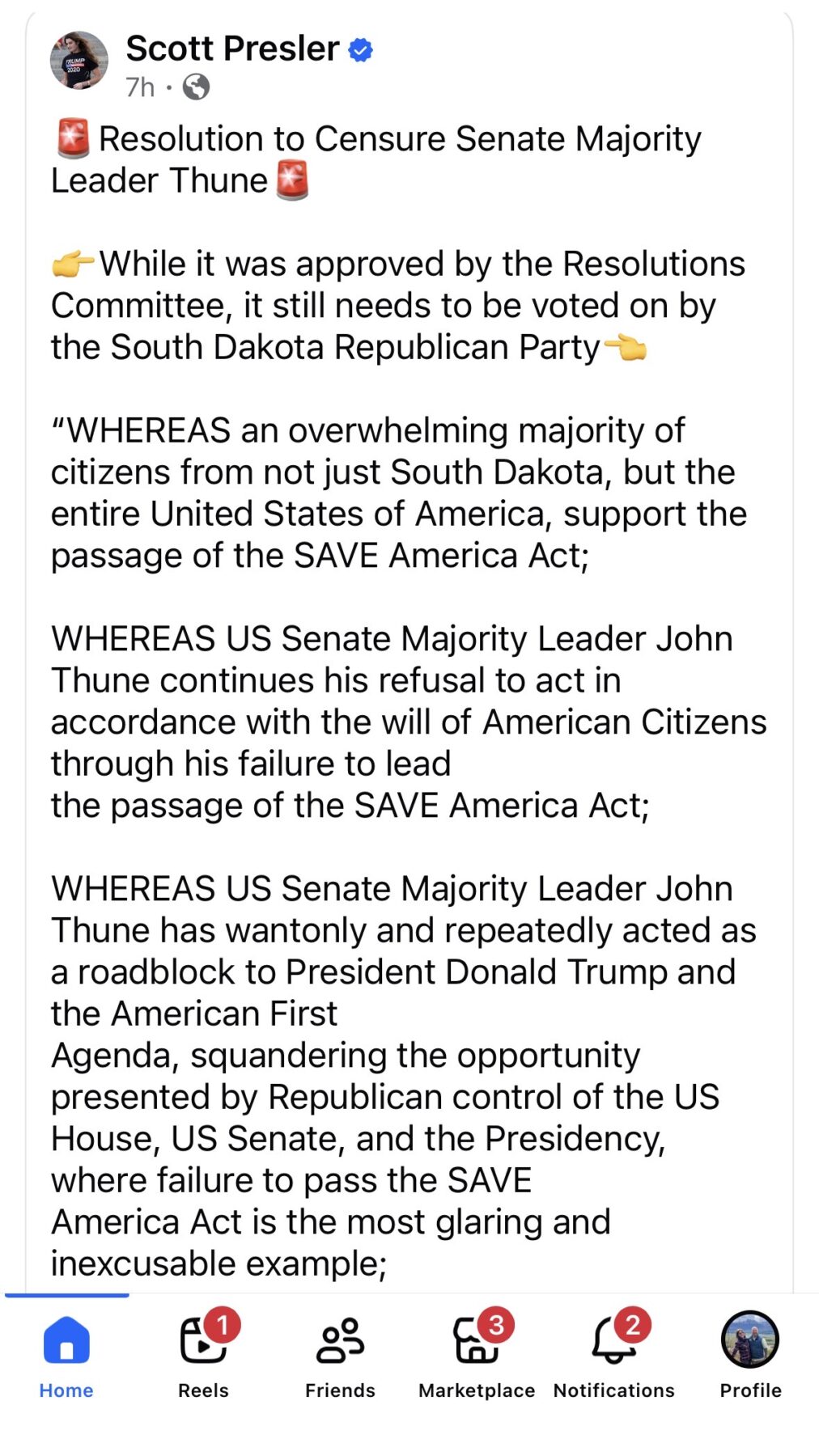
Recently, conservative activist Scott Presler shared that the South Dakota Republican Party’s Resolutions Committee approved a resolution to censure South Dakota U.S. Senator and Senate Majority Leader John Thune. Although the full South Dakota Republican Party voted to reject the resolution, the fact that it was introduced, debated, and advanced demonstrates something important: the South Dakota Republican Party is willing to publicly examine the conduct of its own United States Senator and determine whether he should be held accountable to the principles and expectations of Republican voters.
The failure of the resolution to pass is beside the point. The important principle is that South Dakota Republicans were willing to have the conversation. They did not eliminate the process. They did not shy away from the issue. They recognized that political parties have both the authority and the responsibility to hold their own elected Republicans accountable when members believe they have departed from the Party’s principles or the will of Republican voters.
That is exactly what political parties are supposed to do. Unfortunately, Alaska Republicans chose a very different path.
At the Alaska Republican Party’s May 2026 State Central Committee meeting, delegates reelected Party Chair Carmela Warfield while simultaneously voting to remove language from Article VII of the Alaska Republican Party Rules that allowed the Party to censure a sitting United States Senator.
Instead of preserving accountability, we dismantled it. Instead of ensuring every Republican officeholder remained answerable to the Party’s principles, we voluntarily surrendered one of the few formal mechanisms available to do so. For many conservatives, that decision was not simply disappointing— it was deeply revealing.
For years, grassroots Republicans have expressed concerns about Senator Lisa Murkowski’s voting record and what they view as repeated departures from Republican priorities. Rather than preserving the Party’s ability to address those concerns through its own rules, our delegates chose to eliminate that authority altogether.
The contrast could not be clearer. The South Dakota Republican Party is willing to debate whether its own senator should be censured. The Alaska Republican Party voted to ensure it could not do the same with its own senator.
That sends a powerful message. Not to Senator Murkowski. To Republican voters.
It tells them that accountability depends on the office someone holds rather than the principles they uphold. These are the very reasons so many conservative voters in Alaska have lost faith in the Alaska Republican Party.
Unfortunately, this was not an isolated failure.
Earlier this year, there was little organized effort to recruit strong conservative challengers against the seven Republican legislators who chose to caucus with Democrats. Now, after weakening our own rules, the message is even clearer: Alaska’s Republican establishment appears more comfortable avoiding difficult fights than leading them.
Political parties exist to elect conservatives, defend conservative principles, and hold Republicans accountable when they fail to uphold those principles. When a party loses the will— or the ability— to do that, it begins losing the confidence of the very people it exists to represent.
That is exactly what I believe is happening today.
The comparison is impossible to ignore. One state Republican Party actively considered whether to censure its own U.S. Senator. The Alaska Republican Party chose to remove its ability to do the same.
That difference speaks volumes.
Zack Gottshall is a retired U.S. Army Intelligence Officer, former Commissioner of the Alaska State Commission for Human Rights, Vice President of the Taku/Campbell Community Council, and a small business owner in Anchorage, Alaska.