
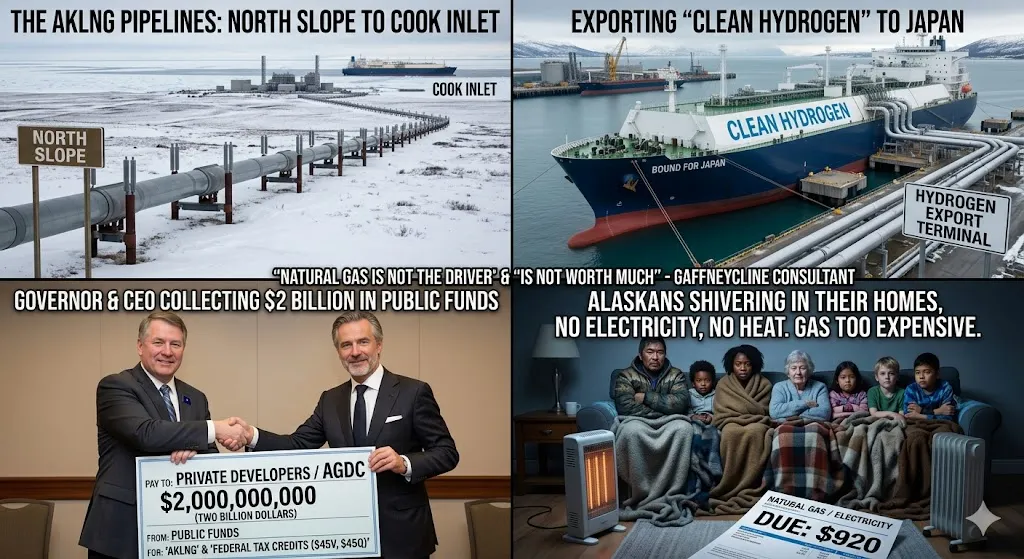
The following article is a partial reprint of the article “The AKLNG Pipeline’s 30-Day Window,” originally published on the author’s personal Substack, June 1, 2026.
In December 2022, three and a half years before this special session, Governor Dunleavy published an op-ed titled “Alaska’s Map to Clean Hydrogen Leadership.” He wrote that natural gas is a key ingredient for hydrogen production, that increasing global demand for low-carbon hydrogen is fueling progress for Alaska LNG, and that Alaska is well positioned to compete because of its geology suited for carbon capture and its vast gas supply. The op-ed was published on RealClearEnergy and hosted on the AGDC website.
That same month, AGDC submitted a concept paper to the U.S. Department of Energy seeking $850 million in federal hydrogen hub funding. The Alaska Hydrogen Hub concept anticipated producing more than 600 tons of clean hydrogen per day, using North Slope natural gas feedstock via the Alaska LNG project and sequestering the captured carbon dioxide in underground geological formations. AGDC initially refused to release the concept paper. The DOE discouraged the application.

In June 2022, Governor Dunleavy concluded a trade mission to Japan. The AGDC newsroom described his meetings as covering Alaska’s potential to export blue and green hydrogen as part of Japan’s energy transition, alongside LNG.
In 2025, Dunleavy’s Alaska Clean Energy Week proclamation described the Alaska LNG project as including a “carbon removal and sequestration plant” and characterized it as “among the lowest carbon impact projects on the planet.” That is not a description of a natural gas export project. It is a description of a carbon credit architecture.
None of this appeared in the urgency argument for the special session. The urgency argument was “LNG market window.”
The Deadline Nobody Will Name
The Legislature’s own oil and gas consultant, GaffneyCline Senior Director Nicholas Fulford, told the Senate Finance Committee on May 27 that natural gas “is not the driver” of the project’s economics and that it “is not worth much.” If the LNG market window is the urgency and LNG is not the driver, the urgency argument contradicts itself in testimony from the state’s own paid advisor.
There is one deadline in the public record with a specific date attached to this project’s actual economic architecture. The One Big Beautiful Bill Act, signed into law on July 4, 2025, extended the Section 45V clean hydrogen production tax credit but moved the construction commencement deadline forward to December 31, 2027. The special session’s bill, SB 2001, contains a construction commencement trigger of January 1, 2028. Those two dates are identical. That is not a coincidence in drafting.
The 45V credit pays up to $3 per kilogram of qualifying clean hydrogen produced, for ten years, to projects that begin construction before January 1, 2028. On the separate 45Q carbon capture side, the credit is worth approximately $85 per ton of CO2 sequestered, an estimated $595 million annually to the project operator at projected volumes. Alaska’s return from that activity under HB 50, the 2024 carbon storage law, is $2.50 per ton. Less than three cents on every dollar of federal credit value generated using Alaska’s geology.
The Governor has been describing this architecture in public since 2022. He described it as Alaska’s hydrogen leadership map. He described it at trade missions in Japan. He described it in AGDC’s federal funding applications. What he has not described, in this special session, is the December 31, 2027 IRS construction commencement deadline that explains the 30-day clock better than any LNG market condition.
The State’s Own Advisor Said Wait
GaffneyCline’s December 2025 report to the Legislative Budget and Audit Committee, written by the same Fulford who testified in the special session, stated plainly that a definitive fiscal framework for the project “cannot yet be contemplated” because the required detailed economic model does not exist. Six months later, the special session is being asked to pass exactly that definitive fiscal framework, permanently, in 30 days, without the model.
The state’s own chief economist told Senate Finance that the project’s cost could reflect a 100% increase over the $46 billion public figure, putting the range between $46 and $92 billion. The Senate Finance co-chair called the $46 billion figure “complete garbage.” Fulford called the cost baseline “wishful thinking.” No updated figure has been provided by the developer.
The legislature is being asked to set a permanent tax rate on infrastructure of unknown cost, on a 30-day clock, to meet a federal tax credit deadline that nobody in the urgency campaign will name, while the social pressure apparatus attacks legislators who order dinner during remote hearings.



