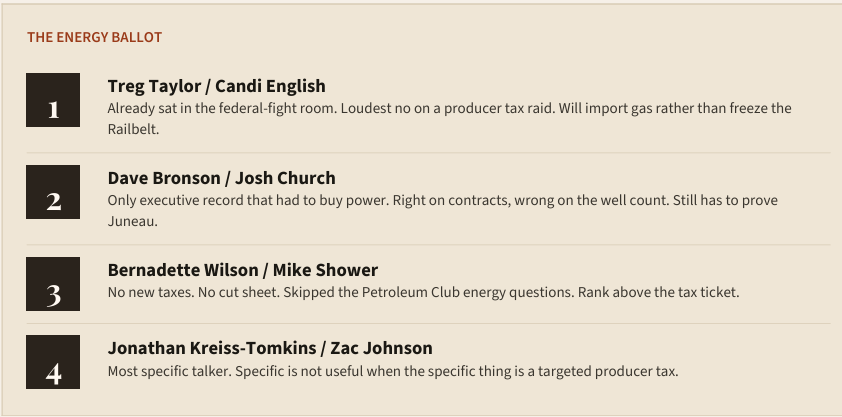
Here is how I would fill out a ranked-choice ballot if the only question was Alaska’s energy and mining future:
Alaska does not run on campaign language. It runs on leases, contracts, tariffs, winter gas, and a tax base that still lives and dies with barrels and mines.
That is the whole race if you strip the team jerseys off it. Every ticket has learned to say affordable energy. Almost none of them have shown they can move a permit, a pipeline tariff, a Railbelt plant, a mine, or the money that pays for the state.
A governor can lean on agencies, pick the people at AIDEA, AEA, DNR, and DEC, and decide whether Alaska fights, joins, or ghosts a federal case. A governor can put steel in a capital budget. A governor cannot sign a federal Record of Decision, reverse EPA’s Pebble veto, order the Army Corps to approve a road, set your electric rate by press conference, or talk an AKLNG deal into existence.
Keep that in your head when you rank this ballot. Ranked choice is not a personality contest. It is a machine that takes your first, second, third, and fourth and turns them into one winner. If you care about energy, rank the ticket that has already sat in the rooms that move work.
Here is how I would mark it for energy and mining only. Taylor first. Bronson second. Wilson third. JKT last.
What already happened, and what still cannot
We have been living inside a pep talk for years.
Open for business. The gas line is right around the corner. Unify the grid. Fifty new mines. Willow will save the Slope. Carbon storage will be the next industry. Permit reform. FAST-41. Another study. Another development corporation. Another winter of hoping Southcentral does not come up short.
Willow is real. It is a federal project with peak talk around 180,000 barrels a day. It is not a statewide production plan, and a new governor in Juneau does not get to invent the next one.
AKLNG is the other exhibit. Governors have called it the future, the bridge, the in-state answer, the export play. Public money went into studies and a state corporation. The Legislature spent 2026 fighting over tax terms for a private developer. Still no final investment decision. Still no North Slope molecule in a Southcentral furnace. The private investment plan is not far enough along for anyone to write a finished state policy around it. Pretending otherwise is how you get another year of slogans.
Cook Inlet is the one that bites first. This is where the campaign talk gets sloppy. Enstar will tell you, if you bother to ask, that the utility is trying to buy every molecule it can find. John Sims has said producers will not, or cannot, commit additional firm supply. He has said Enstar will pay a premium and still comes back empty. He has said one producer told him there is no price worth the risk. That is a commercial problem between a utility that has to serve and producers who will not sign more long-term paper. It is not Alaska refused to contract. Blaming the state for Enstar’s unsigned deals is a good line on a stage. It is a bad map of the basin.
Hilcorp still supplies most of the Inlet. It has been drilling. HEX, the Alaska-owned producer, is in a 2026 campaign of two wells and maybe a third if the ice stays off. Two. Maybe three. Not 33. Keep that number honest when somebody waves it around like a production plan.
The Railbelt got a statute. HB 307 created a transmission organization inside AEA and told it to file an open-access tariff. The RCA parked that tariff for investigation. So when a candidate says one grid, ask the adult question. Amend the statute. Fight the commission. Force asset transfers. Or let the utilities keep inching.
Carbon storage got a statute too. HB 50 built a state program for pore-space licenses and handed a pile of it to AOGCC. That is a filing cabinet. It does not finance a project or make federal 45Q math work.
Mining is the same movie with different dirt. FAST-41 puts Ambler on a federal calendar. A calendar is not a road. EPA’s 2023 Clean Water Act veto still sits on Pebble. A governor can comment, sue, coordinate, and appoint. A governor cannot wish that determination into the trash.
That is the inheritance. Four tickets want the keys. They have been on stages since August. AOGA. Petroleum Club. Commonwealth North. Resource council. Loussac. A lot of coffee. A lot of I support energy.
First: Taylor / English
Taylor was the state’s lawyer from 2021 to 2025. English comes out of oilfield support work. This is the ticket that has already used the one room a governor actually owns on federal energy fights.
People keep talking about that room like it is theoretical. It is not. The attorney general decides whether Alaska shows up on NPR-A, ANWR, Willow, Ambler, Pebble, lease delays, offshore bans, and the federal rules that try to steer money away from oil and mines. Taylor sat in that chair. The Department of Law joined dozens of federal challenges on his watch. He backed the state’s position on Willow. He pushed back on the Pebble veto. He joined the multi-state suit against the Labor Department rule that let retirement fiduciaries put ESG screens ahead of returns. That last one is the ESG fight people skip when they hear him say resource development is Alaska’s ESG.
Here is the logic, without the panel-speak. Federal ESG, as practiced in that Labor rule, was a way to starve oil, gas, and mining of capital and call it virtue. Taylor sued to stop it. On the ground in Alaska, the results that actually change lives look like Red Dog and the North Slope. Poverty dropped. Life expectancy moved. That is the point he is making. Development is the social outcome. The federal scorecard was the obstacle. He fought the obstacle.
On the stages this fall he has been one of the loudest no-votes on new industry taxes. All three Republicans have said they will not put a targeted tax on producers. Taylor has said it without a wink. No income tax, no sales tax, no special squeeze on one kind of corporation. There is nothing to tax if the project never gets built. Greenlight now, recalibrate later was about the take after steel is in the ground. It was not a shrug at the gas line. He has been a pipeline supporter. Do not flip that sentence into a hedge.
Cook Inlet is the bridge. He wants state incentives to keep Inlet supply alive until a North Slope line, if it ever closes, can take part of the load. He also said the quiet part. Importing LNG is probably inevitable. Good. If producers will not sign more firm Inlet paper, and the megaproject is still a term sheet, you do not sit in the dark to prove a point. You keep the heat on while you fight for the longer project. Wanting a bridge cargo is not a betrayal of Alaska gas. It is what you do when the furnace is the deadline.
He will not force Railbelt utilities together by statute. He says they are already drifting that way. He wants permitting at the speed of business.
English has not been given a 40-page job description on stage, and neither has anyone else’s running mate. What the ticket has is an oilfield operator in the lieutenant governor’s slot instead of a spare. That is the energy signal. More on that portfolio when they put the rest of it out.
What is still missing is the printed incentive sheet. How much. Who qualifies. When it sunsets. What phase two means in owners, buyers, tariffs, and a stop condition for public cash. The private AKLNG plan is not baked enough for anyone to pretend they have a finished statute.
Still first. He has already done the work the governor uses on federal energy and mining fights. He has been loudest against a producer tax raid. He will import gas rather than freeze the Railbelt waiting for a miracle. Rank him 1 if the question is who knows what to do on Monday morning.
Second: Bronson / Church
Bronson ran Anchorage. Church is the running mate. That is the only executive record in this field that has already had to buy power, fight an Assembly, and live with the ML&P-to-Chugach hangover. You can hate the mayoral years. You cannot pretend they were a radio show.
At the Petroleum Club he said the useful sentence. Alaska is not running out of gas. Alaska is running out of contracts for deliverable gas. Resource in the ground does not heat a house in January. A winter contract does. Keep that half.
Then put Enstar in the room for the other half. The missing paper is not because Juneau hid the pen. John Sims has said the utility is trying to buy every molecule it can find, will pay a premium, and still cannot get more firm supply. Hilcorp says it will meet current commitments and still sees a hole by 2029 without a new source. That is a producer-utility problem. A governor who stops at the slogan is talking past the people who have to sign the deals.
He put a number on drilling. Thirty to thirty-three wells a year. HEX is doing it. Hilcorp is still doing it. Keep the Inlet turning until a gas line, if it ever shows up, can take some of the load. The direction is right. The HEX math is not. HEX is two wells this year and hoping for a third if the ice stays off. Hilcorp is the one running the real Inlet program. Mix those up and a round number starts looking like a production plan.
At AOGA he told the industry what they already know. Alaska has changed the tax rules too many times. Changing the structure midway through scares off the next dollar. Not a lot of businesses are lining up. True. He is with Taylor and Wilson on that. No new raid on producers. JKT is the outlier. Do not hand Bronson unique credit for a position three tickets share.
He will not force Railbelt utilities to merge. He will try to talk them there. Wind turbines, he says, do not pencil. Solar can eat the summer surplus. Data centers are fine if they bring their own generation and stay off the ratepayer.
What he has not published is the stack behind the well line. Who signs the new contracts. Who carries dry-hole risk. Royalty relief, AIDEA paper, utility offtake, or just a speech. How the Inlet bridges to AKLNG if AKLNG stays a PowerPoint. No mine-by-mine map. No carbon-storage decision.
The open question is Juneau. City Hall proved he will fight. It did not prove he can close a gas package, an AIDEA deal, or a tax title with producers, utilities, and a legislature that is not the Anchorage Assembly. That is why he is 2 and not 1.
If Taylor is your first mark, keep the utility mayor in the runoff. Take the contract diagnosis. Correct the well count. Do not turn City Hall into either a halo or a rap sheet.
Third: Wilson / Shower
Wilson calls herself the outsider. Shower did time in the Senate. On energy she is the ticket that keeps finding somewhere else to stand.
At AOGA she hit her note. Alaska does not have a revenue problem. Alaska has a spending problem. DOGE the heck out of it. No new taxes on producers. No sales tax. No income tax. She blamed a couple of legislators for the gas line still being a poster. Same gas-line grievance Bronson aimed at Juneau personalities. Neither of them brought a financing stack.
She skipped the Petroleum Club debate where the other three had to talk Cook Inlet, AKLNG, and the Railbelt. That is not a scheduling quirk. That is a pattern. She will punch JKT on taxes, which is fair, and then leave the well, the tariff, and the storage tank alone.
Cuts without a cut sheet are not an energy policy. Slash DNR, DEC, AOGCC, and AEA and you do not speed a mine. You slow the clock. Cut Power Cost Equalization and rural power does not get cheaper. It gets darker. Affordable energy with no dispatchable megawatt and no permit clock is last decade’s talk at a higher volume.
On stage she has gone after JKT for a green new energy alignment with Nancy Pelosi. He did not knock it down in the moment. I have not seen a signed Green New Deal document with his name on it. Until somebody produces the paper, treat it as a charge he left on the table, not as a statute. The tax position does not need the extra smear. It is already on tape.
Shower has a legislative record. The campaign has not walked his energy votes. She is 3. Rank her above the tax ticket. Rank her below the two men who have at least stood in front of a gas question and answered it. Clueless is a hard word. On energy, it is the word the stages keep earning.
Fourth: Kreiss-Tomkins / Johnson
JKT won the primary. Begich quit and handed him the lane. He is the most specific talker in the field. Specific is not the same as useful, and on capital it is how you empty a room.
At AOGA he told producers he is pro-math. The budget is a math problem. Oil has to chip in. He wants S-corps treated like other corporations so the state can pull more income tax out of producers. Reporting put a figure around $150 million a year, plus a nod that broad-based taxes on Alaskans are probably coming too. At the resources forum in September, when all three Republicans said they would not install a targeted industry tax, he said he would.
That is the tell. Corporate income tax is not the production tax, not royalties, not property tax. Mixing those is how a campaign hides the bill. Owners do not have to give a speech about it. They just put the next dollar into a basin that will not reopen the code on them. Just keep taxing is a clear way to turn Alaska into a park with a visitor center.
He says he wants aggressive Cook Inlet development. Then he wants legislation forcing Railbelt utilities to operate as one grid. That slams into HB 307 and an RCA docket that already stalled the tariff. A legislature can pass a feeling. The commission still has to live with the rates.
All of the above. Wind, hydro, solar, storage, and gas. Kodiak’s wind and Bradley Lake get named like they are a statewide winter stack. Kodiak is an island system. Bradley Lake is real hydro. Neither one covers Anchorage at 20 below when Inlet nominations miss. If there is a firm-power plan behind the brochure, it has not been on the stage.
Then the load pause. A moratorium on data centers until the Legislature writes a comprehensive bill. Load is coming. A pause sends the next plant to a state that already knows its rules. Taylor and Bronson at least said the adult condition. Bring your own generation.
On mining, sequestration, shipping, TAPS, Ambler, Pebble, he has not put a ticket-level plan on the table. Do not invent one from the party label. He served in the House. Serving in the House is not moving a permit clock.
He is 4. Ranked choice will still count the mark. Rank him last if the question is barrels, mines, winter megawatts, and whether owners still want to write a check.
What a governor can touch in four years
Four years is not a generation. It is one lease-sale cycle, one capital budget rhythm, a handful of appointments, and maybe one major bill if the Legislature is not a knife fight.
A governor can direct DNR leasing on state land. Line up DEC, Fish and Game, and the permit coordinators so a complete application is not a two-year scavenger hunt. Appoint AOGCC, RCA, AIDEA, and AEA and tell them, in writing, what priority means. Use the Cook Inlet lending authority that already exists. Decide whether the state shows up in federal court. Put transmission, storage, and generation money in a capital budget and fight for it. Tell the truth about AKLNG. Owners. Buyers. Tariffs. State exposure. The conditions that stop more public cash. And if Inlet firm supply will not show up, say yes to a bridge cargo instead of a dark house.
A governor cannot approve Willow, Pebble, Ambler Road, or an EPA veto reversal. Cannot command a Corps permit. Cannot set your electric rate. Cannot override North Slope Borough oil-property tax. Cannot make a producer sign a contract Enstar cannot buy. Cannot make a gas line close if the market will not finance it.
That last list is why the slogan years wore out. Open for business is a brochure. FAST-41 is a calendar. A gasline corporation with no buyer is not a heating plan for Anchorage. The next governor inherits those limits. The useful one has already practiced inside them.
Ranked choice will scramble the politics. It will not scramble the physics. The Inlet either has winter gas or it does not. The Railbelt either has firm power or it does not. A mine either gets through the gauntlet or it sits in court. Owners either keep their money here or they leave.
If you are filling out the energy ballot, mark Taylor first, Bronson second, Wilson third, JKT last. Then go home and check the furnace. That machine does not care who won the room.
Must Read Alaska unequivocally supports the election of a conservative to the Office of Governor but does not endorse a particular gubernatorial candidate. MRAK encourages voters to rank all three Republicans in their preferred order.