
By Greg Sarber
This article was originally published in “Seward’s Folly,” the author’s personal Substack, on 7/17/2026, under the title “Ending Election Fraud.”
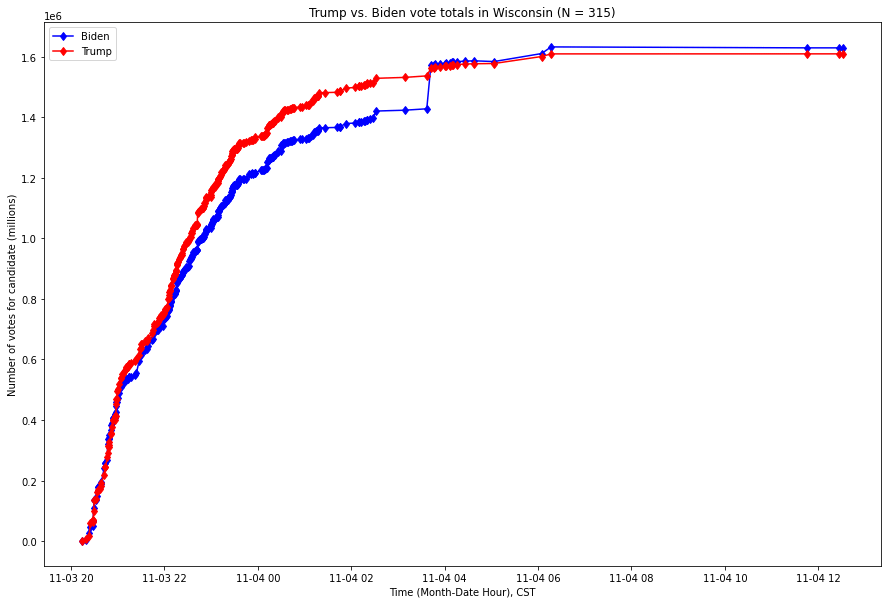
President Trump gave a speech last night alleging that outside actors have been interfering in American elections. His opponents will disagree and claim that the president wants to use this argument to cheat in future elections. Historians will have the final answer on the 2020 election and whether our country’s elections are being manipulated, but one thing is true. There has never been an explanation for the unusual vote count shifts observed in multiple states on Election Night, November 3, 2020. Whether you believe him or not, the president’s claim of outside interference is a plausible explanation for what happened in 2020.
The SAVE America Act, which the President supports, would address some of these issues, but the Senate refuses to even bring it up for a vote for some reason, despite overwhelming support from the American people. President Trump will attempt to make election integrity improvements by using an executive order, but he will have a difficult time achieving any meaningful long-term reform. One argument the Democrats will use to oppose him is by saying that Trump is going to take away the voting rights of minorities and women. Saying his attempts to remove non-citizens from voter rolls will inevitably result in some citizens also getting removed, which will impact minority and immigrant communities the most. In the court of public opinion, the Democrats might find support for this line of thinking.

The fundamental issue of these competing election integrity arguments comes down to what compromises we are willing to make to ensure that every adult citizen in this country votes. Democrats want every vote they can get and are willing to accept some weakness in our election system to get all votes counted. If a few ineligible votes are counted, that doesn’t seem to matter much to them. President Trump only wants eligible citizens to vote and is willing to make it more difficult to do so to ensure election integrity.
To help us evaluate these contrasting opinions, we need to understand the history of voting in this country and how we got to the current understanding of voter rights.
Many people don’t know it, but when our country was founded, very few citizens were eligible to vote. Voting was only permitted for property-owning white men above the age of 21. Non-property owners, most ethnic minorities, and women were excluded. However, a few free black men could vote in northern states, but only if they were property owners. This resulted in a relatively small percentage of the population being allowed to vote. In early elections in this country, only about 6% of the population voted.
Over the years, voting rights were expanded so that by 1971, all citizens in this country, of all ethnicities and genders over the age of 18, were allowed to vote. Basically, if you were an adult citizen who was a non-felon, you could vote in state and federal elections.
However, pendulums always swing too far, and that moment came with the passage of the National Voter Registration Act of 1993 (NVRA). This act, sometimes called the motor/voter act, required states to offer voter registration at DMV offices, public assistance offices, disability service agencies, and by mail. Here in Alaska, we suffered a double whammy. In 2016, a referendum was approved that automatically registered people to vote when they applied for a Permanent Fund Dividend.
Opponents say that these laws cast a broad net that often registered people to vote who were not citizens, such as green card holders and illegal immigrants. Today, Alaska has more registered voters on its voter rolls than there are eligible adults living in this state, a physical impossibility, which would seem to prove the point. If every voter on the Alaska voter rolls voted, we would have 108% of the votes we should have. Something is obviously wrong with this picture.
Critics of automatic motor-voter and PFD registration claim that even though these laws inflated voter rolls, it hasn’t really improved voter turnout for elections, except in one area, that of absentee mail-in voting. Last night, the President alleged that this form of voting contains a significant potential for illegal votes from ineligible voters, which could sway election results.
This problem isn’t just limited to Alaska. Other states also have more registered voters than they have eligible adults living within their borders. This isn’t just some simple accident caused by the motor/voter legislation or the automatic PFD registration. Those extra voters are intentional for some reason and could be used to obtain absentee ballots used to steal elections. The only way to ensure fair elections is to require voter ID at the polls on election day, and when someone picks up an absentee ballot, something the SAVE America Act requires. When Senators, including Alaska’s Senator Murkowski, oppose the SAVE America Act, they are derelict in their duty, and you have to wonder why. The only explanation must be that they benefit from cheating in elections somehow.
The President has a tough fight ahead of him in attempting to improve election security, but it is a fight worth making, and I hope he is successful.
Greg Sarber is a lifelong Alaskan. He is a petroleum engineer who spent his career working on Alaska’s North Slope. Now retired, he lives with his family in Homer, Alaska. Greg is a former board member of Alaska Gold Communications, Inc., the publisher of Must Read Alaska.



