
The following article was originally published in the author’s personal Substack on June 4, 2026.
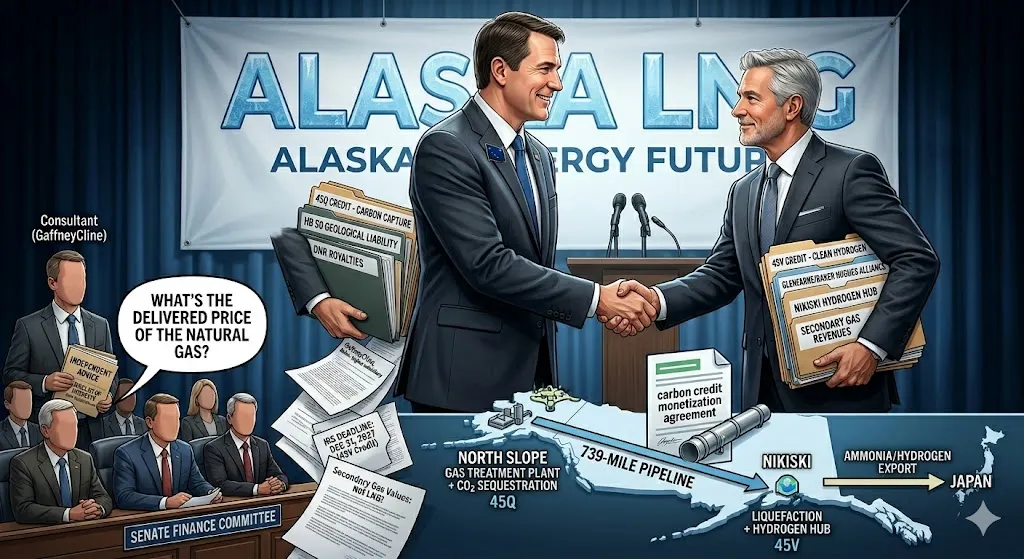
On May 27, 2026, Nicholas Fulford, Senior Director for LNG and Energy Transition at GaffneyCline, appeared before the Alaska Senate Finance Committee as the state’s hired independent adviser on the Alaska LNG project. He delivered a two-hour presentation on behalf of Baker Hughes. GaffneyCline is a Baker Hughes subsidiary that had already announced a corporate alliance with Glenfarne, the project’s majority developer, before Fulford’s first legislative appearance of the session.
In the course of that presentation, Fulford told the committee something that should have stopped the hearing in its tracks. Natural gas, he said, ‘is not the driver.’ It ‘is not worth much.’
“Natural gas is not the driver. It is not worth much.” Nicholas Fulford, GaffneyCline, Senate Finance Committee, May 27, 2026
Source: SB 2001 Special Session SFIN Hearing 1, May 27, 2026, GaffneyCline presentation, slide record

No senator asked the obvious question: if natural gas is not the driver of a project being sold to Alaskans as a natural gas pipeline, what is?
That question is not a mystery. The answer is in the public record, distributed across legislative testimony, federal tax statutes, DOE grant applications, and the governor’s own trade mission statements. The answer has never been put directly to the project’s developer, its consultant, or its political sponsor in any public hearing. Not once.
The documentary record shows what this project actually is, why the legislature’s 30-day clock was set by an IRS deadline rather than an LNG market window, and why Alaskans are being asked to set a permanent tax rate for a project whose primary revenue streams were never disclosed to the body being asked to set that rate.
I. The Adviser Who Served Two Masters
GaffneyCline has presented to both chambers of the Alaska Legislature as the state’s independent energy consultant on the AKLNG project. Every presentation, from Senate Resources in March 2026 through the May 27 Senate Finance hearing, carries the standard independence disclaimer: GaffneyCline ‘is not aware that any conflict of interest has existed.’
The disclaimer is technically precise and substantively misleading. Every GaffneyCline document also discloses, in a separate section, that GaffneyCline is ‘an indirect wholly owned subsidiary of Baker Hughes Company, a global energy technology company that owns and operates other businesses that provide products and services to customers within the energy sector.’
Baker Hughes announced a strategic alliance with Glenfarne before GaffneyCline’s first appearance before a legislative committee. Baker Hughes is not a passive parent company with no interest in AKLNG. It is a major oilfield services and LNG technology company whose strategic partnership with the project’s majority developer creates an alignment of financial interest that no information barrier inside a single corporate family can fully neutralize.
► Has any committee chair asked Fulford, on the record, to describe the commercial relationship between Baker Hughes and Glenfarne, and to explain how that relationship does not constitute a conflict for the state’s independent adviser?
That question has not been asked. The legislature has continued to treat GaffneyCline testimony as independent analysis. It is Baker Hughes analysis. The state is paying for advice from a subsidiary of a company that has a strategic alliance with the developer those advisers are being asked to evaluate.
II. What Fulford Actually Said on May 27
The GaffneyCline presentation to Senate Finance on May 27 contained a slide on carbon capture that deserves more attention than it received in the press coverage of that hearing. The slide stated the following, verbatim from the presentation record:
“Combination of federal tax credits (45Q) and customer demand for lower carbon LNG provides an economic driver. For a 7 million tonne carbon capture plant, at $85/tonne of tax credit, the benefit to AK LNG could be up to 60c/MMBtu of delivered LNG over 12 years. [7 million tonnes of CO2 at $85/tonne = $595m per annum, divided into 1 billion therms of LNG = $0.60 per MMBtu.]”
Source: SB 2001 Special Session SFIN Hearing 1, 27 May 2026, GaffneyCline, Carbon Capture slide
Read that number carefully. A carbon capture facility generating 45Q credits would produce $595 million per year in federal tax credits flowing to the project operator. Fulford placed that figure in the same sentence in which he characterized natural gas as ‘not the driver’ and described the project’s value as residing in ‘secondary gases’ he declined to identify by name.
The DOR’s own SB 280 modeling projects total annual AVT revenue to the state under the proposed $0.25/mcf rate structure at approximately $610 million at full capacity. The 45Q credit stream alone approaches that figure. The difference is that the $610 million in AVT flows to Alaska. The $595 million in 45Q credits flows to Glenfarne as project operator.
The 45Q credit stream Fulford quantified on the record, $595 million per year, flows to Glenfarne. Not to Alaska. Alaska receives injection royalties the state itself estimated at $2.50 per ton, yielding approximately $17.5 million annually.
Source: HB 50 legislative record; DOR fiscal note analysis; GaffneyCline SFIN presentation May 27, 2026
► Why has no committee asked Fulford to identify the ‘secondary gases’ he referenced as the project’s actual value driver, and to describe what portion of project revenue they represent?
► Why has no committee asked for a complete accounting of federal tax credit streams, 45Q and 45V, flowing to Glenfarne over the life of the project, compared against Alaska’s projected revenue under the proposed AVT structure?
III. The 45V Question Nobody Asked
The 45Q carbon capture credit is documented in Fulford’s own presentation. What Fulford did not address, and what no committee has asked about, is the Section 45V Clean Hydrogen Production Tax Credit.
The 45V credit was established by the Inflation Reduction Act. It pays up to $3.00 per kilogram of clean hydrogen produced, on a tiered scale based on lifecycle carbon intensity, for the first ten years of a qualifying project. Projects must begin construction before the statutory deadline to qualify.
The One Big Beautiful Bill Act, signed July 4, 2025, moved that construction commencement deadline from January 1, 2033, to December 31, 2027.
The Alaska Legislature’s SB 280, in Section 45 of the enrolled version, establishes a failure contingency: the AVT and property tax exemption repeal if ‘construction of a natural gas pipeline has not begun by January 1, 2028.’
The federal 45V construction deadline is December 31, 2027. The Alaska AVT sunset is January 1, 2028. These are the same deadline. The 30-day special session clock was set by IRS tax credit rules, not by a closing LNG market window.
Source: One Big Beautiful Bill Act, Pub. L. 119-21, enacted July 4, 2025; SB 280 Version G, Section 45; SB 2001 enrolled text
The AGDC submitted a concept paper to the U.S. Department of Energy in November 2022, formally titled the Alaska Hydrogen Hub proposal. That document describes an integrated hydrogen production facility at Nikiski based on Steam Methane Reforming of North Slope gas delivered via the AKLNG pipeline, with carbon dioxide captured and sequestered in Cook Inlet reservoirs to qualify for 45V clean hydrogen status. The document identifies AGDC as the prime applicant and estimates hydrogen production at 610 to 1,565 metric tonnes per day.
The ACEP Alaska Hydrogen Opportunities Report, published April 2024 by the University of Alaska Fairbanks with DOE Arctic Energy Office funding, estimates that producing 500,000 metric tonnes of clean hydrogen annually at Nikiski could generate up to $1.5 billion per year in 45V credits.
► Has any committee asked Glenfarne or AGDC whether the AKLNG project is intended to qualify for 45V clean hydrogen production credits at the Nikiski terminal, and if so, what the projected annual value of those credits is over the 10-year qualifying window?
► Has any committee asked whether the January 1, 2028 construction commencement requirement in the legislation was written to track the federal 45V construction deadline established by the One Big Beautiful Bill Act?
Neither question has been asked in public session.
IV. Japan Didn’t Sign Up for LNG
Governor Dunleavy has made multiple trade missions to Japan since 2019. The Japan missions are presented to the public as LNG sales efforts. The documentary record shows something more specific.
During the June 2022 Japan mission, the governor’s office stated the delegation met with JERA, the Japanese Ministry of Economy Trade and Industry, Japan Bank for International Cooperation, Tokyo Gas, TOYO Engineering, Mitsubishi, and Chiyoda. The stated agenda covered ‘procurement of Alaska’s natural gas and assessment of the state’s potential to export new sources of fuel.’ AGDC President Frank Richards told Senate Resources that the same reasons enabling LNG from Nikiski fifty years ago would enable the clean hydrogen industry in Alaska.
The governor stated publicly that the proximity of the LNG terminal to the idled fertilizer factory in Nikiski ‘raised the possibility of converting North Slope natural gas into ammonia, which is hydrogen bonded to nitrogen from air.’
JERA, Japan’s largest power producer, signed a non-binding letter of intent with Glenfarne in September 2025. In the same quarter, JERA reached final investment decision on the Blue Point low-carbon ammonia production facility in Louisiana, receiving certification under Japan’s government price-gap support scheme as a supplier of low-carbon hydrogen and derivatives. JERA’s stated strategic objective is to supply 7 million tonnes of ammonia annually by 2035, moving thermal power generation to 100 percent ammonia substitution by the 2040s.
Bloomberg reported directly on why Japanese utilities are signing non-binding Alaska LNG agreements: ‘Preliminary gas offtake deals with Alaska LNG allow Japanese companies to demonstrate commitment to the wider trade package without entering a binding procurement contract.’
The LOIs from Japanese buyers are diplomatic placeholders in a government-to-government trade package. The actual commercial product JERA needs is certified low-carbon ammonia with a documented CCS chain. That is exactly what the Nikiski hydrogen hub architecture produces.
Source: Bloomberg, October 2025; JERA press releases December 2025 and March 2026; Petroleum News, June 2022; AGDC H2Hub Concept Paper, November 2022
► Has any committee asked Glenfarne whether the revenue model for the Nikiski terminal is based on LNG export, clean hydrogen production, ammonia export, or some combination, and in what proportions?
► Has any committee asked what ESG documentation Japanese offtake partners require as a condition of binding purchase agreements, and whether that documentation requires CCS certification under their domestic Hydrogen Society Promotion Act?
V. The Gas Treatment Plant Is in the Wrong Place for Gas
The Gas Treatment Plant is the $10.9 billion facility proposed for the North Slope. GaffneyCline’s own analysis in the May 27 presentation notes that the GTP ‘will require growing processing capability to remove CO2,’ and that ‘many are investing in CCS due to customer demand.’
The North Slope siting of the GTP is presented as an engineering necessity. It is not. Pipeline-quality gas treatment can be achieved at a fraction of the cost using existing infrastructure at or near Prudhoe Bay. The choice to site a $10.9 billion treatment plant at the North Slope, at the origin of the gas stream rather than at the terminal end, is driven by the geographic requirement of the 45Q credit: carbon must be captured at a qualifying facility and injected into a qualifying geologic formation. The North Slope sits above one of the largest assessed CO2 sequestration zones in the United States, estimated by the USGS at 270,000 million metric tonnes in the North Slope basin alone.
The Cook Inlet is separately estimated at 4,330 million metric tonnes of CO2 sequestration capacity in the Hemlock Formation alone, per the AGDC H2Hub application. Both formations are named in the 45Q qualifying geography under HB 50, which the Alaska Legislature passed in 2023 establishing the legal framework for Class VI injection well permitting.
HB 50 built the legal foundation for federal carbon credit monetization in 2023. The AKLNG GTP siting on the North Slope completes the geography. The pipeline connects the two revenue streams. The LNG export fills out the narrative.
Source: USGS CO2 sequestration assessments; AGDC H2Hub Concept Paper, November 2022; HB 50 DNR presentations; GaffneyCline SFIN May 27, 2026
► Has any committee asked why the Gas Treatment Plant is sited on the North Slope rather than at a midpoint or southern terminal, and whether that siting was driven by 45Q credit geography rather than engineering economics?
► Has any committee asked what the cost difference would be between North Slope GTP siting and pipeline-quality treatment at existing Cook Inlet infrastructure, and what that difference implies about the project’s actual economic purpose?
VI. The Cost Nobody Verified
On June 4, 2026, Glenfarne released a public cost range for the first time during the special session: $44.5 billion to $54.5 billion. Governor’s allies declared the disclosure a breakthrough. Senator Myers posted that Alaskans finally have the numbers they need.
The Department of Revenue had been using $46.2 billion in its fiscal modeling since the first regular session hearings. That figure came from GaffneyCline analysis based on the same pre-FEED engineering work completed nearly a decade ago. Glenfarne’s newly released range does not represent new engineering. Its lower bound is below the number Alaska’s own revenue department was already using. Its upper bound reaches $54.5 billion, still well below the $58 billion midpoint estimated by Rapidan Energy Group using current LNG construction cost benchmarks of $1,800 to $2,200 per tonne applied to a 20 MTPA facility in this geography.
What the legislature still does not have: the engineering basis for the $44.5 to $54.5 billion range, the class designation of the estimate, the contingency methodology, or any independent verification. GaffneyCline’s own basis of opinion section in every document states that ‘GaffneyCline has not independently verified any information provided by, or at the direction of, the State of Alaska and/or obtained from other sources.’
► What cost estimate class is the $44.5 to $54.5 billion figure, and what engineering basis supports it?
► Has the Legislature engaged any cost estimator with no corporate relationship to either Glenfarne or AGDC to independently assess whether the project cost falls within the range being used to set permanent tax rates?
Setting a permanent volumetric tax rate without a verified project cost is not fiscal conservatism. It is fiscal negligence. A tax rate is a ratio. You cannot set a ratio when you cannot verify the denominator.
VII. What Alaskans Are Actually Being Asked to Do
The legislative record is clear on the financial consequence of the proposed tax structure. Under current law, the state was projected to receive $8.4 billion in pipeline property taxes by 2042. Under the governor’s original proposal, that figure fell to $829 million, a reduction of $7.6 billion. Local governments faced a corresponding reduction from $5.7 billion to $728 million.
That reduction in Alaska’s revenue corresponds, dollar for dollar, with an increase in Glenfarne’s ability to service debt and generate returns for its investors. Partners Group of Switzerland and other institutional capital hold the upside. The AVT structure does not make the project more Alaskan. It makes it more financeable for foreign capital.
Meanwhile, Alaska retains the geological liability. HB 50 established that after a 50-year post-injection period, permanent monitoring of sequestered CO2 transfers to Alaska taxpayers with no hard cost cap. The Castle Mountain Fault runs through the Cook Inlet sequestration zone. The region has historical seismicity including M7.0 events. The trust fund established under HB 50 to cover long-term monitoring stops collecting contributions after 12 years. The CO2 stays underground indefinitely.
Alaska gives permanent geological liability in exchange for participation in a federally controlled revenue stream Alaska does not control. The legislature built a permanent house on a rented foundation.
In-state gas is not cheap under this project. GaffneyCline’s own Phase 1 analysis shows that at 300 MMscfd throughput, delivered gas prices range from $25 to $35 per MMBtu under realistic capital cost scenarios. The $12/MMBtu cap in SB 280 is a rate subsidy mechanism, not a market outcome. Someone absorbs the cost difference between the capped rate and the actual cost of service. Under the current structure, that someone is the project’s financiers, or the Alaskan public through reduced state revenue and accepted geological risk.
The jobs claim is similarly imprecise. Large-scale remote construction on a 739-mile permafrost pipeline across multiple fault zones, with a compressed timeline, is built by experienced EPC workers, most of whom will come from outside Alaska. The Coastal GasLink precedent in Canada is instructive: that comparable project, initially priced at CAD $6.2 billion, ended up costing approximately CAD $15 billion, and sustained extended disputes over local hiring. Alaska has no binding local hire requirement in the current legislation.
VIII. The Questions That Remain on the Table
The special session has 30 days. The Senate Finance Committee has held substantive hearings. The Senate has maintained institutional discipline that the House has not. But even the Senate has not asked the questions the documentary record demands.
These are not hostile questions. They are the questions any fiscally responsible legislature must answer before setting permanent tax policy on a project of this scale:
► Fulford testified that natural gas is not the project’s primary value driver and that value resides in undisclosed ‘secondary gases.’ What are those secondary gases, and what is the projected annual revenue from each over the project’s life?
► What is the projected annual value of 45Q carbon capture credits flowing to Glenfarne as project operator, and what percentage of total project revenue does that stream represent versus LNG export revenue?
► Is the Nikiski terminal designed to qualify for 45V clean hydrogen production credits, as described in the AGDC H2Hub concept paper submitted to DOE in November 2022? If so, what is the projected annual value of those credits over the 10-year qualifying window?
► The legislation requires construction commencement by January 1, 2028. The One Big Beautiful Bill Act moved the 45V construction deadline to December 31, 2027. Was the legislative deadline written to track the federal tax credit deadline? If not, what was it based on?
► GaffneyCline is a wholly owned subsidiary of Baker Hughes, which has announced a strategic alliance with Glenfarne. What steps has the legislature taken to obtain independent cost and revenue verification from a firm with no corporate relationship to either party?
► What binding documentation do Japanese offtake partners require to sign purchase agreements, and does that documentation require CCS certification under Japan’s Hydrogen Society Promotion Act? Has any state agency reviewed those requirements?
► After the 45Q and 45V credit windows close (12 years and 10 years respectively), what is Alaska’s projected revenue from the project, and what is Glenfarne’s projected revenue? Is the state’s fiscal position better or worse post-credit than it was before the property tax was eliminated?
IX. What Fiscal Conservatism Actually Requires
Supporting resource development is a Madisonian position. The North Slope has gas. Alaska has geology. There is a legitimate case for building the infrastructure to monetize both. That case does not require anyone to be corrupt, naive, or dishonest.
The case for the project as currently structured has not been made. Permanent property tax elimination, permanent geological liability acceptance, no independent cost verification, no disclosed federal tax credit accounting, a consultant with an undisclosed corporate conflict, and a 30-day legislative clock keyed to an IRS deadline nobody named in public testimony: those are the terms on offer. They have been asserted, loudly, by people who benefit from the assertion.
The legislature’s job is not to feel good about a project. It is to protect the public interest with specificity. The Senate Finance Committee has asked better questions than any prior committee this session. But the most important questions have not yet been asked, and the session clock is running.
If the bill passes without answers to the questions above, Alaska will have set a permanent tax rate for a project it does not understand, accepted permanent geological liability for a revenue stream it does not control, and done so under the advice of a consultant whose parent company has a strategic interest in the outcome.
That is not a gas pipeline deal. That is a carbon credit monetization agreement with a pipeline attached. Alaskans deserve to know which one they are approving.
Dana Raffaniello is a network engineer, and Mat-Su Borough Assembly District 2 candidate based in Palmer, Alaska. He publishes at raff6482.substack.com.
Primary sources used in this article include: GaffneyCline SB 2001 SFIN presentation May 27, 2026; GaffneyCline HB 381 House Resources presentation April 1, 2026; GaffneyCline SB 275 Senate Resources presentation March 18, 2026; GaffneyCline Key Issues Legislative Policy Options December 2025; DOR SB 280 presentations; AGDC H2Hub Concept Paper DOE FOA-0002779, November 2022; ACEP Alaska Hydrogen Opportunities Report, April 2024; SB 280 Version G and H enrolled texts; One Big Beautiful Bill Act, Pub. L. 119-21; HB 50 legislative record; Rapidan Energy Group Alaska LNG analysis, June 2025.



