For the “First Friday” art walk in Juneau last week, the Third Floor of the Capitol was open with a new item of art on display outside the office of the lieutenant governor, and Lt. Gov. Byron Mallott highlighted it with particular pride.
The work in question is a large photograph of the Tongass People’s “shaming totem” of a former U.S. secretary of state, with a few artistic liberties taken by the photographer to add insult to injury: The ears are unnaturally red, the mouth is exaggerated, and the lighting is ghoulish.
The totem mocks Secretary of State William Seward, who orchestrated the 1867 purchase of Alaska from Tzarist Russia. The real totem was recently replaced in Saxman (a Native village near Ketchikan) after the previous two rotted.
But Seward evidently insulted coastal Alaska Natives by not reciprocating a potlatch they had held in honor of the visiting dignitary over 150 years ago.
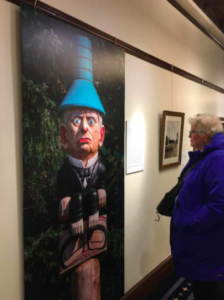
According to KINY radio, Mallott says that the totem is an admonishment to visitors that all people should be treated with respect.

Mallott told the radio station that the insult remains all these years later.
“There has been a lack of closure and I think the Seward Pole kind of represents that in a very clear, powerful way. But it is not a closure people are sitting around waiting for. People are continuing to grow and develop and create lives and our own history and our own society as Alaskans all, in this place. But it is appropriate, I think, to continue these conversations to work toward having respect for every single Alaskan.”
Respect for William Seward is evidently not warranted in Mallott’s view, but Seward was a towering figure for civil rights, who was not only instrumental in the acquisition of the Alaska Territory, but was a lifelong activist who freed many slaves at great personal and professional risk.
Seward and his wife Frances were ahead of their times for social justice causes, especially abolition. Their home was a safe house along the Underground Railroad, which passed fleeing slaves along to freedom in the north.
Seward became an abolitionist at an early age, influenced by his interactions with the slaves working in his family home, whom he found to be engaging, intelligent, and moral.
His activism continued throughout his life and he risked political power for the cause of emancipation. His speeches and writings are widely documented.
However, his lack of understanding about the culture of potlatches and the tradition of reciprocating them led to a grave insult taken by the tribe, and thus the subsequent erection of a totem in Saxman. On it, Seward was depicted with white face paint and red “ashamed” cheeks.
The two earlier totems rotted with time and rain, and a new one has been completed. They have continued to memorialize Seward’s faux pas of so many years ago.
A large photograph of the totem now reminds every visitor to the Office of the Governor that respect should be given, or else there will be a price to pay. Because some insults can just never be forgiven.