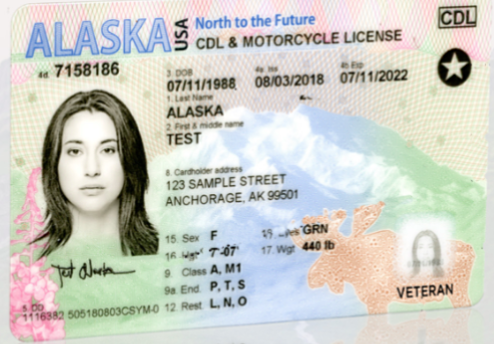
AVAILABLE IN JANUARY, MANDATORY IN 22 MONTHS
It’s going to be a busy year at the DMV in 2019.
The new driver’s licenses, which are compliant with the federal Real ID requirements, are being made available Jan. 2. And you’ll need to get your entire ID act together in order to get one.
Alaska’s Division of Motor Vehicles released the redesign of the Alaska driver’s license and ID cards earlier this month The new IDs are made of polycarbonate and have higher-level protections against counterfeiting.
Polycarbonates are tough materials that are engineered plastic that has the ability to house complex optical features, is high impact-resistant and doesn’t scratch easily, making them well-suited for scraping ice. Some of the ink used on the new license changes colors as you move it in the light.
Veterans will also have the opportunity to have their designation on the front of the license or ID card.
Starting Oct. 1, 2020, Alaska residents will need to present a REAL ID compliant license/ID, or another acceptable form of identification, for accessing federal facilities, entering nuclear power plants, and boarding commercial aircraft.
However, to get a REAL ID card, you’ll not just be trading in your old driver’s license or ID. You must present one identity document, which shows your date of birth, true full name, identity and U.S. citizenship or lawful status, such as a passport or birth certificate.
The State of Alaska Real ID checklist is available at this link.
Getting the new Real ID might be costly for those who don’t have passports already, or for those who are not in possession of their birth certificate or other documentation. Passports cost about $145; Alaska birth certificates cost about $30. The driver’s license itself is $20. If you need a birth certificate and a new license, you’ll be out $50.
At the time the Real ID act was passed in 2005 and standardized enhanced identification across the states, it was criticized as a form of national ID, something privacy advocates and civil libertarians say is unconstitutional, because identification should be the province of the states, not the federal government.
[Read: Cato Institute discussion of the issues with Read ID]