The NCAA quietly updated its policy for transgender athletes on Wednesday. For college competition, it will use the same model as the U.S. and International Olympic Committees, which have a sport-by-sport policy.
Effective immediately, transgenders who compete as women in women’s college-level sport competitions will be governed by the national governing body of that specific sport. If there is no international federation policy, the IOC policy will be applied.
So far, women who are transitioning their appearance to appear and live as men are not an issue because they typically don’t try to compete in mens categories. But after University of Pennsylvania transgender swimmer Lia Thomas set records in swimming, athletes, parents, coaches, and the public began questioning the NCAA policy.
As of the new policy on Wednesday, biological men who are modifying their appearance to present as women will be required to meet a testosterone standard a month prior to the sport’s championship roster selections.

The ruling could affect whether Thomas can continue to compete. Until age 19, Thomas had been competing in the boys and mens swimming competitions. Thomas, who has the burly physique of a man, then switched over to compete as a woman. Thomas would have to have a testosterone level below 10 mol/L for 12 consecutive months prior to a competition and remain below that threshold throughout a period leading up the competition in a female category in any USA Swimming event.
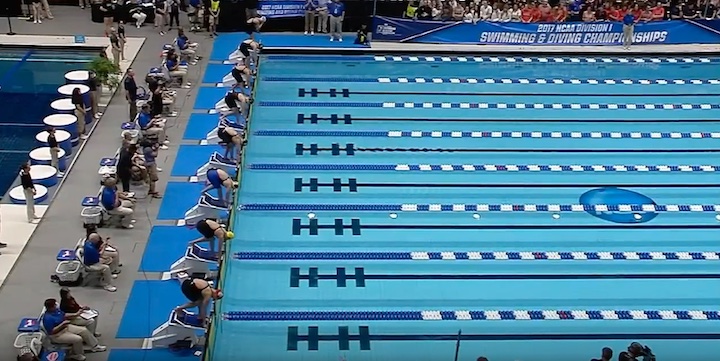
The NCAA women’s swimming and diving championships take place in March.
The NCAA Board of Governors made the decision at its conference, now underway in Indianapolis. The organization did not post the new policy on its front page, but buried it in under its “About” tab, located at the bottom of the page. The full statement is as follows:
“The NCAA Board of Governors on Wednesday voted in support of a sport-by-sport approach to transgender participation that preserves opportunity for transgender student-athletes while balancing fairness, inclusion and safety for all who compete. The new policy, effective immediately, aligns transgender student-athlete participation for college sports with recent policy changes (PDF) from the United States Olympic and Paralympic Committee and International Olympic Committee.
“Like the Olympics, the updated NCAA policy calls for transgender participation for each sport to be determined by the policy for the national governing body of that sport, subject to ongoing review and recommendation by the NCAA Committee on Competitive Safeguards and Medical Aspects of Sports to the Board of Governors. If there is no NGB policy for a sport, that sport’s international federation policy would be followed. If there is no international federation policy, previously established IOC policy criteria would be followed.
“The Board of Governors urged the divisions to provide flexibility to allow for additional eligibility if a transgender student-athlete loses eligibility based on the policy change provided they meet the newly adopted standards.
“The policy is effective starting with the 2022 winter championships. Transgender student-athletes will need to document sport-specific testosterone levels beginning four weeks before their sport’s championship selections. Starting with the 2022-23 academic year, transgender student-athletes will need documented levels at the beginning of their season and a second documentation six months after the first. They will also need documented testosterone levels four weeks before championship selections. Full implementation would begin with the 2023-24 academic year.
“We are steadfast in our support of transgender student-athletes and the fostering of fairness across college sports,” said John DeGioia, chair of the board and Georgetown president. “It is important that NCAA member schools, conferences and college athletes compete in an inclusive, fair, safe and respectful environment and can move forward with a clear understanding of the new policy.”
“Approximately 80% of U.S. Olympians are either current or former college athletes,” said Mark Emmert, NCAA president. “This policy alignment provides consistency and further strengthens the relationship between college sports and the U.S. Olympics.”
“Additionally, the NCAA’s Office of Inclusion and the Sport Science Institute released the Gender Identity and Student-Athlete Participation Summit Final Report (PDF). The report assists ongoing membership efforts to support inclusion, fairness, and the mental and physical health of transgender and non-binary student-athletes in collegiate sport.”