The federal budget is in worse shape than the government is admitting, according to an analysis from a federal budget watchdog group that downgrades the nation’s economic outlook.
“The nation’s fiscal and economic outlook has deteriorated substantially since the last Congressional Budget Office (CBO) baseline in May, when CBO projected debt would reach a record 110 percent of Gross Domestic Product (GDP) by 2032. Under an updated current law baseline, we now project debt in 2032 will reach 116 percent of GDP, deficits will reach 6.6 percent of GDP, and interest will reach a record 3.4 percent of GDP. Under a more pessimistic (and in many ways realistic) scenario, debt in 2032 would reach 138 percent of GDP, deficits would reach 10.1 percent, and interest would total 4.4 percent of GDP. These projections suggest an unsustainable fiscal trajectory,” wrote the Committee for a Responsible Federal Budget.
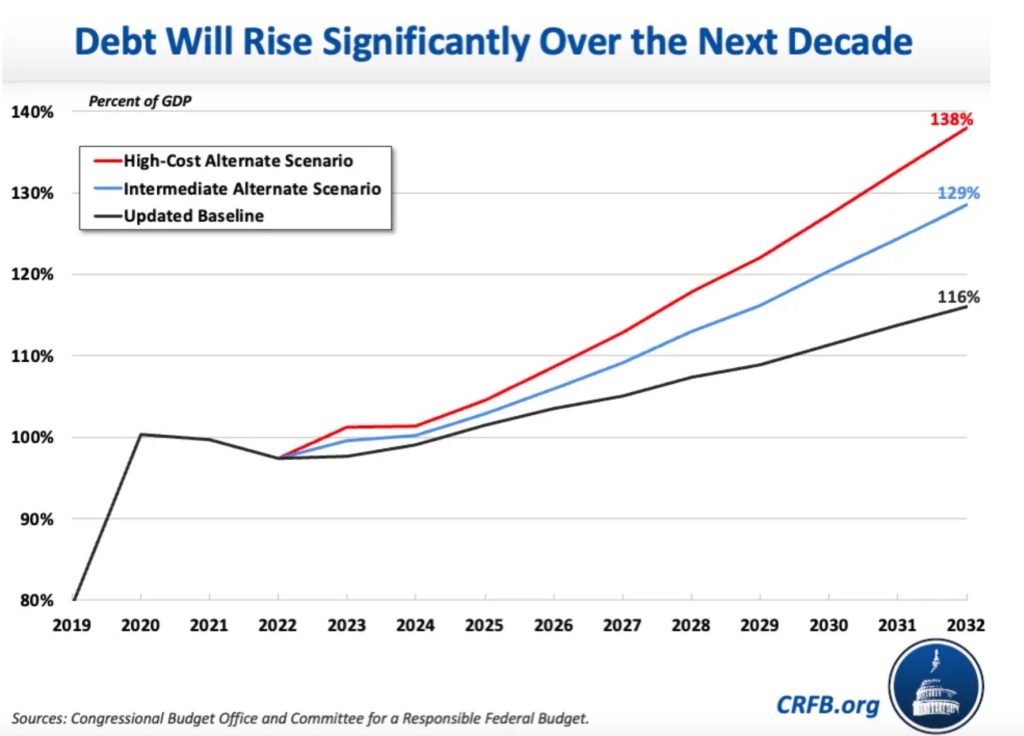
“Under a more pessimistic (and in many ways realistic) scenario, debt in 2032 would reach 138 percent of GDP, deficits would reach 10.1 percent, and interest would total 4.4 percent of GDP,” the watchdog group said. “These projections suggest an unsustainable fiscal trajectory”
The U.S. national debt has exceeded $31 trillion this year and consumer prices are up 9.1 percent over the year ended June 2022, the largest increase in 40 years, according to the Bureau of Labor Statistics.
“At the same time as inflation is surging and interest rates are rising, our new projections show that the United States faces an unsustainable fiscal outlook. Policymakers should come together and act quickly to put forward a plan that would help the Federal Reserve fight inflation in the near term while putting deficits and debt on a more sustainable long-term path,” the policy group wrote. “The CRFB Fiscal Blueprint for Reducing Debt and Inflation provides a framework to tame inflation, reduce recession risk, address expiring policies, stabilize the national debt as a share of output, grow the economy, secure trust funds, and improve fairness and efficiency in the budget and tax code.”
View the report, recommendations, and more charts at this link.