
By MICAH SHIELDS
On Alaska’s Kenai Peninsula, a case of staggering betrayal unfolded that should shake every parent, taxpayer, and public servant to the core.
Nathaniel Erfurth, now a former Soldotna High School teacher, was convicted this year on 28 felony counts, including 24 charges of second-degree sexual abuse of a minor. His crimes were not abstract. They were specific, sustained, and committed under the nose of a system that should have stopped him long ago.
According to the police affidavit, Erfurth and the minor would meet for private conversations at a tiny house on his own property, as his wife and child were at the main residence. During the trial, his wife insisted, “He genuinely thought he was helping.” (Sara Erfurth said in testimony- as reported by KSRM, July 29, 2025).
Perhaps more telling was the response from Erfurth’s colleagues and professional community. Even after the jury’s verdict, some in his professional community rushed, not to defend the victim or to reckon with their own complicity, but to lament that the conviction might give critics of public education more “ammunition.” It was a response that sidestepped any reckoning with the victim or the system’s failures.
It’s clear that Erfurth’s actions and the community’s response didn’t emerge in a vacuum. This is a case study in what happens when institutional loyalty trumps moral responsibility, when unions perpetuate a culture of victimhood and are structured to protect their members at all costs, even at the expense of children.
Kenai teachers union elects new president after sex-scandal
At the heart of the issue lies a fundamental conflict of interest: When public sector unions represent government employees, they are negotiating directly against the interests of the public they are supposed to serve. The original purpose of unions was to protect workers from exploitation by private employers. But in government, where employees serve the public and are funded by taxpayers, the dynamic changes. The governed become, in effect, the opposing party, and are portrayed as the oppressors.
Soldotna High teacher, who is also the KPEA union president, arrested for sexual abuse of minor
By tolerating this inversion, we tacitly agree with the narrative- that our teachers and administrators are oppressed by us. In doing so, we not only weaken the authority of the governed, but we also hand over our children to be raised within a worldview where accountability is the enemy. This hypocrisy strikes at the very heart of our national identity. As Americans, we declare ourselves to be a people “of the people, by the people, for the people, whose just powers are derived from the consent of the governed.” Yet by permitting unions to negotiate against the governed, we implicitly accept that the governed themselves are unjust oppressors.
This inversion of responsibility leads to a dangerous outcome: public servants, by accepting union protection, fundamentally see themselves- not as stewards of the public trust, but as victims of public scrutiny. As a result, complaints- like those reportedly first filed with local police in the Erfurth case- can be minimized, delayed, or quietly dismissed. And when the system fails, the unions often respond not by supporting reform, but by circling the wagons.
And when someone like Erfurth is convicted, it only reinforces that worldview: that even a teacher caught abusing students is too often treated as if he were a martyr, rather than held fully accountable as a predator.
This narrative isn’t accidental. It’s built into the DNA of organizations like the National Education Association. Bob Chanin, former general counsel for the NEA, made this explicit during his 2009 farewell speech, one that received a standing ovation from union leadership. He said:
“It is not because of the merit of our positions. It is not because we care about children, and it is not because we have a vision of a great public school for every child. NEA and its affiliates are effective advocates because we have power, and we have power because there are more than 3.2 million people who are willing to pay us hundreds of millions of dollars in dues each year… This is not to say that the concern of NEA and its affiliates with closing achievement gaps, reducing dropout rates, improving teacher quality, and the like, are unimportant or inappropriate… But they need not and must not be achieved at the expense of due process, employee rights, and collective bargaining. That simply is too high a price to pay.”
Let that sink in. Protecting union members takes priority over improving education, even over protecting children. When justice, safety, and learning collide with union power, union power wins.
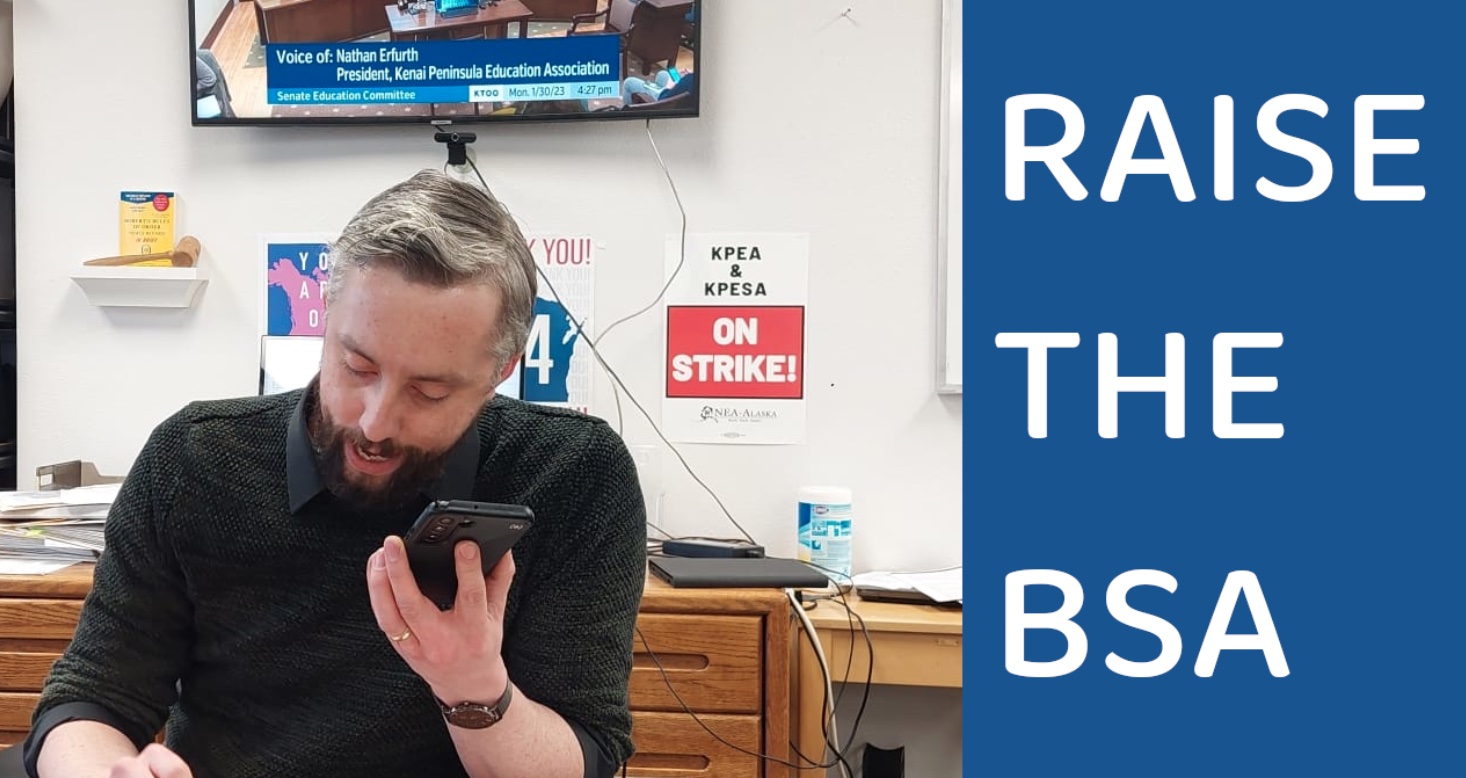
In this case, Erfurth wasn’t dismissed when the first concerns arose in 2016, or again in 2017. He was promoted, later becoming president of the Kenai Peninsula Education Association, the local teachers’ union, a role documented in KPEA’s public records.
Meanwhile, parents are voting with their feet, turning to homeschooling, correspondence programs, and charter schools in record numbers. Enrollment in correspondence programs alone has jumped from about 12,500 pre-pandemic to over 22,000 students today. This exodus is not just about curriculum or test scores; it’s a response to the fact that the system has been designed to alienate parents, with unions like the NEA openly, as seen in Chanin’s speech, positioning themselves against parental authority whenever it threatens union interests.
In response to this exodus, NEA-Alaska is currently suing to block correspondence school allotments, programs that give parents more control over their children’s education. Their message is clear: “We won’t reform, and we’ll attack your alternatives.”
The solution isn’t just better training or more oversight. Nothing but addressing the underlying issue will suffice. One option is to prohibit public sector unions from operating in roles where impartiality and accountability are essential. A more targeted approach would be to empower citizens to sue unions directly when their obstruction enables harm, whether it’s emotional distress, lost educational opportunities, or delayed justice.
When a union protects a predator, it becomes complicit. And the public should not be forced to fund its own betrayal.
Alaska’s children deserve better. They deserve schools that serve them, not institutions that protect themselves. This is not a partisan issue. It is a moral one.
It’s time to put students back at the center of public education and to remind government unions that power without accountability is not public service. It’s systemic corruption.
Micah Shields is a lifelong Alaskan, avid outdoorsman, husband, and father of four.


