
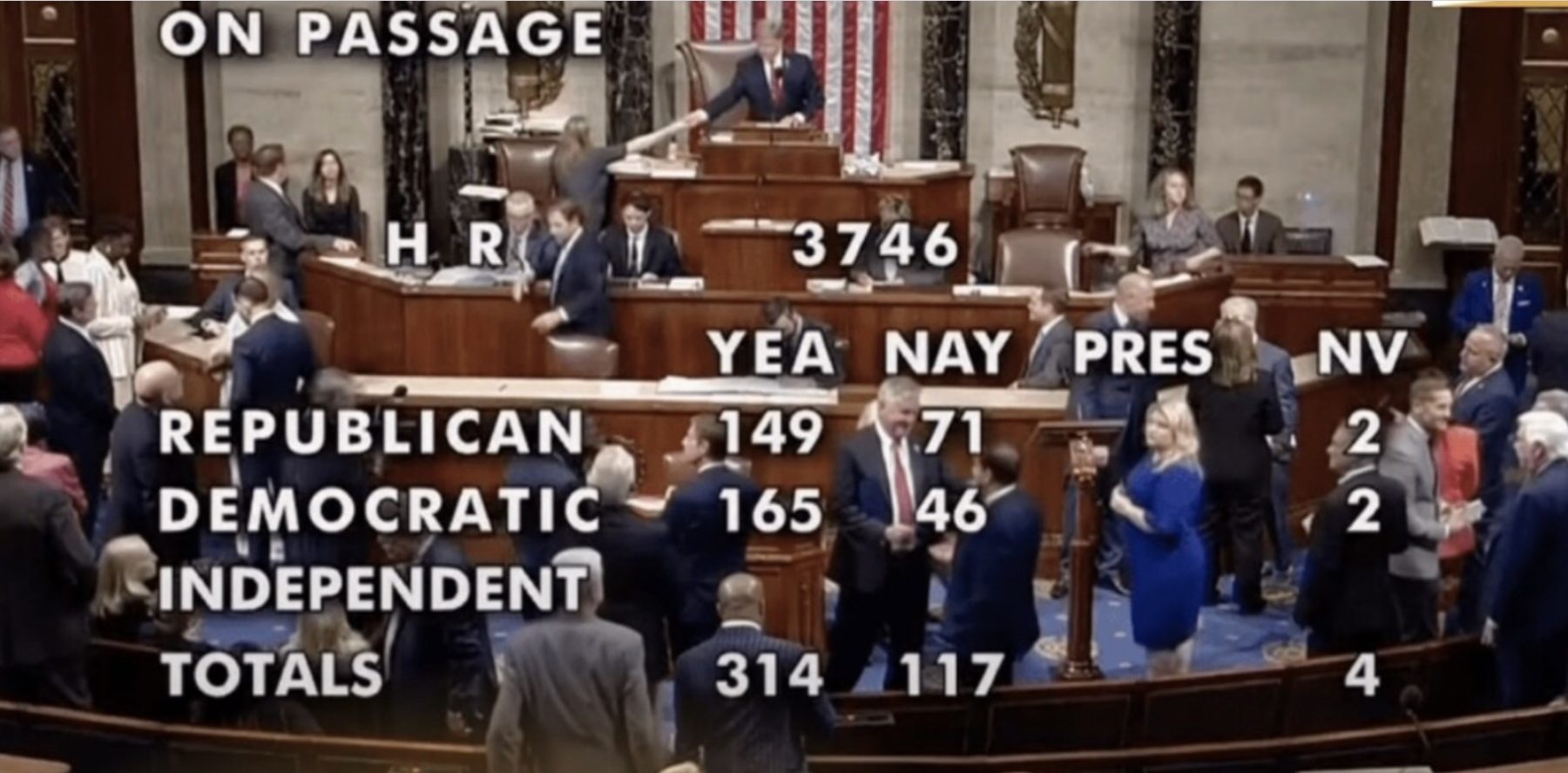
The U.S. House voted on Wednesday night to raise the debt ceiling — the amount that the U.S. Treasury can borrow to make ends meet in a government that is living far beyond its means.
The Fiscal Responsibility Act hammered out by President Joe Biden and House Speaker Kevin McCarthy, a Republican, passed the House 314 to 117, with more Democrat votes than Republican vote. Some 149 GOP voted for it, and 71 voted against it, saying it didn’t go far enough to rein in federal spending.
On the Democrat side, Rep. Mary Peltola of Alaska stayed with the 165 Democrats voting for the bill.
The bill suspends the current debt limit of $31.4 trillion until after the Nov. 5, 2024 presidential election, when 435 House seats and 33 of the 100 Senate seats will be on the ballot then.
Rep. Mike Lee, a Republican from Utah, was uncharitable toward the bill, calling it the ” “Biden-McCarthy Debt Expansion Act.”
“To those who thought this was a Republican bill, the numbers don’t lie: 165 Democrats voted for it, and only 149 Republicans joined them. Those voting against it included 71 heroic Republicans and only 46 Democrats,” he said.
The Fiscal Responsibility Act of 2023 claws back $30 billion of unspent Covid-19 funds; completely fund veterans medical care, and ends the pause in the repayment of student loans in August. Non-defense spending is flat for one year and then goes up by 1% in 2025.
At a press conference after the bill’s passage, McCarthy praised it:
“Each week, we have stood up for the American public. Be it a strongest border security, be it a parents’ bill of rights so you can have a say in your kid’s education, be it ending the pandemic or standing up against those who are weak on crime to make our streets safer,” McCarthy said. “Tonight, I hope we proved it to you again that we put the citizens of America first, and we didn’t do it by taking the easy way. We didn’t do it by the ways that people did it in the past by just lifting it. We decided that you had to spend less, and we achieved that goal.”
The measure now goes to the Senate, where Sen. Bernie Sanders is a no, and Sen. Joe Manchin is a yes, because the bill funds a natural gas pipeline in West Virginia.
The conservative group, American Heritage Action, disapproved of the bill.
“As a long-standing policy position, we have consistently called for dollar-for-dollar cuts and reforms commensurate with any debt ceiling increases. This bill does not do that. This bill suspends the debt ceiling until 2025, enabling President Biden and a divided Congress to generate an estimated $4 trillion in new federal debt,” the group wrote.
“This deal does not meet the moment, and it does not address the root problems that have led to nearly $32 trillion in national debt,” Heritage Action said. “As members of Congress continue the fight to rein in Washington’s spending addiction and prevent the country’s fiscal ruin, we remain committed to finding solutions to once and for all bend the spending curve down.”


