
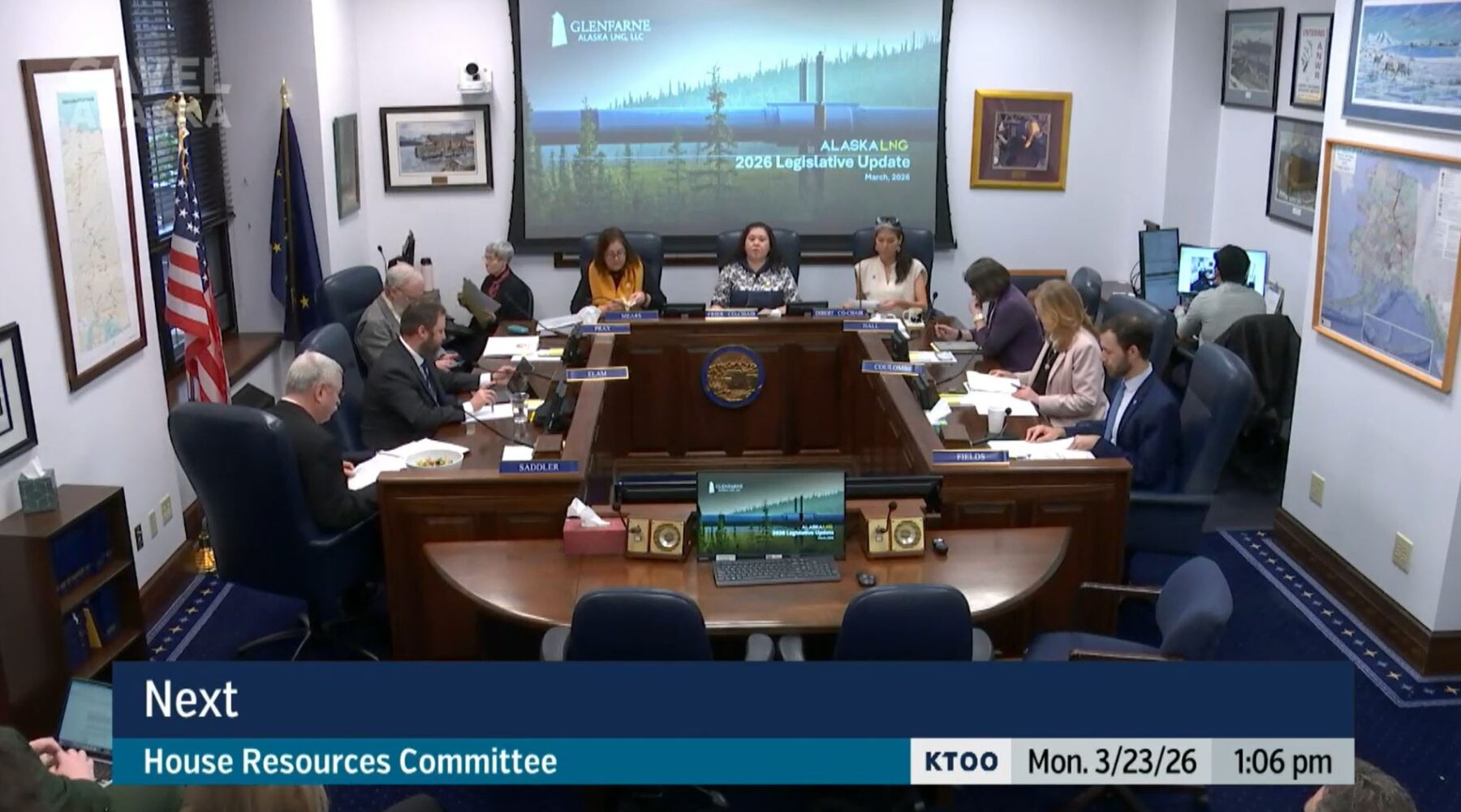
The House Resources Committee convened a dual-purpose session emphasizing Alaska’s economic foundations and future energy security. Lawmakers first advanced HJR 44, affirming support for Alaska Native Corporations’ participation in the SBA 8(a) program, before receiving a detailed update on the Alaska LNG project from developer Glenfarne.
Co-Chair Rep. Robyn Frier (D-Utiqgvik) called the meeting to order and shifted its agenda to prioritize HJR 44, a resolution from the Resources Committee itself. Sarah Snowberger, Chief of Staff to Co-Chair Rep. Maxine Dibert (D-Fairbanks), presented the measure. “HJR 44 affirms Alaska’s support for the ability of Alaska Native corporations and tribal entities to continue participating in the U.S. Small Business Administration 8(a) business development program,” she stated. Snowberger described the 8(a) program as a “cornerstone of economic self-sufficiency, community development and workforce growth,” particularly in rural areas. She noted that since ANCSA in 1971, ANCs have reinvested revenues into dividends, scholarships, healthcare, and infrastructure, supporting thousands of jobs and reversing historical economic outflows.
Nicole Borromeo, President of the ANCSA Regional Association, provided compelling testimony. In 2022 alone, regional ANCs generated $13.5 billion in total revenue, with $4.5 billion from Alaska operations, supporting nearly 25,000 jobs and over $6 billion in statewide economic activity—roughly 6% of state employment. “ANC success is built on performance,” Borromeo emphasized. She addressed national scrutiny, attributing concerns to misunderstandings rather than Alaska-specific issues. “The genesis of the concern is misguided and based on the misunderstanding that somehow Alaska Native corporations or tribal or government fall into diversity, equity and inclusion,” she clarified. Borromeo highlighted that entity-owned firms operate under statutory presumptions of economic disadvantage established by Congress, delivering value through competitive federal contracting while complying with strict oversight. Past issues identified in GAO reports were limited and addressed through SBA reforms, making the program a “model of effectiveness and efficiency.”
Committee members raised thoughtful questions reflecting caution. Rep. Mike Prax (R-North Pole) requested substantiating GAO reports and Missouri-related documentation for the record. Rep. Dan Saddler (R-Eagle River) sought data on the total value of 8(a) contracts awarded to ANCs since the late 1970s, noting the need for evidence to support the resolution’s claims. Snowberger committed to compiling available figures and providing requested materials. Despite procedural concerns about the bill’s rapid movement and the need for full documentation, the committee advanced HJR 44 with attached fiscal notes and individual recommendations after objections were withdrawn. The resolution urges Congress and the SBA to preserve Alaska Native participation, recognizing the program’s proven role in rural economic development without expanding federal mandates.
The session then shifted to an Alaska LNG project update. Adam Prestidge, President of Glenfarne Alaska LNG, and Mark Begich of Northern Compass Group joined Matt Kissinger of AGDC at the testifier table. Prestidge described the project as “one of the most important infrastructure projects in the entire world right now,” highlighting Glenfarne’s 75% joint venture stake secured nearly a year earlier. He stressed energy security for Railbelt communities facing Cook Inlet decline, job creation exceeding 7,000 during construction, and billions in economic activity. “Unless this pipeline gets built, Southcentral Alaska will face a challenge of energy security for a long time to come,” Prestidge warned.
Begich framed the moment as pivotal, noting confidence had risen dramatically due to aligned factors. “If you would have asked me a couple years ago where this project would be, I’d say it’s maybe a 10-20% opportunity,” he stated. “Today based on all the information… This is probably in my view an 80% plus project.” Kissinger detailed progress on milestones: Class 2 FEED completion ahead of schedule, binding offtake agreements for 13 million tons per annum (MTPA), and phased development separating the pipeline from the LNG export facility. He confirmed pipeline mechanical completion targeted for end-2028 with operations by mid-2029, and LNG exports by early-to-mid 2031.
Members pressed on practical details. Rep. Donna Mears (D-Anchorage) questioned duplicative short-term LNG import projects and their potential billion-dollar burden on ratepayers. Prestidge acknowledged coexistence was possible but emphasized private negotiations and RCA oversight to avoid excess infrastructure. Rep. Zack Fields (D-Anchorage) sought clarity on in-state pricing and timelines, with Prestidge outlining volume-based step-downs that would lower costs as throughput increases. Rep. Saddler addressed public skepticism, asking what differentiates this effort. Begich and Kissinger cited resolved litigation, secured right-of-way, AOGCC regulatory changes enabling offtake, and private-sector risk assumption as key distinctions.
The committee raised tax structure concerns ahead of HB 381 hearings. Kissinger referenced benchmarking showing Alaska’s property tax burden potentially ten times higher than competing jurisdictions—$500 million annually versus $50 million elsewhere. He supported exploring volumetric alternatives to enhance competitiveness without compromising state revenue. Prestidge reaffirmed commitments to 500 million cubic feet per day for domestic use and ongoing coordination with utilities and the Railbelt.
Co-Chair Frier closed by noting ongoing oversight and scheduled future briefings.


