
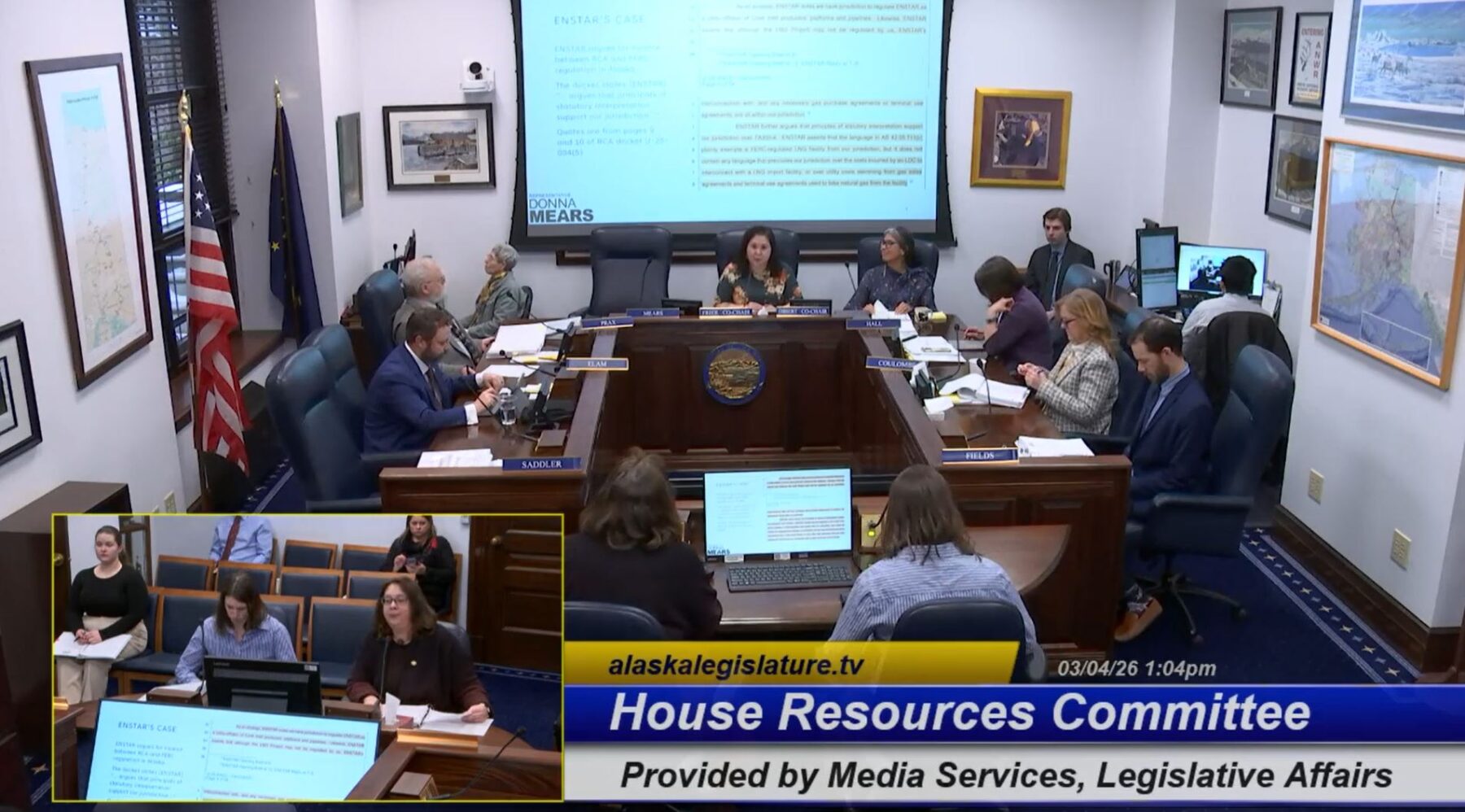
The Alaska House Resources Committee convened to review HB208, a piece of legislation aimed at clarifying the regulatory oversight of liquefied natural gas (LNG) import facilities. Sponsored by Rep. Donna Mears (D-Anchorage), the bill seeks to eliminate ambiguity in state statutes on the authority of the Regulatory Commission of Alaska (RCA) over gas sales contracts tied to federally permitted LNG terminals. The meeting marked the second hearing for HB 208, following an initial review in May 2025.
Rep. Mears framed HB 208 as a “consumer protection bill,” emphasizing its role in affirming the RCA’s jurisdiction over utility gas sales contracts originating from LNG import facilities. At its core, the bill proposes repealing a single line from Alaska Statute (AS) 42.05.711(v), which exempts LNG import facilities under Federal Energy Regulatory Commission (FERC) jurisdiction from state regulatory oversight. Mears argued that this provision has sown confusion, particularly when an LNG facility requires FERC approval for siting and construction, potentially misinterpreted as preempting state authority over the economic aspects of gas sales.
To illustrate the issue, Mears referenced a January 28, 2025, RCA hearing on an Enstar rate case (Docket U-25-0045), where the statutory language became a flashpoint. Although the docket primarily addressed other matters, interveners challenged the RCA’s authority, leading to protracted debates that delayed proceedings. Mears provided committee members with excerpts from the docket, underscoring the RCA’s position: the commission maintains statutory jurisdiction over public utilities, focusing on rates rather than importation acts. The RCA emphasized its consumer protection mandate, asserting that jurisdiction is based on the fuel’s status as a utility commodity, irrespective of origin.
Enstar’s stance, as outlined by Mears, supported RCA oversight, drawing parallels to the commission’s regulation of oil and gas sales in Cook Inlet. In contrast, interveners like JL Properties and RSD invoked the federal Natural Gas Act, arguing FERC’s “exclusive authority” over LNG terminals extends to all related contracts, rendering state involvement redundant or conflicting.
Mears concluded by stressing that while the ambiguity did not alter the Enstar docket’s outcome—the RCA upheld its authority—it unnecessarily prolonged the process. “We frequently hear criticisms of the RCA timelines being longer than parties would like, and this statute has contributed to this problem,” she said, urging the committee to support HB 208 for streamlined regulation.
Rep. Zach Fields (D-Anchorage) queried the sponsor statement’s phrasing, which suggested current law leaves consumers unprotected by removing RCA oversight. Fields proposed revising it to clarify that the RCA retains authority over gas supply contracts, distinct from facility permitting.
Fields praised the status quo, citing an April 2025 RCA decision rejecting a utility’s attempt to pass import terminal costs to consumers. “In this way, we do have a degree of protection over gas sales contracts. That’s a good thing,” he said, expressing support if the bill reinforces consumer safeguards without expanding risks like construction cost overruns.
Rep. Prax (R-North Pole) probed the bill’s intent, questioning whether it addressed fears of unregulated prices from terminals. He highlighted potential downsides of added oversight. Mears clarified FERC’s limited role in Alaska—confined to physical siting of LNG facilities and dams—contrasting it with the Lower 48, where FERC handles rates. She likened the conflict to obtaining a building permit that inadvertently blocks cost regulation, emphasizing RCA’s essential consumer role.
Prax inquired about testimony from stakeholders like Hilcorp, which recently acquired Marathon’s facility, or utilities. Mears directed him to the docket for positions, including Enstar’s.
Rep. Coulombe (R-Anchorage) sought clarification on whether HB 208 prevents rolling import facility construction costs into consumer rates. RCA Chief Administrative Judge Laura Barson, after confirming, stated the bill does not bar such proposals; the RCA reviews all contracts for just and reasonable rates under the Alaska Public Utilities Regulatory Act.
Fields followed up, “under current law, that structure could allow the RCA to say certain costs would be unreasonable or potentially certain profit margins would be unreasonable to pass on in gas rates. Is that correct?” Barson concurred, noting RCA jurisdiction over utilities extends to approving or disapproving surcharges, while FERC exclusivity applies only to facilities.
Rep. Sadler (R-Eagle River) delved into FERC’s “exclusive” jurisdiction, “when you say RCA authority does not extend to a facility that is exclusively permitted by FERC, help me understand the parameters of that modification exclusively… What does ‘exclusive’ mean? How far does it extend.” Barson explained it derives from the Natural Gas Act, defined by FERC itself, but declined to speculate on hypothetical expansions, like regulating distribution in Fairbanks.
Co-Chair Dibert (D-Fairbanks) moved to advance HB 208 with fiscal notes and recommendations. Prax objected, arguing price controls exacerbate Cook Inlet gas shortages by deterring producers. “I don’t think, in the end, it’s in the public’s interest to even set the price low enough that somebody thinks they can’t make money off of it,” he said, advocating further exploration.
HB 208 advanced out of committee with a vote of 6-3.


