
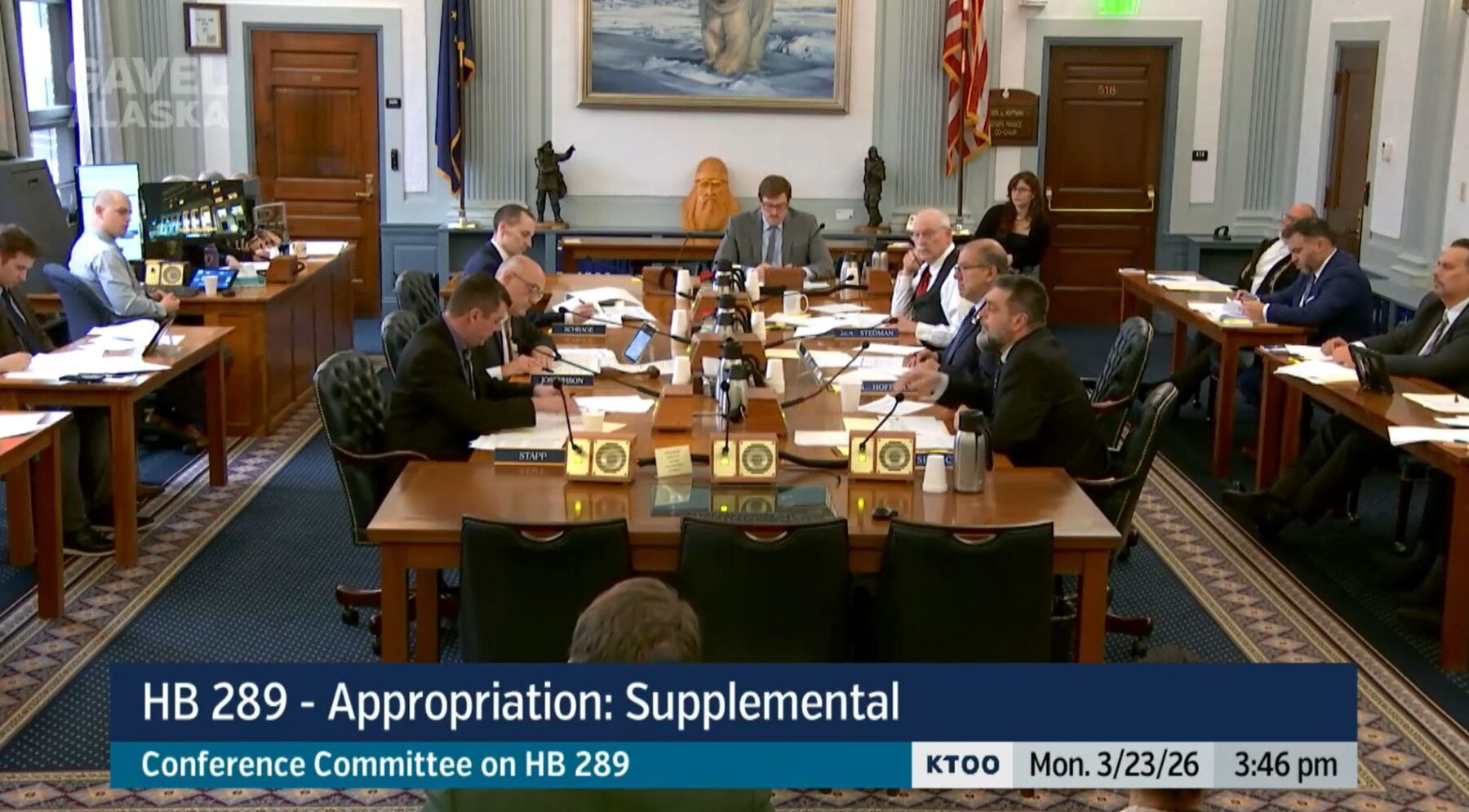
The conference committee for HB 289, the FY26 supplemental appropriations bill, wrapped up its work with an emphasis on fiscal discipline and targeted use of the Constitutional Budget Reserve (CBR). Lawmakers adopted House positions across nearly all departments, refined controversial CBR draw language to limit headroom to $20 million, and reported the conference committee substitute out with individual recommendations.
Chair Rep. Andy Josephson (D-Anchorage) convened the meeting noting limited powers of free conference granted by both chambers. The committee processed items department by department using March 23 motion sheets, setting aside objected items for later review.
Non-controversial adoptions moved swiftly. The Department of Administration saw Item 1 (House) adopted without objection. Commerce, Community and Economic Development followed with Items 1–2 (House) passing unanimously. Corrections cleared Items 1–3 (House), while Education and Early Development adopted Items 1–5 (House). Fish and Game passed Items 1–5 (House), Natural Resources cleared Items 1–3 (House), and Revenue adopted Items 1–5 (House). Transportation and Public Facilities, University of Alaska, and Judiciary also aligned with House positions on their respective items. Debt service, special appropriations, and capital budget items followed suit, with House versions prevailing across the board. Fund capitalization adopted a mixed approach: Items 1–2 (House) and Item 3 (Senate).
The session’s focal point emerged during fund transfers, particularly Item 1 involving CBR draw language. Sen. Lyman Hoffman (D-Bethel) moved adoption of the Senate version modified by Amendment H.A.4. Chair Josephson objected for explanation. Alexei Painter, Director of Legislative Finance Division, detailed the amendment’s refinements: Section A simplified the draw calculation to compare unrestricted revenue against enacted general fund appropriations (prior-year bills plus the current bill), appropriating any shortfall from the CBR. This deterministic approach prevents unintended expansions from subsequent appropriations. Section B addressed “headroom,” limiting transfers to only the amount necessary for additional general fund needs—eliminating excess beyond demonstrated requirements.
Josephson then offered a conceptual amendment to H.A.4, reducing headroom from $30 million to $20 million on line 19. Painter supported the calibration with data from the Legislative Finance document on governor’s supplemental items not in either version. Known needs totaled $12,584,400 general fund, netting $11.6 million after excluding one intentionally omitted item. Adding a potential $4.6 million FY24 SNAP penalty (under appeal and possibly mitigable) brought foreseeable requirements to roughly $16.2 million. Typical April items—election fund capitalization ($100,000–$200,000) and judgments/claims/settlements ($300,000–$400,000)—plus occasional emergents further informed the tighter $20 million figure. The conceptual amendment passed without objection.
Rep. Will Stapp (R-Fairbanks) objected to the amended language, preferring the original House version with no CBR draw provision at all. “I don’t believe this bill requires a CBR draw to be funded,” he stated, arguing against any contingency language. Hoffman defended the approach: “We’ve adopted language that says the constitutional budget reserve account will only be used if necessary… This is the most prudent way forward.” After a brief at-ease and roll call, H.A.4 as amended carried (House: two ayes, one nay; Senate: three ayes). The remaining fund transfer Item 2 (House) passed unanimously.
The committee then authorized technical and conforming adjustments by Legislative Finance and Legal Services before moving the conference committee substitute out with individual recommendations. Stapp maintained his objection for the record, but the motion prevailed. The report advances to both floors.
Departments largely followed the more restrained House positions, limiting supplemental growth. Unresolved elements, such as the precise impact of the FY24 SNAP penalty and potential April amendments, will be monitored closely. If unrestricted revenue exceeds expectations, the draw may prove unnecessary entirely, validating the conditional language.


