
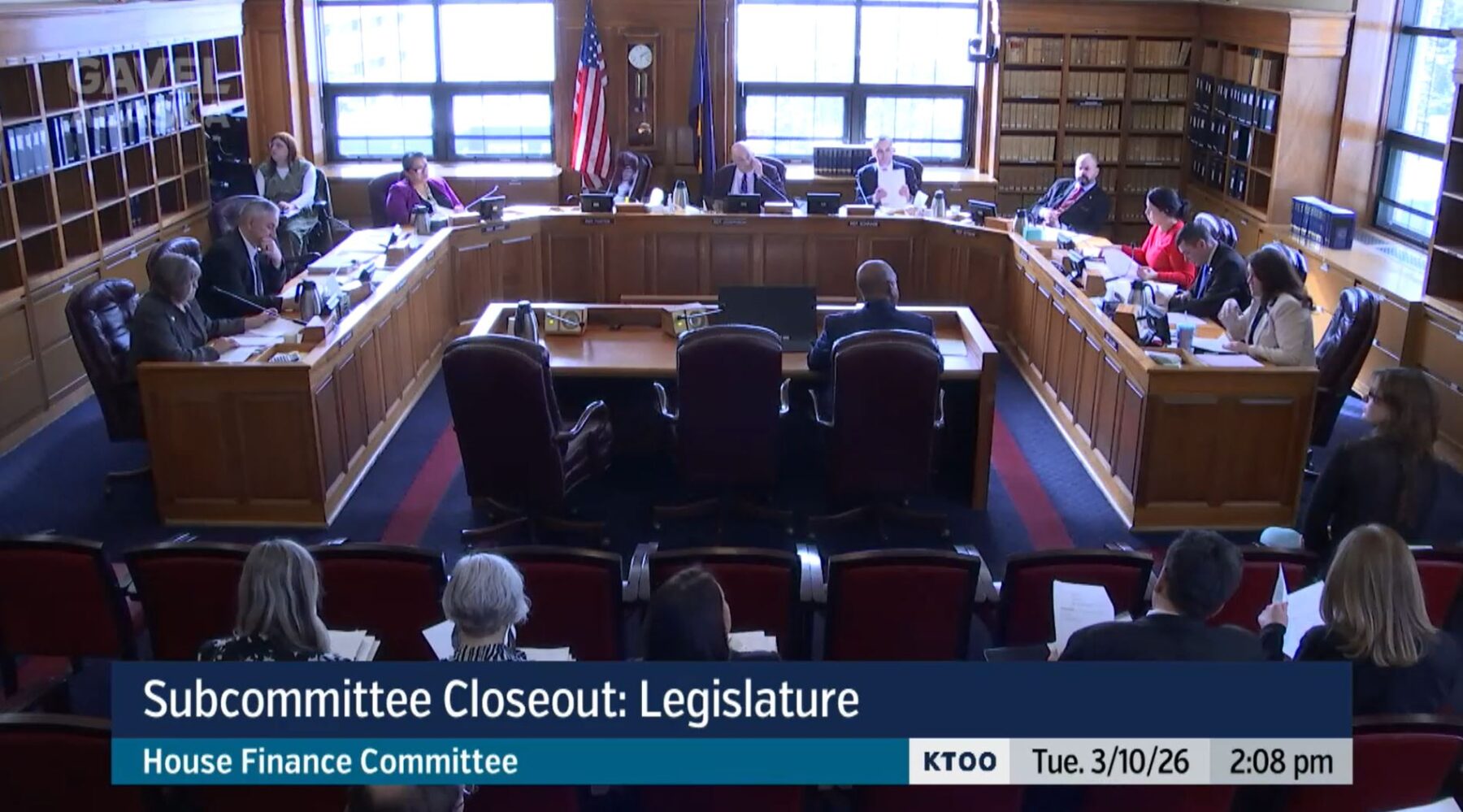
The Alaska House Finance Committee wrapped up a marathon afternoon of subcommittee closeout reports and began formal hearings on House Bill 280, the state’s proposed shift to market-based sourcing for corporate income taxes.
David Jiang, staff to Rep. Alyse Galvin (NA-Anchorage), presented the Department of Commerce, Community, and Economic Development (DCCED) closeout totaling $197,193,100 for FY27. The subcommittee achieved a net-zero change from the governor’s amended request by boosting Unrestricted General Funds (UGF) $2.1 million (13.2%) while trimming Designated General Funds (DGF) by the same amount. Positions stayed flat at 596. Key accepted increments included $2,238,800 UGF to restore Alaska Gasline Development Corporation (AGDC) operations and $1,306,200 UGF as stop-gap funding for the Railbelt Transmission Organization (RTO) until the Regulatory Commission of Alaska (RCA) finalizes its open-access tariff.
The panel spent significant time on Item 10—professional licensing investigations. The governor sought $4.2 million via a transfer from professional licensing receipts to business licensing receipts. The subcommittee halved the amount to $2.1 million and switched to direct UGF for greater transparency, noting that program receipts would have functioned as an indirect UGF appropriation. Legislative Fiscal Analyst Rob Carpenter explained the remainder would continue coming from licensing fees, with historical averaging and carry-forward authority to smooth shortfalls. State Auditor Kris Curtis flagged potential compliance issues, reminding members that statutes require each board’s fees to cover regulatory costs exactly—a policy dating to 1992.
Rep. Jamie Allard (R-Eagle River) questioned the addition of two permanent full-time positions for federal disaster grant management when DCCED carries 67 vacancies. Carpenter noted conceptually that reallocation is possible, but these roles stem from burdensome new federal grants. Rep. Galvin recalled subcommittee discussion assuming continued climate-related emergencies. Rep. Jeremy Bynum (R-Ketchikan) pressed whether the Capital Improvement Project (CIP) funded positions would become a future UGF burden once grants expire; the increments were built as permanent rather than temporary.
The Office of the Governor’s $32 million budget (primarily $31 million UGF) and the Legislature’s $96 million budget passed with minimal changes. The legislative budget included $912,000 for travel, $750,000 to restore special-session funding to $1 million, and $855,000 for Gavel to Gavel coverage to replace lost federal dollars. Executive Director Jessica Geary confirmed the program could not continue without the state backfill. Rep. Allard requested future reports include point-in-time vacancy counts; Remond Henderson agreed to add them.
Department of Revenue closeout totaled $485.5 million. The subcommittee denied the governor’s request for a single APFC appropriation, keeping three separate lines for investment management fees, non-state facilities rent, and IT licensing. In a pointed policy statement, lawmakers created a new “APFC Anchorage Operations” appropriation and immediately zeroed its $34,000–$35,000 lease funding to signal strong opposition to opening the Anchorage office. Henderson noted the move could spark a constitutional clash over legislative versus executive authority.
HB280 – Apportion Taxable Income and Digital Business
The committee then turned to HB 280. Scott Mackey of CTIA, the Wireless Association. testified first, urging a statutory carve-out to preserve cost-of-performance sourcing for telecom services. “Cost of performance is the sourcing methodology that most fairly reflects how the industry earns its income,” Mackey stated, citing recent carve-outs in Idaho (2024), Kansas, and Arkansas (2025). He emphasized Alaska telecom providers’ significant in-state capital investment and employment, warning that market-based sourcing would trigger immediate financial-statement hits under deferred-tax accounting.
Karen Boucher of the Financial Institution State Tax Coalition, representing the Alaska Bankers Association, requested adoption of the Multistate Tax Commission (MTC) model for banks. She argued the Division of Taxation lacks statutory authority under UDITPA to issue special regulations for financial institutions and warned that HB 280’s narrow receipts definition would exclude core lending and hedging income, reducing Alaska-taxed revenue. Boucher offered concise statutory language: financial institutions apportion income using the general corporate formula while directing the Division to update its regulation to the MTC’s broad definitions.
Melissa Patak of the Motion Picture Association sought customer-location (advertiser home-state) sourcing for broadcast and cable advertising revenue. She listed 14 states already using this approach and assured members the change would not materially alter the Department of Revenue’s revenue estimate.
The committee set HB 280 aside for further drafting and fiscal modeling of proposed amendments. Action items include OMB clarification on DCCED’s new grant positions, a five-year board-by-board licensing cost analysis, and legal guidance on fee reductions when UGF supplants investigations.
The next meeting is scheduled for March 11 at 9 a.m. to advance the operating and mental-health budget substitutes.


