
SENATE REPUBLICAN CAUCUS FRACTURING?
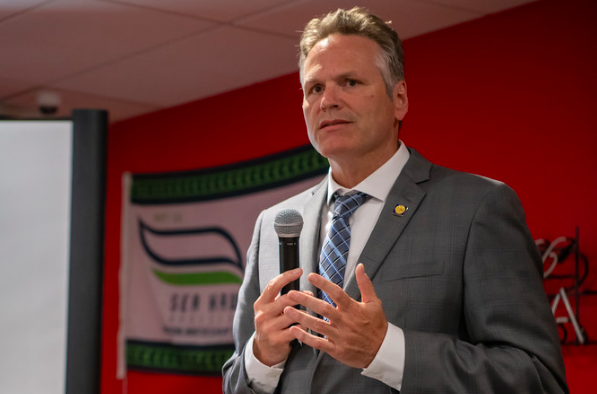
Gov. Michael Dunleavy today indicated he will veto some or all of the State spending add-backs that have come from the House and Senate in the appropriation bill that passed the Senate today.
Dunleavy hasn’t said how much he’ll veto. He simply said that expects to get the bill soon, and he intends to work it over.
His message during today’s press availability was to supporters of the Permanent Fund dividend: He is disappointed. The passage of a $1,600 dividend this year, instead of the statutory calculation of $3,000, has turned the dividend program into more of a social welfare line-item, rather than an actual dividend coming from oil production.
That means, without some significant change, the dividend will be gobbled up as government takes more and more of it each year to make up for a spending imbalance.
Dunleavy said the Legislature’s actions could also invite a voter backlash. Voters cannot appropriate via initiative so it’s unclear what action they might take, other than replacing legislators in 2020.
“A few years ago, no politician would have thought of putting their hands on the PFD,” he told reporters. “Alaskans never got upset about the size of the PFD because it was a rules-based system.”
But this is the fourth year the statute has not been followed. The Legislature has not acted to change the statute, nor sent a change of the PFD calculation to a vote of the people, something Dunleavy proposed in legislation this year — legislation that has gone nowhere.
MORE SPENDING, LESS PFD
The Senate today added another $70 million in spending into House Bill 2001.
Of the governor’s $444 million in vetoes of the Operating Budget, only $23 million remain, with $421 million in add-backs by the House and Senate and a Permanent Fund dividend that has been reduced by nearly half.
An unanswered question is whether Dunleavy will veto the $1,600 dividend or simply cut his losses and accept the smaller dividend, since the Legislature appears to be in no mood to fund a $3,000 dividend.
Whatever he decides to do, the state budget still has a massive structural problem. Even with his original vetoes, the State budget was only halfway to balancing. Earlier this year, Dunleavy said that balancing the budget would have to take two or more years, since he didn’t have the support of enough legislators to get there in one year.
Dunleavy praised the passage of the Capital Budget, which passed the House earlier in the day. He said he was glad to see the funding for Power Cost Equalization and state scholarships restored, along with the other items that he had proposed for funding in his original budget.
SENATE’S BINDING CAUCUS MAY REORGANIZE, BECOME BIPARTISAN
The Senate Republican Majority will likely soon be taking a vote on whether it will allow the conservative Republicans who didn’t vote for the HB 2001 (PFD/spending bill) to remain in the caucus.
Sen. Lora Reinbold was the only recorded vote against the bill, and she explained on the floor of the Senate that although she didn’t agree with all of the governor’s vetoes, the amount set for the Permanent Fund dividend is breaking the law, and she wasn’t willing to do that. She will almost certainly be removed from the caucus.
Sens. Shelley Hughes and Mike Shower, from the conservative Mat-Su Valley, asked to be excused from the floor and watched the votes from their offices.
They were hoping that by being excused they would not be thrown out of the caucus. They may have also been hoping to prevent giving Senate President Cathy Giessel a handy excuse to form a bipartisan power coalition with Democrats. But it’s unclear whether the caucus will give them a pass.
Sen. Mia Costello, who has already been removed by Giessel as Majority Leader, voted in favor of the spending measure, which passed 17-1. She has been iced out of the Republican caucus informally after she went with other conservative legislators to the Wasilla special session called by the governor. Others who went to Wasilla for the session voted for the bill today, including Sens. David Wilson and Peter Micciche.
The binding rules for the Senate Republican caucus, which are private to the caucus, have possibly changed and now include not only voting with the caucus on the the operating budget, but on all appropriations.


