

By DAVID BOYLE
Anchorage School Board member Kelly Lessens has introduced a revised policy on school breakfast and lunch programs, a policy she says will make the Anchorage School District conform to both federal and state laws that are being rolled out later this year.
While state law only requires a district to provide health and physical education for students, federal law is more restrictive for districts wanting to receive federal funds. That federal dollar is what Lessens and the school board are after, and federal dollars come with regulations.
The ASD received $20.9 million for the breakfast/lunch program in 2020. Due to schools being closed in 2021, there was a dramatic decrease to $12.7 million in 2021 in federal taxpayer funding for the breakfast/lunch program.
One can see why adhering to federal limitations regarding feeding students is important — it’s about the money. Each student is funded depending on whether the student is on the free or reduced lunch program. The more free lunch students you have, the more federal funding you get.
In 2020, the district had 16,343 students in the free lunch program and 341 students in the reduced lunch program. More than 43 percent of all ASD students were enrolled in one or the other program.
To qualify for free/reduced price lunches, a household must meet the income eligibility guidelines, which is based on household size. To qualify for a free lunch, a household would have an income of less than $43,069 annually. That household would qualify for a reduced-price meal with an income of less than $61,291.
The federal government pays (through the State of Alaska) ASD $5.94 for each free lunch and $5.54 for each reduced-price lunch.
There is also a Community Eligibility Provision, which allows the district to receive the free lunch payments for all students in a specific school if more than 40% of its students qualify for a free lunch. So, if a household of four has an income of $100,000 or even more, those students also get a free lunch, if the school has 40 percent or more students on the free/reduced lunch programs.
If the district is certified to be in compliance with the “program” meal pattern, it receives another 6 cents per served lunch. This is a laborious process prescribed by the federal government that includes counting vegetable servings by the type, serving size, and how many were served. Here is a link to the requirements; they read like military specifications.
To ensure the the district gets maximum funding from the federal government, Kelly Lessens’ policy restricts food sale fundraising and “classroom incursions” in nutrition. An incursion is not something happens in Ukraine, in this instance. An incursion is a tray of cupcakes or cookies brought by a parent for a bake sale.
Under this policy, food sale fundraisers that happen during the day must adhere to federal SMART snack guidelines. “Fundraising groups offering SMART-Snack-compliant food must provide receipts and nutritional labels and/or product specifications for all foods offered for sale.”
A classroom incursion would also occur if a parent brought cupcakes to celebrate a student’s birthday. If a family does not want to participate in classroom food incursions, it must fill out an opt-out form at the beginning of the school year. Parents are able to opt-out of this program much more easily than they can opt- out of sex education.
However, to show compliance to the federal government, there is a burgeoning bureaucratic workload for school staff.
In 2020 the district spent $21,595,000 on student nutrition; in 2021 that dropped to $16,035,000. Note that in 2021 the district was closed to in-person learning and the district was only delivering lunches to neighborhoods. Here is a chart showing expenditures over the years:
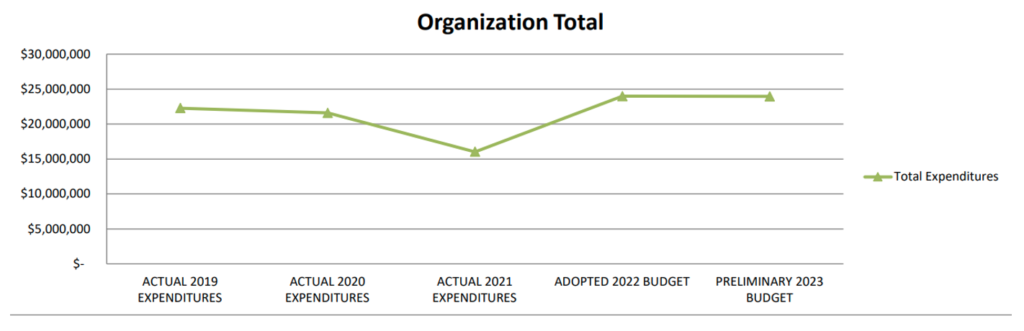
The school nutrition program required 213 full-time equivalent positions in both 2020 and 2021.
If the Anchorage School District wants to continue receiving federal taxpayer funds for school lunches, it must follow the federal regulations, including the no-cupcake rules, or lose those dollars.
The federal government controls our K-12 education system through its school lunch/breakfast/snack program, just like it controls our health care system through its mandated hospital protocols via Medicare/Medicaid reimbursements.
If the federal government can control what our kids eat for snacks at school, will mask mandates be next? Will a national curriculum be the next chapter in the book of bureaucracy?


