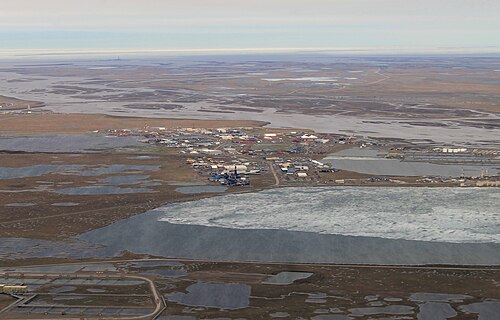
A proposed nearshore liquefied natural gas (LNG) export project on Alaska’s North Slope has drawn national scrutiny after a ProPublica report alleged Russian influence through a sanctioned company. Polar Train LNG LLC, the U.S. developer, has categorically rejected the claims as false and unsubstantiated. Polar Train released preliminary findings that its former CEO Joe Riddle— ProPublica’s primary source of information—engaged in efforts to divert company business to a venture owned by himself.
Polar LNG describes the project as a privately funded effort to bring stranded North Slope natural gas to market using modular gravity-based structures (GBS) for a nearshore export facility. The company estimates costs at $8–9 billion, targets deliveries around 2030 subject to permits and approvals, and projects capacity of about 7 million tonnes per year. It states the project would create an additional market route for North Slope gas, support jobs and long-term revenue for Alaska, keep facilities within the state’s tax base, and contribute to year-round commercial activity and Arctic operating experience consistent with U.S. strategy.

Ownership runs through Polar Train LNG LLC (wholly owned by Polar Eagle LNG LLC), which is owned by UAE-based Tech Wave Industrial Projects Management. Tech Wave is owned by Bjorn Gundersen and Rajeev Lehar. The company says funding has come exclusively through Tech Wave via Gundersen’s personal investments and borrowed funds, with no equity held by Russia’s Novatek. An option agreement exists for Novatek potentially to acquire a minority stake in Polar Eagle, but only contingent on more than 50% U.S. investor ownership, governmental consents including CFIUS clearance, and other conditions. A separate memorandum with Novatek concerns potential acquisition of an unfinished LNG train using GBS technology, which would require its own OFAC license; an application is under review. Polar LNG states all activities comply with U.S. law, including sanctions law. The project will advance only after all required federal, state, and local approvals and with Alaska Native stakeholder support.
The ProPublica article, published in early November 2026, alleged that surveys conducted in 2025 and 2026 west of Prudhoe Bay—mapping seabed, sampling sediment, and collecting oceanographic data—were steered by Novatek through the UAE entity, potentially giving a Russian oligarch close to Vladimir Putin access to sensitive data near energy and military infrastructure. It highlighted metadata on an OFAC sanctions-waiver application linking a Novatek lawyer, references to funding discussions between Joel Riddle and a Novatek-linked contact, and the resignation of then-CEO Joel Riddle, who asserted the project risked sanctions issues and Russian control of U.S. resources.
Polar LNG responded that the ProPublica reporting was selective, misleading, and reliant on a disgruntled former employee. Surveys were conducted by U.S. companies as routine site-selection work; data is non-classified, has been shared with local businesses and researchers, and confirmed publicly available bathymetry. The company said the sole purpose was identifying a suitable site to unlock North Slope gas for Alaska and U.S. energy security, and that insinuations of intelligence-gathering are false.
Polar LNG also noted that a preliminary investigation by Willkie Farr & Gallagher LLP, reviewing thousands of emails and company documents, found he breached fiduciary responsibilities. While serving as CEO, Riddle allegedly formed similarly named entities (including Polar Train LNG Holdings LLC and Polar LNG LLC) and pursued unauthorized plans to acquire or divert Polar Train’s business, relationships, contracts, employees, and data to the entities he created. He also signed agreements without authorization, disrupted OFAC and regulatory processes, and continued spending after receiving directives to stop. The company terminated him for cause after his resignation and is pursuing legal claims. Tim Talkington is now acting CEO of Polar Train LNG LLC.
The episode occurs against rising Arctic security concerns. In June 2026, Senators Mike Lee (R-Utah) and Jeanne Shaheen (D-N.H.) introduced the bipartisan Arctic Security and Diplomacy Act. It would require prior U.S. consent for foreign vessels conducting maritime research in American waters, disqualify vessels of or reasonably associated with adversaries such as China and Russia, and direct strategies and reporting on espionage and influence operations in the Arctic. Sponsors cited expanding Russian and Chinese activity, research vessels as potential covers for intelligence collection, and the need to protect U.S. waters from the Aleutians to the Beaufort Sea while strengthening alliances.
The U.S. Treasury has not commented publicly on the status of any specific OFAC applications. Polar LNG maintains the project is designed to advance U.S. energy interests and Alaska’s economy under full legal compliance, while the company continues investigating the former CEO’s actions.