On Monday, July 27, Lt. Governor Dahlstrom hosted a public hearing for the three 2026 ballot measures. The first hearing was on Ballot Measure 1, which proposes new campaign finance limits. The initiative’s sponsor, State Representative Calvin Schrage (NA-Anchorage), gave the statement of support, claiming the new limits would “level the playing field” and reduce outside influence on Alaska elections. Amy Demboski, speaking for the opposition, argued that the ballot measure would give an unfair advantage to incumbents and increase the power of political action committees (PACs) by allowing them to give up to 4x as much money as current law allows.
Ballot Measure 1
Lt. Governor Dahlstrom began the hearing by reading the ballot measure and reminding the audience that a ballot measure differs from legislation debated in the legislature in that it may not be amended or altered.
Ballot Measure will appear on the primary ballot on August 18 as follows:
“This act would change the amount of money that people and groups can give to state and local political campaigns. A court ruling in 2021 removed the limits on contributions by individuals. With this act, individuals could give $2,000 to candidates and $5,000 to political parties. Groups besides political parties could give $4,000 to candidates and $5,000 to other parties or groups. Individuals could also give $4,000 to joint campaigns for governor and lieutenant governor, and groups could give $8,000. These limits would increase with inflation every ten years beginning in 2031. Should this initiative become law?”
The full bill text can be read here:
Statement of Support
State Representative Calvin Schrage (NA-Anchorage), the initiative’s sponsor, delivered the statement of support. He began with the background story: Alaska used to be “a national leader in campaign finance integrity,” 73% of Alaskans voted for strict campaign finance limits in 2006, a federal judge struck down those limits in 2021 as unconstitutional. The case Shrage referred to is Thompson v Hebdon where the Ninth Circuit Court ruled that Alaska’s campaign finance limit of $500 was too low and did not properly account for inflation.
Rep. Schrage argued that the state’s lack of campaign finance limits has allowed wealthy individuals and special interest groups to have “an outsized impact and shift a candidate’s focus away from the constituents they are supposed to serve.”
According to Rep. Schrage, “When a single donor can spend hundreds of thousands or even millions of dollars on a single candidate, it creates a dangerous environment. It not only grants undue influence to the ultra-wealthy, but it also exposes our elected officials to the risk and perception of quid pro quo corruption. Alaskans from all across our state placed this initiative on the ballot because we believe our elections should belong to us, not the highest bidder.”
Rep. Schrage emphasized the initiative’s intention to “level the playing field” for less wealthy candidates and non-incumbents.
Statement of Opposition
The statement of opposition was given by Amy Demboski, a Palmer resident, and joined by former State Representatives Liz Vasquez and Ben Carpenter and former State Senator David Wilson.
According to Demboski, “Proposition 1 wants you to think that it’s for fairness, but it actually limits your right as an individual Alaskan to support the causes you believe in…. By putting a cap back on individual donations this act makes it harder for regular people to have a big impact.”
Demboski countered Schrage’s claim that the initiative levels the playing field for non-incumbents, arguing instead, “Reintroducing new caps creates a pay-to-play barrier where only those who already possess significant name recognition can thrive, effectively silencing the grassroots support necessary for insurgent or unconventional candidates.”
While the ballot initiative would apply the limits equally to incumbents and non-incumbents, it would require a candidate to win over more donors to raise the money they need. An incumbent may possess a wider network of supporters and more developed soliciting infrastructure; whereas a relatively unknown challenger may only be able to reach a handful of donors. When the challenger may no longer accept large donations, the incumbent gains advantage over the challenger.
Demboski also challenged the initiative’s inflation adjustment mechanism, saying the 10-year “freeze on contribution limits” before adjusting for inflation is inadequate.
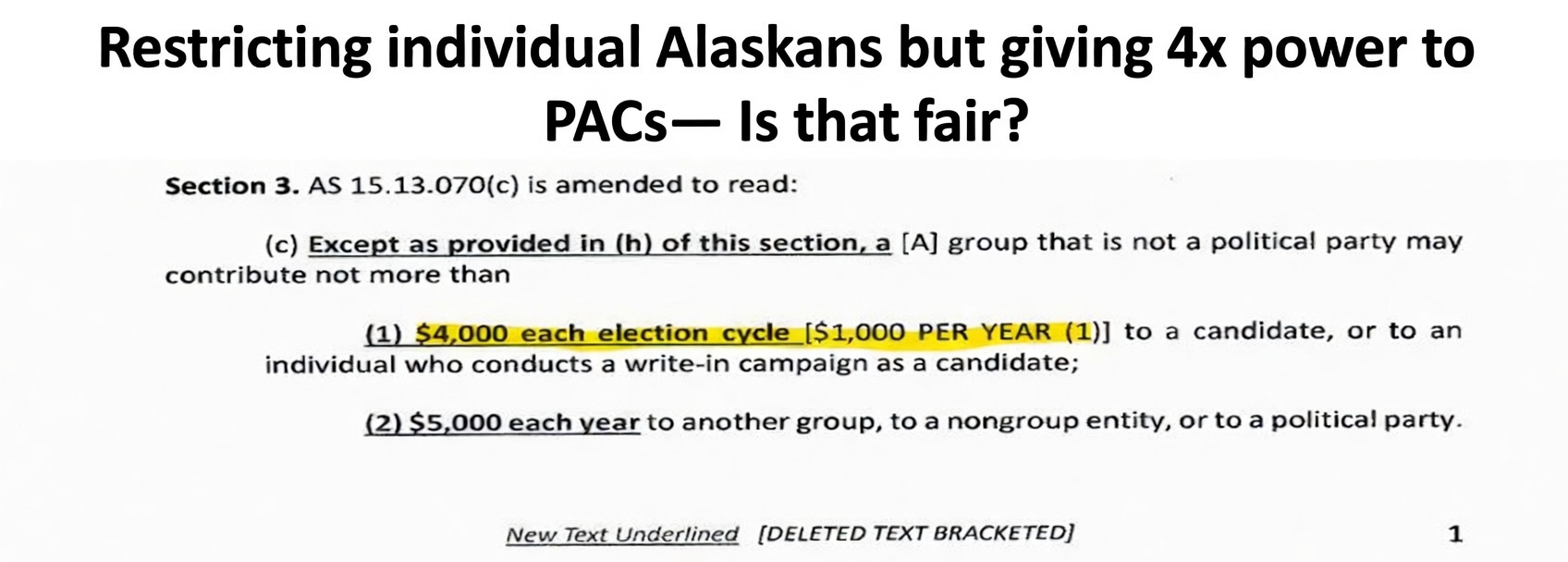
Furthermore, the ballot measure would restrict individual donors but allows political action committees (PACs) and unions to give 4x the amount current law allows. “So it quadruples the amount PACs, and unions can give to candidates, while at the same time capping and diminishing the voice of regular Alaskans. If they want to talk about an equitable playing field, this is absolutely not true,” stated Demboski.