
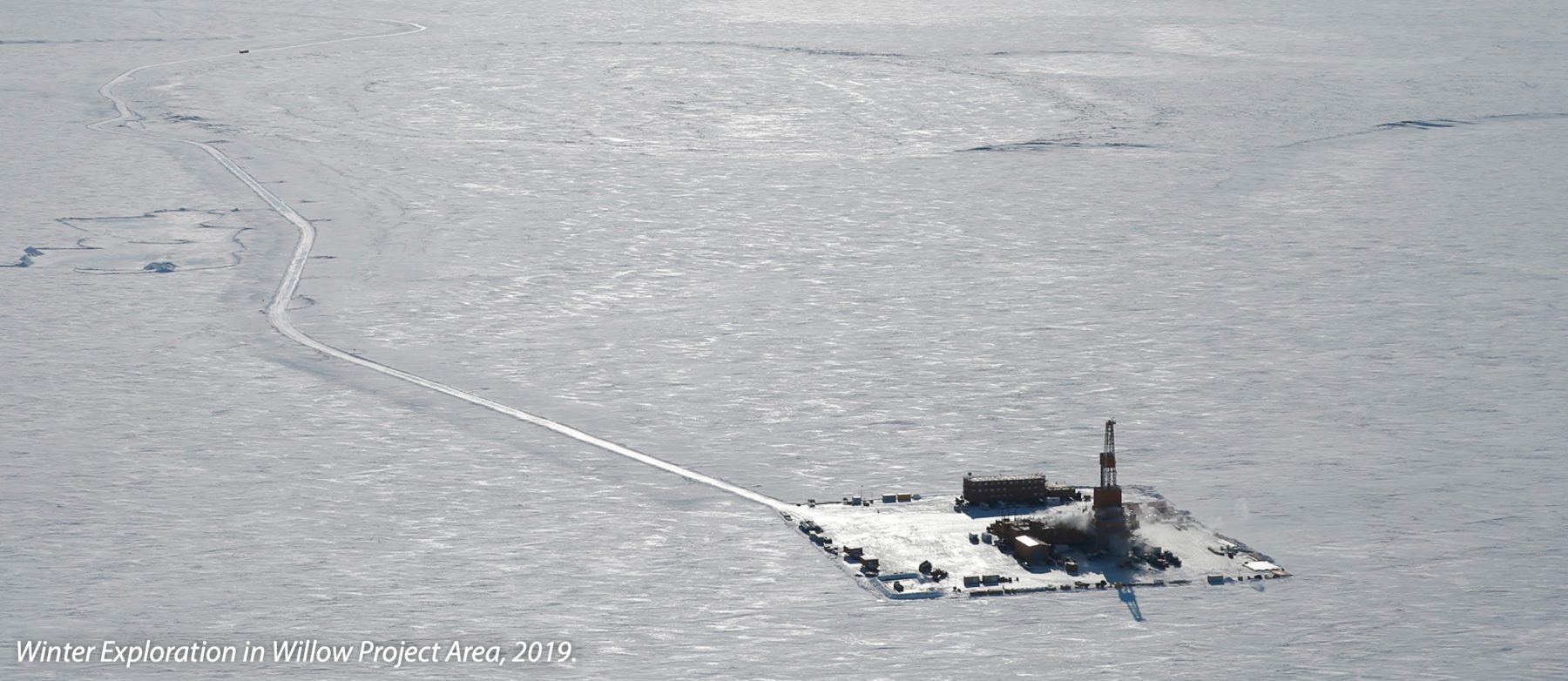
The federal government has given a qualified thumbs-up to a scaled-down version of the Willow Project. A Bureau of Land Management final Supplemental Environmental Impact Statement released on Wednesday represents a major milestone in the permitting process for the ConocoPhillips project that commenced in 2018. The company, which has not made its final investment decision, is indicating that the scaled down version is still economically viable.
Located in the National Petroleum Reserve in Alaska, the Willow Project could produce 180,000 barrels of oil per day at its peak and deliver $8 billion to $17 billion in new revenue for the federal government, the State of Alaska, and North Slope Borough communities, not to mention significant economic activity in a state that has been in economic decline.
The company says the project, if it gets a final record of decision from the Department of Interior, will be built using materials primarily made and sourced in the United States and has the potential to create over 2,000 construction jobs and 300 long-term jobs.
ConocoPhillips announced the new oil discovery in January 2017. Located in the Bear Tooth Unit in the northeast portion of the National Petroleum Reserve-Alaska (NPR-A), Willow started with two discovery wells, Tinmiaq 2 and 6, which had been drilled on federal leases in early 2016.
A project the size and scope of Willow hasn’t been developed on the North Slope since Alpine was developed in the late 1990s. Additional oil production will keep a key piece of U.S. infrastructure, the Trans-Alaska Pipeline System, economically viable. The production rate from Willow is estimated to be about a 20% increase over current TAPS throughput.
TAPS is now running at about one quarter of its capacity, with roughly 490,000 barrels of oil per day flowing from the North Slope to the port of Valdez.
“After nearly five years of rigorous regulatory review and environmental analysis, the National Environmental Policy Act process is almost complete and should be concluded without delay. ConocoPhillips looks forward to a final record of decision and is ready to begin construction immediately after receiving a viable ROD and full authorization from all permitting agencies,” said Erec Isaacson, president, ConocoPhillips Alaska.
Alaska Natives are one of the big winners in this decision. Federal law requires 50% of lease revenue from NPR-A projects be made available to a unique grant program that offers significant social and environmental justice benefits to Alaska Native communities.
In the supplemental environmental impact statement, the Bureau of Land Management identified Alternative E as the preferred alternative. Under Alternative E, the federal agency could authorize three drill sites initially, and potentially one additional drill site in the future, pending the final record of decision.
There were five drill sites initially proposed by ConocoPhillips and this alternative is a reduction of project footprint in the Teshekpuk Lake Special Area by more than 40%. The three core drill sites in Alternative E (BT1, BT2, and BT3) reflect an integrated design concept and ConocoPhillips says the path forward with three is “viable.”
ConocoPhillips Alaska intends to immediately initiate gravel road construction once all necessary approvals are in place, and then proceed to a final investment decision, the company says. Mobilization could start as soon as February. Additional North Slope construction activities for Willow will occur throughout the summer and fall. Concurrently, material fabrication will begin in U.S. facilities and the pace of contracting and procurement will increase, the company said.
“We appreciate the strong support for Willow from communities on the North Slope and across the state, as well as from Alaska’s bipartisan congressional delegation,” Isaacson said. “Willow will produce much needed domestic energy while generating substantial public benefits.”
Rick Whitbeck of Power the Future Alaska said that although the decision is not final, the EIS “contained incredibly good news for the Willow project. In spite of #ClimateCult opposition, the right decision was made for America, Alaska & energy independence.”


