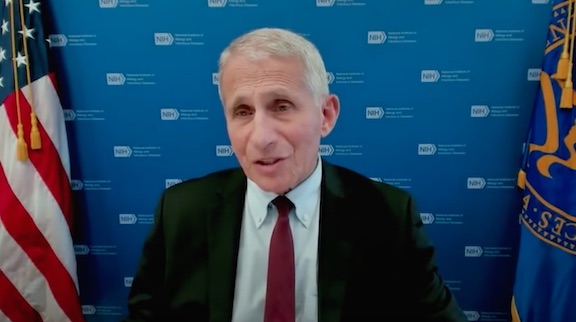
Dr. Anthony Fauci, the nation’s top infectious disease official who was in charge of federal Covid-19 policy for President Donald Trump and President Joe Biden, will leave his job at the end of the year. Fauci, 81, said he would “pursue the next chapter of my career.” He will collect $350,000 a year in retirement benefits from the U.S. Treasury.
His departure as the president’s chief medical adviser and from the National Institute of Allergy and Infectious Diseases comes on the heels of Centers for Disease Control and Prevention Director Dr. Rochelle Walensky admitting that her agency made “some pretty dramatic public mistakes” handling the Covid-19, and saying the organization must “pivot” to restore the public trust. Some critics ay the organizational pivot should start with Walensky’s resignation.
When Covid-19 was declared a pandemic in March 2020, Fauci became a household name, widely regarded as the expert on Covid and related infectious illnesses. The media accepted his every word as truth, while those doctors and scientists with contrary opinions were dimissed as quacks and conspiracy theorists.
At one point, Fauci characterized himself as the infallible sole arbiter of scientific facts. He told MSNBC, “if you are trying to get at me as a public health official and a scientist, you’re really attacking not only Dr. Anthony Fauci, you’re attacking science.”
Before he told Americans they must wear masks, he was on record saying masks in public were useless, and the Covid virus was less concerning to him than influenza. He also dismissed any suggestion that the virus had escaped from the Wuhan Institute of Virology, (which had been funded by the NIAID, where he worked). Fauci told U.S. senators on the record that he wore a mask in public because it was protective, but later he told ABC News that he wore the mask as a signal, because since he was immunized, he has almost no chance of being infected by the virus. He has since contracted Covid not once but twice, even though fully vaccinated and boosted.
Another time, he provided an estimate on how long it would take for America to reach “herd immunity.” Then, he revised his estimate upward, based on polling data that showed more Americans would take the vaccine.
“Criticisms of Anthony S. Fauci, director of the National Institute of Allergy and Infectious Diseases, are likewise rooted in misrepresentations he’s made about masks and in his often changing guidance, unleavened by any willingness to accept responsibility or acknowledge errors,” wrote columnist Hugh Hewitt in the Washington Post in January. Hewitt likened the mistrust Americans had developed for the medical establishment to the mistrust they had had of the Pentagon during the Vietnam War era.
“As McMaster demonstrates in his book, [Robert McNamara, President Johnson’s Defense secretary] maintained complete confidence in his own judgment and his commitment to continually escalating force against the Viet Cong and their patrons in Hanoi. Working with Maxwell Taylor, then the chairman of the Joint Chiefs of Staff, McNamara cut the Pentagon’s service chiefs off from Kennedy and then Johnson, and stacked every decision tree with carefully preselected acolytes. Johnson cared only for the politics of the situation, McNamara for his own vindication. But dissent didn’t vanish. It grew in an embittered senior military leadership and eventually broke into public view with publication of the Pentagon Papers. Public quiescence vanished slowly and, as costs escalated, the famous ‘credibility gap’ grew. Disaster awaited with collapse of support for the war and for South Vietnam.” Hewitt wrote.
“We have begun to see a similar deterioration of the public’s trust in public health and education authorities, and a deep, never-before-experienced suspicion of both the Centers for Disease Control and Prevention and the Food and Drug Administration. Part of this is the result of misinformation and anti-vaccination points-of-view that unfortunately have taken deep root. I was a strong and early supporter of vaccines and boosters and remain convinced that the best means of persuading the ‘vaccine skeptical’ is engaging with them and calmly reviewing the evidence of effectiveness — not shaming, dismissiveness or caustic declamations.”
It was the the “Fauci as McNamara” comparison that Hewitt was making in his column. In January, a NBC poll asked respondents: “Do you trust what the Center for Disease Control and Prevention (CDC) says?” 44 percent said yes; 43 percent said no.
“That’s a crisis of trust in public health authorities, a new ‘credibility gap,’ and it is itself a public health crisis,” said Hewitt.