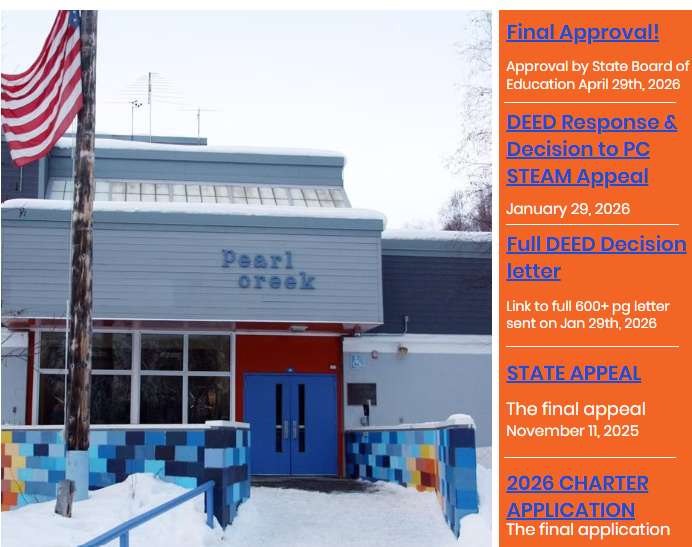
In a first-of-its-kind legal battle that has pitted Alaska’s State Board of Education against the Fairbanks North Star Borough School District, the proposed Pearl Creek STEAM Charter School has become a high-stakes test of a previously untested Alaska statute that mandates local school districts operate charters if the State School Board approves that charter on appeal.
After the Fairbanks School Board denied Pearl Creek’s application to open, the school appealed to the State Board of Education— a process provided by Alaska law for charters who feel their application was unjustly denied. After extensive review, the State Board overturned the district’s decision and granted Pearl Creek permission to open. According to AS 14.03.250, “A local school board that denied an application for a charter school approved by the state board on appeal shall operate the charter school.” However, the Fairbanks school board is still refusing to open the school.

The sequence of local district says “no,” but State says, “yes” to a charter school application has never happened in Alaska history. However, existing statute provides clear guidance for this exact situation. The Pearl Creek case tests those existing statutes in real time for the first time.
The Facts
In 2025, a group of parents and educators, organized as the Pearl Creek STEAM Academic Policy Committee (APC), applied to reopen the closed Pearl Creek Elementary School as a kindergarten-through-sixth-grade public charter focused on science, technology, engineering, arts, and mathematics, with outdoor and place-based learning elements. The building had been shuttered the previous year amid severe budget cuts and declining enrollment.
On Oct. 21, 2025, the Fairbanks North Star Borough School Board unanimously denied the application. In a detailed 52-page written decision, the board cited serious concerns: an incomplete facility plan, budget shortfalls that could cost the district millions annually, flawed admissions procedures, inadequate special education staffing, transportation gaps, and broader impacts that could force further school closures or larger class sizes in neighborhood schools.
The APC appealed. Alaska statute (AS 14.03.250) allows applicants whose applications are denied by a local board to appeal first to the Commissioner of Education and Early Development, and then to the State Board of Education. In January 2026, Commissioner Deena Bishop approved the application after reviewing the record. The State Board followed suit on April 29, 2026, issuing a 15-page decision that found the application compliant and ordered the district to proceed.
Here the path diverged sharply from the statute’s expectations. Under AS 14.03.250(f), “A local school board that denied an application for a charter school approved by the state board on appeal shall operate the charter school as provided in AS 14.03.255 – 14.03.290.” The language is mandatory: “shall operate.”
The Fairbanks district refused. It filed an administrative appeal in Superior Court (consolidated cases 4FA-26-01831CI and 4FA-26-01895CI) challenging the State Board’s decision. It declined to sign a contract, post jobs, or take steps toward a fall 2026 opening. District leaders argued the state approval process was flawed, the costs unsustainable amid ongoing budget pressures, and that the district had a right to judicial review before committing irreversible resources.
The charter group responded with a civil lawsuit seeking a preliminary injunction to force the district to open the school. Superior Court Judge Kirk Schwalm denied that request on June 17, 2026, finding the charter group had not shown irreparable harm sufficient to justify immediate court-ordered opening while the merits of the appeal remained pending.
Acting Attorney General Cori Mills then filed an emergency petition with the Alaska Supreme Court on June 18, 2026, arguing the district was openly defying a clear statutory duty and that delay would kill the school for the coming year. The high court declined emergency review on June 23–24.
Meanwhile, Commissioner Bishop sent a June 10 letter warning that state funds could be withheld or redirected if the district failed to operate the approved charter. The district replied sharply, rejecting the threat as unlawful and inconsistent with prior advice from the Attorney General’s office that DEED lacked direct enforcement power.
As of mid-July 2026, Pearl Creek is highly unlikely to open this fall. The Superior Court merits decision is expected around October. The charter group continues planning, and the Borough Assembly has taken steps toward a lease of the Pearl Creek building, but the core legal standoff remains unresolved.
The Analysis: Rule of Law vs. Local Reality
The Pearl Creek fight is more than a local school dispute. It is the first known instance in which the State Board has fully overridden a local denial of a new charter and then faced open resistance to the “shall operate” mandate. Education leaders have described it as unprecedented. Lisa Parady, executive director of the Alaska Council of School Administrators, stated in May 2026 regarding Pearl Creek: “It is my understanding that it’s the first time the state board has imposed a charter school on a district.”
The statute’s design is clear. Local boards get the first look because they understand community needs, budgets, and facilities. But the appeal process exists precisely to prevent local boards from permanently blocking parent-driven options for budgetary or competitive reasons. Once the State Board exercises its independent judgment and approves, the local board is supposed to implement. Why write a detailed appeal process into law if districts can simply ignore the final step when it is triggered — even if such triggers are rare?
District supporters counter that “shall operate” assumes a clean, well-supported state decision. They argue Fairbanks faces real fiscal constraints after closing schools, that the application had material deficiencies the state underplayed, and that forcing a multi-million-dollar new program without a court ruling on the legality of the approval risks chaos for all students. Local control, they say, is not just tradition but practical necessity: elected boards, not distant appointees, live with the budget and enrollment consequences.
The state and charter advocates see it differently. They point to the plain text of the law, the funding power the state holds over districts, and the risk that rare cases become never-enforced cases, rendering the parental-choice backstop toothless. “He who has the gold makes the rules” is real in Alaska’s heavily state-funded education system, and Commissioner Bishop’s funding ultimatum was a direct exercise of that leverage.
Original Primary Documents
Readers can review the key records themselves:
- Fairbanks School Board Denial Decision (Nov. 2025, 52 pages): BoardDocs PDF
- DEED Commissioner Decision (Jan. 29, 2026): Charter site PDF and full record Google Drive
- State Board of Education Final Decision (April 29, 2026): DEED PDF and DocumentCloud
- Commissioner Bishop Funding Threat Letter (June 10, 2026): DocumentCloud
- District Response to Commissioner: DocumentCloud
- APC Motion for Preliminary Injunction: DocumentCloud
- Superior Court Order Denying Injunction (June 17, 2026): DocumentCloud
- Acting AG Cori Mills Emergency Petition for Review (June 18, 2026): DocumentCloud and squarespace PDF
- Alaska Supreme Court Denial of Emergency Petition: DocumentCloud
- Additional application materials, earlier appeals, and financial analyses: Pearl Creek STEAM website
- Governing statute AS 14.03.250 (full text): Justia
The Pearl Creek case forces Alaska to confront a basic question the Legislature left for the courts and politics to answer: When the rare statutory trigger fires, does the system actually work as written? The answer will shape not only one Fairbanks school but the practical balance between local control and statewide school choice for years to come.