
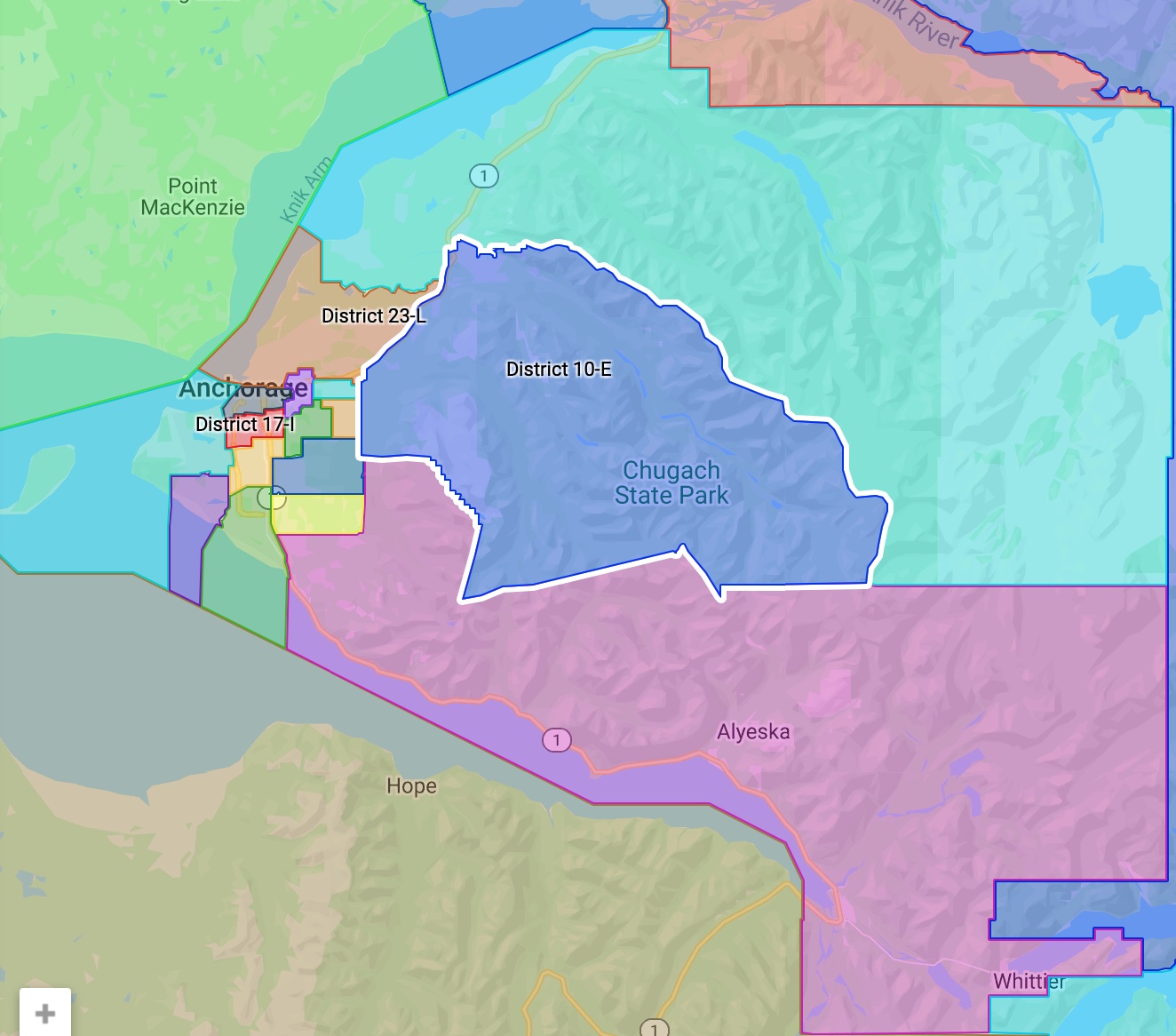
Democrat activists in Anchorage, including one who is a candidate for Anchorage Assembly, are challenging the Alaska Redistricting Board’s maps again, just as they did earlier this year, when they convinced the Alaska Supreme Court to send the Eagle River political boundary map back to the redistricting board for a do-over.
They’re so upset with the new map that they have asked the court to hold the Alaska Redistricting Board in contempt of court.
The three — candidate for Assembly George Martinez, Democrat activist Yarrow Silvers, and Alaska Democratic Party 2020 national delegate Felisa Wilson — say the new map is still gerrymandered. What the three want is for one more Democratic seat in Anchorage, although the new map already gave the Democrats more power in Anchorage. For the three Democrats and their backers in the Alaska Democratic Party, it’s all or nothing.
The three activists filed a challenge with Anchorage Superior Court on Monday. Judge Thomas Matthews, who had rejected the first Eagle River political boundary map, which had a portion of Muldoon included, is considering the legality of the new map. Is it contiguous? Is it compact? And, importantly for the Democrats, does it give Democrats more power in the Alaska Senate and does it weaken Eagle River’s increasing power as a community? Eagle River has been growing, while Anchorage has been shrinking and the Democrats are interested in minimizing the Eagle River political strength.
“Despite clear direction from the Alaska Supreme Court and the Alaska Superior Court, and repeated objections from East Anchorage Plaintiffs, the public, and even members of the Board itself, the Board corrected only one of the two senate pairings that resulted in the unconstitutional Senate District K. As a result, the Board preserved, and in many ways exacerbated, the unconstitutional political gerrymander rejected by this Court. So long as the objectives behind the Board’s unconstitutional intent remain uncorrected, so too does the constitutional violations arising from them. The Board does not shed this Court’s findings of unlawful intent on remand. Thus, on remand, the Board’s intent to split Eagle River districts to increase the representation of the majority political party remains, and the only way to correct the dilutive consequences of this unlawful intent is to cure it. Approval of the Board’s evasive actions not only sanctions the Board’s unconstitutional conduct, it erodes public trust in the independence and integrity of the redistricting process, and in the protections afforded by the Alaska Constitution,” the three asserted in their statement to the court.
There is no compromising with the three, who have two of the Alaska Redistricting Board members on their side. The legal delay created by their repeated challenges could impact the upcoming elections; June 1 is the last day for people to sign up for the Aug. 16 primary. Anchorage Superior Court Judge Thomas Matthews is the first stop for the redrawn maps; whatever he decides will then go to the Alaska Supreme Court for appeal. All that needs to be done in the next 43 days to meet the already published election calendar.
The Supreme Court upheld all of the other district lines drawn by the Redistricting Board. There had been several challenges, but the court only decided that the Eagle River Senate lines, as originally drawn, were problematic.
Now, the three complainants are calling for punishment of the Alaska Redistricting Board for contempt of court.
The filing from the three Democrats states, “The majority members of the Board blatantly and willfully evaded the remand order to perpetrate their unlawful objective. These Board members ignored the Court’s clear directive to correct the unconstitutional partisan gerrymander and instead orchestrated a pretextual hearing process that undermined the legitimacy and independence of the redistricting process. While East Anchorage Plaintiffs respect the “Herculean task” undertaken by the Board, respect for that effort does not shield the Board from the consequences of its direct and willful refusal to follow the constitutionally-mandated redistricting process. In Alaska, courts have “inherent power” to punish a party for contempt, “whether direct or indirect,” where “necessary to preserve the dignity, decorum and efficiency of the court.” Here, the Board’s conduct not only threatens “the dignity, decorum, and efficiency of the court”, it impugns the dignity of our electoral system and the public’s trust in that system. The Board’s knowing failure to comply with this Court’s Findings of Fact and Conclusions of Law is contemptuous, justifying any and all court action necessary to bring the Board into compliance with the order…”


