
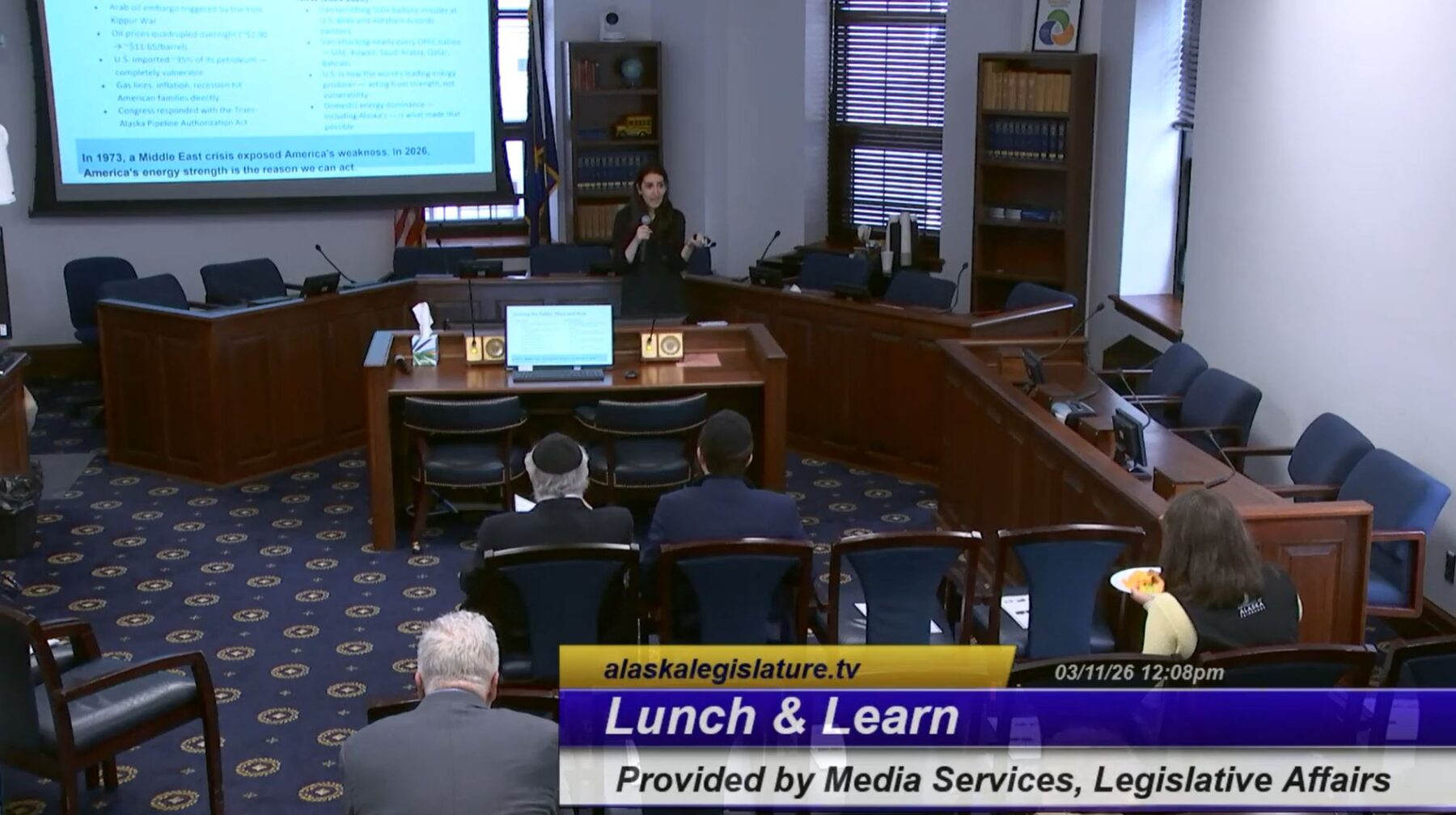
State lawmakers and staff gathered today for a lunch-and-learn briefing hosted by Representative Kevin McCabe’s (R-Big Lake) office featuring the Council for a Secure America (CSA). The session underscored Alaska’s longstanding contribution to American energy independence and its strategic importance amid ongoing Middle East tensions, including Iranian missile strikes on U.S. allies and Abraham Accords partners.
Staffer Elesheva Almeida welcomed attendees, noting the informal setting while emphasizing Alaska’s “very unique role” in global stability and energy. Executive Director Jennifer Sutton of CSA, delivered a detailed historical and geopolitical overview. Sutton traced the origins of U.S. energy policy to the 1973 Yom Kippur War and Arab oil embargo, which quadrupled prices from $2.90 to $11.65 per barrel and exposed 35% import dependence, triggering gas lines, inflation, and recession.
Congress responded swiftly with the Trans-Alaska Pipeline Authorization Act, passed in November 1973. Construction began in 1974, and the pipeline—now known as TAPS—opened on May 31, 1977. Prudhoe Bay’s 1968 discovery enabled this infrastructure, which has since transported more than 18 billion barrels. Alaska production peaked near 2 million barrels per day in 1988, supplying roughly 25% of U.S. oil at its height. “Alaska was there first,” Sutton told the group, framing TAPS as a direct policy response to the 1973 crisis that placed the state “at the geopolitical center of U.S. national security and energy dominance.”
The Abraham Accords would never have happened without U.S. energy dominance
Sutton connected this foundation to today’s realities. The Lower 48 shale revolution doubled crude output from 5 to 11 million barrels per day, slashed net imports from 12 million barrels per day in 2008 to near zero by 2020, and boosted natural gas production over 70%. The 2015 repeal of the crude export ban shifted America from price taker to price stabilizer. This domestic strength, Sutton argued, enabled the Abraham Accords and allowed both Republican and Democratic administrations to respond decisively to regional crises without economic vulnerability.
Current events underscore the stakes. Iran has launched over 500 ballistic missiles at Abraham Accords nations and OPEC partners including the UAE, Kuwait, Saudi Arabia, Qatar, and Bahrain. Seventy percent of Iran’s government revenue historically derived from oil sales, with China purchasing 90% of those exports. Sutton noted shadow fleets and sanctions evasion fund proxies such as Hezbollah, Hamas, and the Houthis. The Strait of Hormuz carries 20% of global oil and 25% of LNG—roughly 21 million barrels per day—yet U.S. resilience means any disruption impacts America far less than China, which sources about 13% of its oil from the region.
CSA focuses on rapid-response educational primers, polling, and fact-based briefings rather than legislation. Sutton highlighted open-source analysis drawing from sources across the spectrum and offered one-pagers summarizing Iran’s oil flows, regional alignments, and energy security dynamics. She invited Alaska stakeholders to a potential North Slope delegation, mirroring CSA trips to the Bakken, Oklahoma, Texas, and Wyoming, so “the people of Alaska could tell their story.”
A geologist attendee raised diversification, noting ANWR potential may represent less than a year of U.S. consumption amid high demand. Sutton endorsed “energy addition”—all domestic forms of energy viewed through a national security lens—while prioritizing American technology and supply chains. “A Chinese solar panel is not going to make America safer at the expense right now of drilling in certain states,” she said, stressing U.S.-based innovation in AI and data centers.
Sutton clarified CSA’s emphasis on the U.S.-Israel relationship: Israel remains America’s strongest democratic ally in the Middle East, sharing values and strategic interests. Israel’s own natural gas discoveries have reshaped its regional diplomacy, enabling cooperation with neighbors including Egypt during the Russia-Ukraine conflict. The Abraham Accords, she noted, exemplify how U.S. energy strength plus strong alliances advance peace and prosperity.
Attendees left with a clearer picture of Alaska’s foundational contributions to national security and the ongoing opportunity for the state to lead in LNG exports to Asia, potentially displacing adversarial supply chains to markets like South Korea and Japan.
“The Abraham Accords would never have happened without U.S. energy dominance,” Sutton stated, underscoring how domestic production enables decisive American diplomacy.
The session reinforced Alaska’s position not merely as an energy producer but as a strategic exporter of national security at a pivotal global moment.


