ALASKA-LED TEAM VINDICATES 911 ‘TRUTHERS’
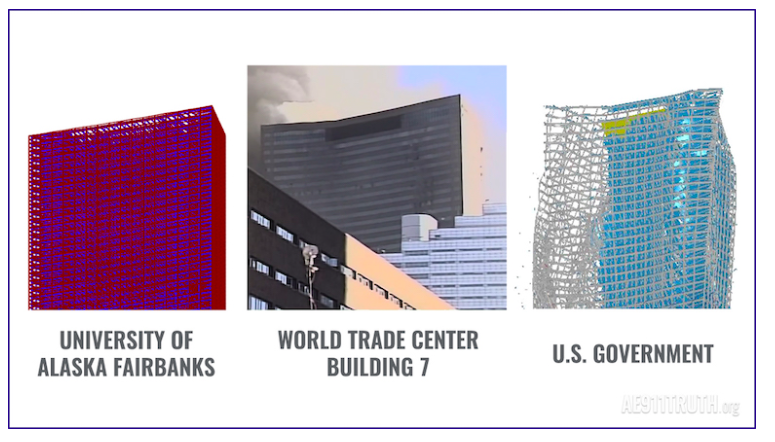
(Editor’s note: In response to reader comments, the photo illustrating this story was replaced to show Building 7. It’s an image from the ae911truth.org website.)
The leading program in Alaska for engineering at the University of Alaska Fairbanks and an organization called “Architects & Engineers for 9/11 Truth,” have created a partnership in an investigative study of what brought down Building 7 of the World Trade Center on Sept. 11, 2001.
The release of the draft report on Sept. 3 triggered a two-month public comment process.
[Read the report at this UAF link]
The draft report concludes that fire did not cause the collapse of WTC 7 on 9/11, contrary to the conclusions of the several national private engineering firms and the government’s National Institute of Standards and Technology.
The study concludes that the collapse of WTC 7 was instead a “global failure involving the near-simultaneous failure of every column in the building.” According to the study’s authors:
“The UAF research team utilized three approaches for examining the structural response of WTC 7 to the conditions that may have occurred on September 11, 2001. First, we simulated the local structural response to fire loading that may have occurred below Floor 13, where most of the fires in WTC 7 are reported to have occurred. Second, we supplemented our own simulation by examining the collapse initiation hypothesis developed by the National Institute of Standards and Technology (NIST). Third, we simulated a number of scenarios within the overall structural system in order to determine what types of local failures and their locations may have caused the total collapse to occur as observed.”
The study had three objectives:
- Examining the structural response of WTC 7 to fire loads that may have occurred on Sept. 11, 2001,
- Ruling out scenarios that could not have caused the observed collapse, and
- Identifying types of failures and their locations that may have caused the total collapse to occur as observed.
The UAF research team simulated the local structural response to fire loading that may have occurred below Floor 13, where most of the fires in WTC 7 are reported to have occurred.
The team then “supplemented our own simulation by examining the collapse initiation hypothesis developed by the National Institute of Standards and Technology (NIST).”
Then, the team simulated a number of scenarios within the overall structural system in order to determine what types of local failures and their locations may have caused the total collapse to occur as observed.
The research team is currently organizing and uploading all of its data into a format that can be readily downloaded and used. We expect to post the data sometime between Sept. 16-30, 2019.
Architects & Engineers for 9/11 Truth was started by San Francisco architect Richard Gage, who postulates the government has been hiding evidence of a controlled demolition of the third Trade Tower building that collapsed during the 911 attack.
There will be a two-month public comment period from September 3 to November 1, 2019, with the final report to be released later this year.
“During this period, we welcome any and all members of the public to submit constructive comments intended to further the analyses and presentation of findings contained in the report.
Reviewers outside of the University of Alaska Fairbanks and Architects & Engineers for 9/11 Truth will also review the report during this period. Commenters are asked to send their comments in an attached PDF or Word document to [email protected].”
The government study came to different conclusions, explained in this NIST video: