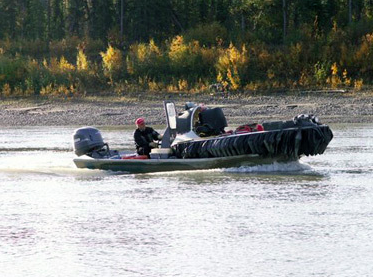
ANILCA RULES THE DAY IN FAVOR OF ACCESS
Hunter John Sturgeon has been battling for 12 years and has spent $1.2 million to defend Alaskans’ rights to use their rivers as highways. He’s been to the Supreme Court, and won a partial victory two years ago.
But the court asked the Ninth Circuit to review its work, and the Ninth again ruled against the moose hunter who had been stopped by Park Service rangers on the Nation River, and was sent packing.
Today the U.S. Supreme Court, in a unanimous ruling of 9-0, ruled that the Nation River is not “public” land, (this means it is not federal land) and like all non-federal land is navigable inside of Alaska’s national parks. It’s Alaska land.
Rivers are exempt, the court ruled, under the Alaska National Interest Lands Conservation Act, from the National Park Service’s ordinary regulatory authority. The Park Service doesn’t get to order Alaskans off of rivers in the state.

Justice Kagan wrote the opinion and Justice Sotomayor filed a concurring opinion, joined by Justice Ginsburg, three of the most liberal judges on the Supreme Court.
“What it says is that Alaska not only owns the rivers, but it gets to manage the navigable rivers in the state. Alaska is different. The Supreme Court has said it again and again, that we are different, not only by culture, but by law,” said Sturgeon. We should be treated differently — that’s what the law said.”
Sturgeon said he had many people to thank, and that is was not a win just for his right to hunt, but for all Alaskans.
“It’s a huge win for all of Alaska. People congratulate me, but hundreds of people helped me in this lawsuit — people like Craig Compeau of Fairbanks and Ed Rasmuson, who have been my two biggest supporters from the beginning. But people have helped, from $5 to $20,000, and the Alaska Outdoor Council added $100,000.”
[Read: John Sturgeon, hunter, heading back to Supreme Court]
[Read: Sturgeon gets round two at Supreme Court]
About 8,000 cases were denied by the U.S. Supreme Court this session, but Alaska’s John Sturgeon vs. Frost (U.S. Park Service case #17-949) was accepted — for the second time.
The high court’s first ruling in favor of Sturgeon in 2016 was narrow. It sent key questions back to the Ninth Circuit, which doubled down in October, 2017 on its ruling against state sovereignty and aspects of the Alaska National Interest Lands Conservation Act. The 9th Circuit judges ruled the federal government has authority over rivers within the national parks under a broad scope of water reservation provisions in federal law.
That left Sturgeon going back to the Supreme Court, which issued its ruling this morning, 12 years after Sturgeon was stopped by Park Service rangers while navigating the Nations River on his way to his moose hunting grounds.
Justice Kagan wrote:
“Petitioner John Sturgeon traveled for decades by hovercraft up a stretch of the Nation River that lies within the boundaries of the Yukon-Charley Preserve, a conservation system unit in Alaska. On one such trip, Park rangers informed him that the Service’s rules prohibit operating a hovercraft on navigable waters ‘located within [a park’s] boundaries.'”
“Sturgeon complied with the order, but shortly thereafter sought an injunction that would allow him to resume using his hovercraft on his accustomed route. The District Court and the Ninth Circuit denied him relief, interpreting Section 103(c) to limit only the Service’s authority to impose Alaska-specific regulations on inholdings—not its authority to enforce nationwide regulations like the hovercraft rule.
“Today’s ruling represents an important moment for Alaska’s sovereignty and the rule of law,” said Gov. Michael Dunleavy. “Once again, the Supreme Court shows why the Ninth Circuit Court is one of the most out of touch and out of line courts in the nation.”