

An adventure tour company in Alaska offers packages exclusively for “people of color” so that they can run on trails without being with white people.
This summer, an Alaska company out of Cordova called Run Alaska Trails hosted a multi-faceted trail running and adventure tour that was for BIPOCS only — that’s “Black, Indigenous, People of Color” in the parlance of the new American apartheid movement.
They ran trails on the Kenai Peninsula and they went whale watching as a group that was relieved of the burden of having white participants.
One woman who signed up for the run wrote about her experience in The Seattle Times.
“Before this trip, I had participated in various ‘outdoor adventure’ activities — like whitewater rafting, kayaking and hiking in the mountains. But I’ve often been the only person of color in these situations, or one of only a few. I’m half Filipina and half white, and I’m aware that I sometimes blend into all-white spaces, and I sometimes stick out,” wrote Allison Torres Burtka in a special to The Seattle Times.
In Outside Magazine, Burtka also described the exhilarating experience of white exclusion: “In my mind, Alaska was never a place where Black people go. It was like this beautiful opportunity to give us all permission to go someplace that we didn’t think was for us,” the trip’s organizer was quoted as saying.
It is happening on college campuses across America, where institutions are creating black-only spaces — dorms and clubs being the most well-known. At Western Washington University south of Seattle, there is segregated housing just for blacks. That follows the footsteps of Harvard, New York University, the University of Colorado, Stanford, and Cornell, which have all created black-only housing.
University of North Carolina at Asheville advertised a “BIPOC Gardening Day” as a part of “Welcome Week” at the campus. The office of the mayor of Cambridge, Mass. posted an eight-page explanation of “Why People of Color Need Spaces Without White People.”
Jay McDonald, an Alaska-born activist who has a multi-race family, called the Alaska Human Rights Commission to discuss whether companies operating in Alaska can exclude whites from events in Alaska.
The Commission enforces the Alaska Human Rights statute which makes it unlawful to discriminate: in employment, places of public accommodation, housing, financing and credit, and practices by the State. The mission statement is simple: “To eliminate and prevent discrimination for all Alaskans.”
In Alaska it is illegal to discriminate in:
- Employment
- Places of Public Accommodation
- Sale or Rental of Real Property
- Financing and Credit
- Practices by the State or its Political Subdivisions
Because of:
- Race
- Color
- Religion
- Sex
- National Origin
- Physical or Mental Disability
And in some instances because of:
- Age
- Marital Status
- Changes in Marital Status
- Pregnancy
- Parenthood
- Sexual Orientation / Gender Identity or “expression”
Can a tour company like Run Alaska Trails exclude participants and refuse the bookings of white people based on color?
When McDonald called the Human Rights Commission, the person responding to his complaint seemed to think it is fine to segregate for BIPOC, because the ad for the event says “people of color.”
“White is a color,” the Human Rights Commission employee responded to McDonald, adding that she herself did not feel excluded by the BIPOC promotion. She told McDonald that she didn’t understand what the concern is.
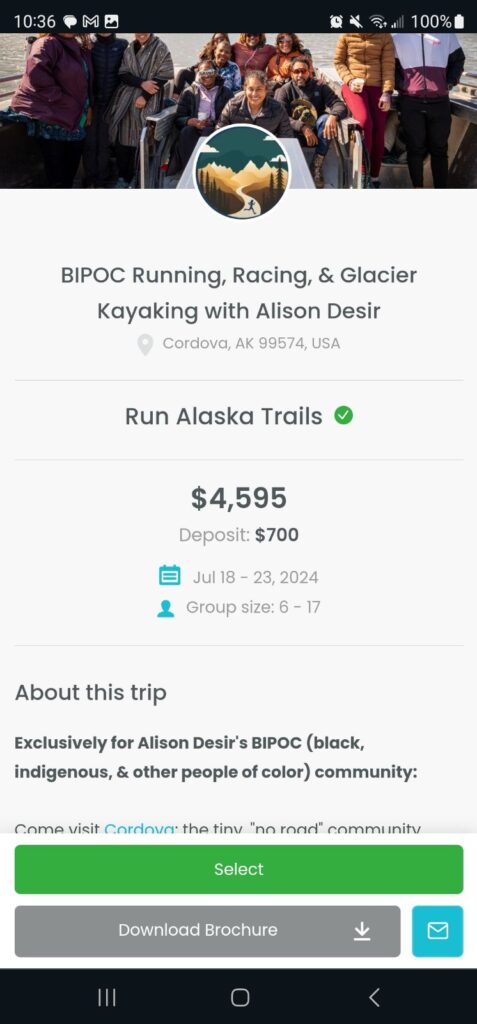
The concern for some people is that private companies are now re-segregating America.
“So the idea of running and adventuring in Alaska with a group that was all people of color was enticing. If any of us got stares, our travel companions might be getting them, too — or at least they’d understand what it felt like,” Burtka wrote. It was pretty clear that white is not a color.
“THE PEOPLE IN my group have several ethnic backgrounds — Black, Latinx, Asian, Indigenous and biracial. We are all people of color, but we don’t have the same experiences navigating through the world,” she wrote.
“Out on the trails, the other people around were almost all white. I wondered what they thought of us, because groups as diverse as ours probably aren’t running through the woods in Alaska very often. Most of them returned our friendly waves and greetings,” the writer said.
The feature on the glories and benefits of race-based trail running is behind a paywall at the Seattle Times. But the article it makes it clear that keeping whites out of a group is a big benefit to the participants.
McDonald has another perspective: It is illegal, and the answer from the Human Rights Commission is inadequate.
“They are doing it in Chugach National Forest and their business is permitted inside the federal forest. They are violating Title 6 as well as the 14th Amendment,” McDonald said.
On the company’s own web page, it acknowledges it is an equal opportunity provider, but apparently that has a new definition.



