
Nate Silver, the statistics wizard considered one of the top predictors in America, said Hillary Clinton had a more than 71 percent chance of winning the presidency.

He made that claim on Aug. 5, 2016, just three months before Donald Trump was declared the victor, not with the popular vote, but by the Electoral College.
Four years later, Silver is again predicting that the Democrat in the presidential election will win, and he’s giving Joe Biden a 72 percent likelihood to be the victor.
Remarkably, Silver’s organization glosses over its statistical record on anything related to President Trump, saying the model did a good job in 2016, when it so badly missed.
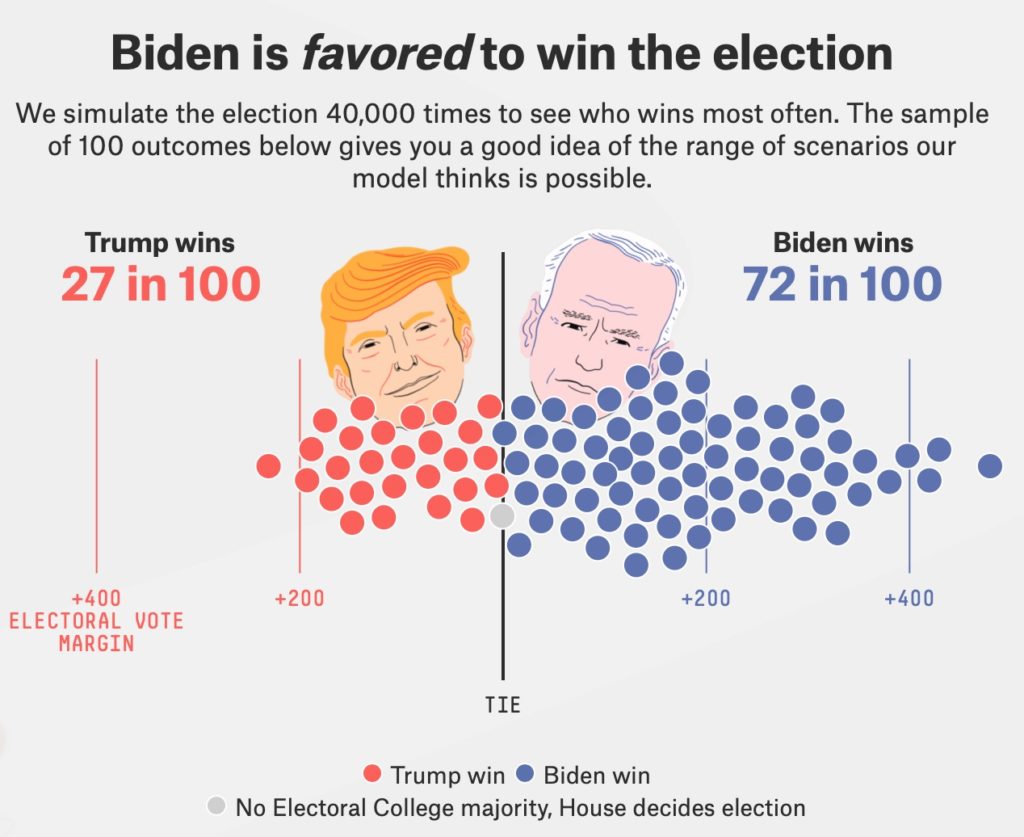
“Although it had Hillary Clinton favored, it gave Donald Trump around a 30 percent chance of winning on Election Day, which was considerably higher than other models, prediction markets, or the conventional wisdom about the race,” the website said.
Not exactly. The August, 2016 model gave Trump a 28.6 percent chance of winning, not 30 percent, but we’ll allow him editorial license, since it was his poll.
Trump only won by being able to work the map properly. Clinton, as we are reminded by Democrats time and again, received 2.87 million more votes than Trump. That’s more than a 57,000 vote advantage if we spread those votes like butter between the 50 states. Luckily, we don’t have the heavily populated blue states like New York and California overwhelming the less-populated red states like Alaska.
The Silver methodology uses various polls that it’s sent, with the exception of a few that are wildly biased. But those polls – CNN, Fox, Morning Consult, Pew — all have flaws, increasingly so as time and technology march on.
Indeed, a recent study shows that polls have closer to a 6 percent margin of error, rather than the 3-4 percent they cite.
Silver is a statistician who analyzes sports and elections at the website he founded, FiveThirtyEight.com. He is considered by news reporters to be a credible, hipster source for the predictive arts during elections and he was spot on in 2012, making him the savant he is today. 2016 was, he says, kind of an anomaly.
According to Silver, if his model says a candidate has a 30 percent chance of winning, that’s something you can take to the bank. But then he equivocates by saying this is no ordinary election. COVID has made things very unpredictable.
That’s not the only thing that is now unpredictable. We hear that people are not telling others how they are voting, because families, coworkers, and friends who do not like the president have been getting wildly emotional and their responses are erratic and unpleasant, sometimes violently so. This writer has spoken to a dozen individuals who won’t display a Trump bumper sticker, because their neighborhood leans liberal and they don’t want their car vandalized, and others who won’t display a Trump sign or flag on their property, for fear of having their house torched.
These are conditions not accounted for in the polls of America, which typically reach a more liberal respondent.
But none of this should comfort President Trump. The Electoral map is what brought him to the dance the first time, and will be what likely governs November, if riots, plague, and massive fraud do not also come into play.
The odds that riots, plague, and widespread voter fraud are factors for November? At least 50 percent.
Read about all the equivocating variables in the Nate Silver modeling in his Aug. 12, 2020 article, titled “How FiveThirtyEight’s 2020 Presidential Forecast Works — And What’s Different Because Of COVID-19.”

