
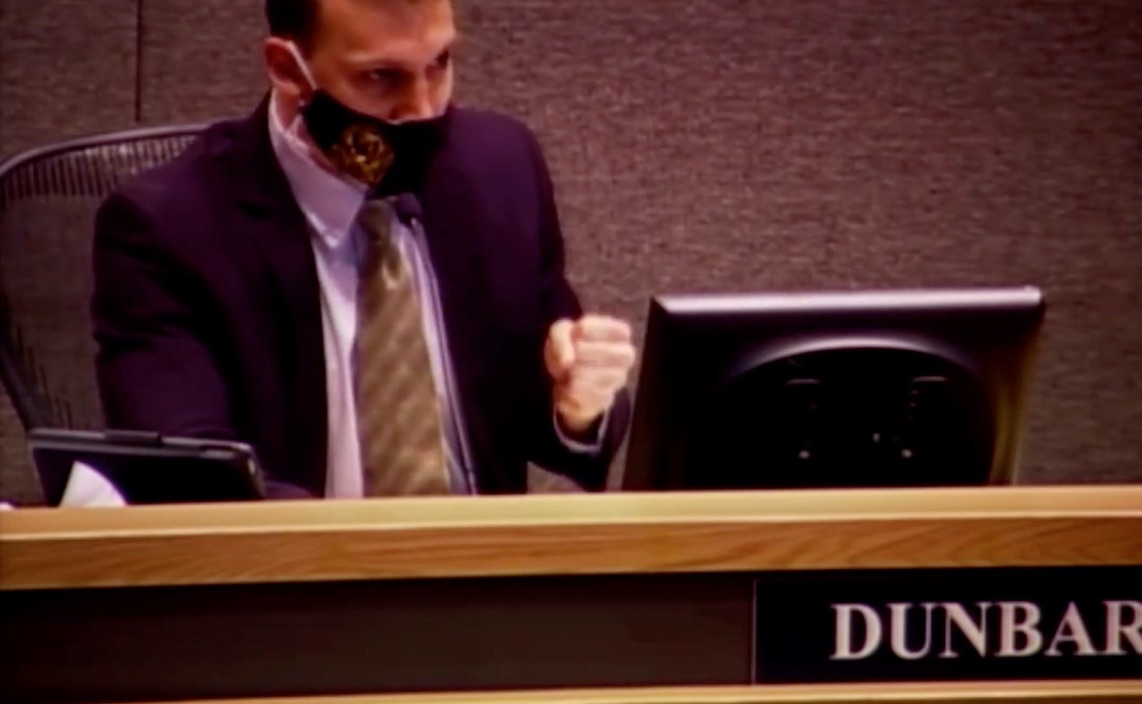
New campaign finance laws known as Ballot Measure 2, passed by voters in November, are beginning to sting the Forrest Dunbar campaign.
In the current attack ad against opponent Dave Bronson launched by supporters of Forrest Dunbar, the disclaimer at the end of the ad admits that “A majority of contributions to Building a Stronger Anchorage came from outside the state of Alaska.” That’s now required by law.
Majority of money is an understatement: All of money used to attack Dave Bronson is coming from a national attack dog group.
What group? The Sixteen Thirty Fund.
Ballot Measure 2 created a wide-open jungle primary for state and national seats, as well as ranked-choice voting during the General Election. None of that will go into effect until the 2022 cycle.
But the campaign finance part of the ballot measure requires greater disclosure of where the money comes from. Dark money must be disclosed in campaigns being run this year.
Only a handful of Alaskans truly understand the ballot measure, which stretches 25 pages long. Among other things, it requires persons and entities that contribute more than $2,000 that were themselves derived from donations, contributions, dues, or gifts to disclose the true sources (as defined in law) of the political contributions.
That means that groups like Building a Stronger Anchorage have to follow the law, and tell Alaskans the real source of their funding.
Building a Stronger Anchorage is funded, as it turns out, 100 percent by the dark-money Sixteen Thirty Fund in Washington, D.C. The Sixteen Thirty Fund’s existence dates back to the scandal-ridden ACORN group that was exposed to be engaged with voting fraud by Project Veritas’ James O’Keefe.
In 2018, The Sixteen Thirty Fund spent $141 million on over 100 left-leaning and Democratic causes.
According to Influence Watch:
“The Sixteen Thirty Fund (sometimes styled “1630 Fund”) is a left-of-center lobbying and advocacy organization founded in 2008.[1] Sixteen Thirty Fund often operates alongside its charitable “sister” nonprofit New Venture Fund, which provides similar funding and fiscal sponsorship services to center-left organizations. Both groups, along with the Hopewell Fund and Windward Fund, are administered by Arabella Advisors, a Washington, D.C.-based philanthropy consulting firm that caters to left-leaning clients.
According to its founding documents, the Sixteen Thirty Fund was created with seed funding from Americans United for Change (AUFC), ACORN, USAction, the Sierra Club, and Working America. [2]
Both Sixteen Thirty Fund and New Venture Fund have been criticized as “dark money” organizations by left-leaning news outlets, including the New York Times, for serving as a way for left-wing groups to anonymously funnel money toward various advocacy issues, such as attacking vulnerable Republicans or pushing state-level environmental restrictions. [3] [4]
In April 2021, the New York Times criticized Arabella’s “system of political financing, which often obscures the identities of donors,” as “dark money,” calling the network “a leading vehicle for it on the Left.” [5] Left-leaning Politico has called the Sixteen Thirty Fund a “massive ‘dark money’ network” responsible for “boost[ing] Democrats” in the 2018 midterm elections, a “liberal dark-money behemoth,” a “secretly funded nonprofit,” and “one of the Left’s financial hubs” responsible for “attacking Republican senators” in 2019. [6] [7] [8] The Sixteen Thirty Fund has also been characterized as one of the “key groups founded to resist Trump” by the left-leaning Atlantic. [9]
In its 2018 Form 990, New Venture Fund shows a $26.7 million grant to the Sixteen Thirty Fund for “capacity building.” [10] Sixteen Thirty Fund’s Form 990 of the same year, also shows zero employees, and notes in Schedule O that “New Venture Fund (NVF) is the paymaster for Sixteen Thirty Fund payroll. NVF pays the salary and immediately invoices Sixteen Thirty Fund, which reimburses the full amount.” [11]
Arabella and its nonprofit network have been criticized as “dark money” funders both for channeling hundreds of millions of dollars to left-wing organizations and for hosting hundreds of “pop-up groups”—websites designed to look like standalone nonprofits that are really projects of an Arabella-run nonprofit. [12]
In November 2019, Politico criticized the Sixteen Thirty Fund, the 501(c)(4) advocacy wing of Arabella’s nonprofit network, as a “little-known,” “massive ‘dark money’ group [that] boosted Democrats” in the 2018 midterm elections with $140 million. “The money contributed to efforts ranging from fighting Supreme Court Justice Brett Kavanaugh and other Trump judicial nominees to boosting ballot measures raising the minimum wage and changing laws on voting and redistricting in numerous states,” the left-leaning website reported. Politico also noted that Sixteen Thirty Fund’s biggest single donation (made anonymously) was for $51.7 million, “more than the group had ever raised before in an entire year before President Donald Trump was elected,” adding that “the group’s 2018 fundraising surpassed any amount ever raised by a left-leaning political nonprofit.” [13]
The left-leaning Washington Post further criticized Arabella’s Sixteen Thirty Fund as a “big campaign donor” in a November 21, 2019 opinion by the editorial board, which called on Congress to change nonprofit disclosure laws, noting in particular a $26.7 million anonymous donation to the Fund. [14] However, the Post also failed to connect the Sixteen Thirty Fund to Arabella Advisors and its other three nonprofits.
In a November 24, 2019 letter to the editor published by the Washington Post, Capital Research Center president Scott Walter identified the $26.7 million donation as originating with the New Venture Fund, the largest of Arabella’s in-house nonprofits, and confirmed Politico’s suspicion that the Sixteen Thirty Fund is “part of a larger network of dark money.”


