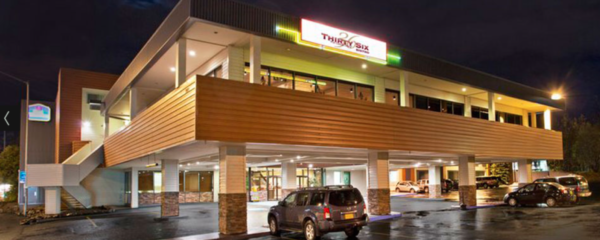
The old Golden Lion Hotel, at the corner of 36th Avenue and New Seward Highway, was originally purchased by Mayor Ethan Berkowitz’s administration for use as a drug and alcohol treatment center, over the objection of the neighborhoods in the area — College Village and Geneva Woods.
The purchase was put together during the summer of 2020 when the Assembly banned the public from the Assembly Chambers and made many decisions in secret under the banner of “it’s an emergency.”
Berkowitz used the proceeds from the sale of Municipal Light & Power to Chugach Electric to purchase the hotel for $9.3 million, with the promise to the Regulatory Commission of Alaska that it would be used for a drug treatment center. The Golden Lion was to fulfill the requirements of the ML&P sale, as approved by the RCA.
Now, after two years of the hotel sitting fallow and the neighbors objecting to having a drug magnet near the children in their area, there’s another new use in mind. The Anchorage Assembly’s hastily thrown-together task force wants to use the vacant hotel instead as a homeless shelter.

The Golden Lion’s 85 rooms could be filled immediately with between 85 and 170 homeless people, at a cost to taxpayers of $371,000 for October, November, and December.
That factors out to $1,455 in rent for a one or two-person unit per month, only in this case it would be a hotel room.
The sudden “emergency” repurposing of the hotel is an example of how local government makes promises to adjacent neighborhoods about uses for property it buys, but can change its mind and use the property for an entirely different purpose. And it can do so within months of having made a promise. All it needs to do is to say there is an emergency.
The task force was created by the Assembly majority in August in response to the leftist majority’s discontent with the progress Mayor Dave Bronson has made for the winter housing of homeless in Anchorage — progress the Assembly has blocked by preventing the mayor from being able to move ahead with the plans of his administration.
The task force is led by Meg Zaletel, the Anchorage Assembly member who also is the executive director of the Anchorage Coalition to End Homelessness. Also on the task force are Assemblyman Felix Rivera, City Ombudsman Darrel Hess, and representatives from various social service agencies, such as United Way and Bean’s Cafe.
The task force also suggests using the Dempsy Ice Area for congregate (mass) sheltering.
“The Task Force recommends that these recommended options be exercised as quickly as possible and simultaneously and that the MOA work expeditiously to provide funding to support expanded capacity by existing shelter operators with proven positive performance,” the task force said.
The task force’s recommendation, thrown together in just three weeks, supplants the Mayor-Assembly year-long negotiated plan that the Assembly had already approved.
The Anchorage Assembly task force is yet another effort to have the legislating branch of local government take over the job of the executive branch, as it has attempted to do repeatedly since Mayor Dave Bronson was sworn in in 2021. Last week, the Assembly put a long delay on the mayor’s cornerstone homelessness project — a navigation center to help indigents, vagrants, substance abusers, and those with sudden housing needs sort out their issues and get pointed in the right direction, whether it be shelter for domestic violence victims, drug treatment for meth addicts, or a cot in a congregate shelter.
Although the Assembly had, after a year-long negotiation with the Mayor’s Office, approved the navigation center, last week Assemblyman Rivera said the long-term solution project that he negotiated with the mayor needs to be delayed indefinitely and the city needs to focus on housing people immediately.
If the hotel is used for a homeless shelter rather than a treatment center, it’s likely the city will have to pay the Regulatory Commission of Alaska back for the amount the city spent to buy a property with the proceeds of the ML&P sale.