
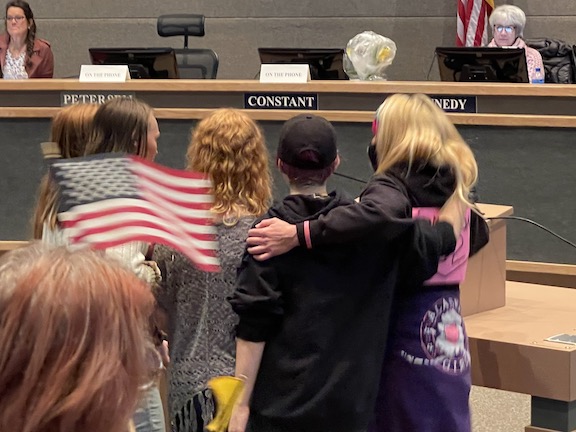
A man who told the Anchorage Assembly that the homeless problem in Anchorage is primarily among Natives, and that Native villages and corporations need to help solve the problem, has prompted members of the Assembly to ponder how to censor the public’s free speech at the Assembly.
The Assembly has already taken its first steps toward censorship by eliminating the first half hour of public participation that was a standard of the meetings until this month. The reason stated was that the Assembly didn’t want to hear from the public so much. The Assembly leadership also enforces its speech rules in an uneven manner, singling out those it disagrees with for harsh treatment; punishment includes being forcibly ejected from the meetings. The Assembly has created rules for what constitutes an “actual disturbance” (clapping when the Assembly leaders don’t want to hear clapping), and has limited signs in the Assembly Chambers to letter-sized pieces of paper.
The leadership of the Assembly on Tuesday sent out a press release condemning the man for his statements, which the leadership said was racist. The Anchorage Daily News has also labeled the man’s statement as racist.
Chairwoman Suzanne LaFrance and Vice Chair Christopher Constant wrote, “As the Assembly Leadership, we want to speak out against the racist and offensive statements made by the member of the public. Unfortunately, this is not the first time racist views have been expressed in the Assembly Chambers. The First Amendment gives wide latitude to members of the public to express opinions, even hateful ones, and this latitude extends to the Assembly Chambers.”
In that statement, the chair and vice chair appear to realize that there is only so much they can do, but they can at least call the man’s remarks “racist.”
“We are saddened by the pain the statements have caused to our friends, neighbors and community members who are Alaska Native. We want everyone in our community to feel welcome, safe and valued. Our community is full of rich and diverse cultures that should be celebrated and acknowledged for their important contributions to our society, culture, government, schools, and economy. We recognize that there is much work to be done to end racism and ensure that everyone is treated with respect,” the two wrote.
The Assembly is majority white, with two Hispanics on the 12-member body — Jamie Allard and Felix Rivera. There are no Alaska Natives who serve on the Anchorage Assembly.
“As to the comments the member of the public made pertaining to housing and homelessness, the Assembly will continue to work diligently with the community and the Administration to solve this complex issue until everyone who resides in the Municipality of Anchorage feels welcome and has a place to call home,” LaFrance and Constant wrote.
The Anchorage Daily News described it in the expected fashion: “A man’s racist testimony about Alaska Natives during an Assembly meeting last week ignited a larger conversation about how city officials and residents should respond when people make false or derogatory statements, especially during public meetings.”
The newspaper, in describing the testimony, gave the verdict that the man’s comments were “generalizations, stereotypes and untrue.”
After the man had finished speaking during his three minutes allowed at the podium, a visibly angry Assemblyman Forrest Dunbar began to argue with him, in violation of the rules of the Assembly that prohibit sitting members from badgering the public who is speaking.
Dunbar asked the man, “Where did you learn all this false nonsense?”
That’s when Assemblywoman Jamie Allard called for a point of order and said, “Let’s just not debate. I understand both perspectives and I just hope we can move on and not debate.” She was trying to calm the tension that Dunbar had created by harassing a witness who expressed a point of view that was not in alignment with the Assembly. Although she is Hispanic (one of two on the Assembly), the Left has called her racist and a Nazi, and she was interested in stopping the acceleration of the dispute started by Dunbar with the man at the podium.
The largest newspaper in Alaska wrote: “Many said that Lazer’s blatant statements laid bare often-repeated misinformation and the anti-Indigenous ideology at play in Alaska’s communities — and further exposed how testimony during the public meetings has been used to spread messages of bigotry and misinformation.”
Now, a professor emeritus from the University of Alaska has weighed in with a letter to the Assembly about how to handle speech that is racist, hateful, or not welcome. He wants the public censored.
According to Steven Aufrecht, professor emeritus of Public Administration at the University of Alaska Anchorage, some speech just pollutes the public discourse. And, he says in his recommendations to the Assembly, some people should just be banned from speaking at the Assembly, although the rules must be tightened up in order for that to work.
“Charles Fox and Hugh Miller, two public administration scholars, many years ago suggested some conditions for participation in a public discourse. Without these, democracy cannot thrive,” Aufrecht wrote to the Assembly.
The professor’s recommendations to the Assembly continued. According to his letter, some people just pollute the public discourse because their brains are polluted with misinformation:
“Pollution of Public Discourse
“What’s that? If toxic chemicals get into the water system, the whole system has to be cleaned out before people can drink the water again.
“When people come to the public forum, but insult their fellow citizens, spout half truths and complete lies, don’t learn the complexity of issues, they are really civic outlaws who pollute the public forum.
“Our progress to finding alternatives that we can all reasonably live with is thwarted. Instead, the public forum is cluttered with rhetorical litter – lies, falsehoods, innuendo and clear cut slanders – that have to be cleaned up before we can go on.
“But it’s not as simple as picking up trash. People’s brains have been polluted, misinformation has been planted, and people have lost trust in others, healthy debate dissolves into hostile conflict.
“The point of civic debate, theoretically, is to work out our disagreements. We:
“1. share ideas about the problem, the possible solutions
“2. identify facts,
“3. forecast consequences and costs.
“That’s the ideal. Separating the objective from the emotional is never easy. We want to allow for emotion in testimony, but we also must draw a line when emotion becomes polluting of the discourse and derails sincere attempts to deal with issues.
“Recommendations
“Point of the Assembly having the public speak is:
- “Hear their preferences
- “Hear the reasons for supporting one action/path over another
- “Gain additional facts about the costs (financial or other), impacts, etc. about one option versus another
- “Identify options that meet the needs of the most people, or minimally inconvenience the fewest people
- “Get a sense of how many people support a position (though good polling would be more accurate than counting people at meetings)
“Actions that pollute the public discourse:
- “Repetition of the same information
- “Addressing unrelated issues
- “Intentional misinformation
- “Personal insults and attacks
- “Trying to get one’s preferred outcome through physical or verbal abuse and intimidation rather than reason and information
“Strategies to encourage good public discourse and to discourage pollution of public discourse.
- “Clarifying what is expected of speakers
- “Written guidelines for oral testimony
- “Video guidelines
- “Written public testimony form to help people focus their presentation
- “State your preference – A, B, C etc.
- “Facts supporting your preference
- “Reasons for your preference
- “How does it affect you?
- “How does it affect others?
- “Costs/Savings it might entail
- “Additional facts/points that have not been raised
- “Offer the public a summary of the basic options, supporting data, costs, and impacts and ask speakers to address those points – particularly if they have something to add or refute
- “Assembly chair or members ask questions guiding the speaker toward answering the questions on the public testimony form – “Do you have any new facts to add to the discussion?”
- “Use of technology to get the public’s views
- “Electronic surveys people can take live at meetings to show support for one or another option or point – these can be done via cell phones and can show results on the screen. People watching from home should also be able to participate.
- “Online written, possibly audio and video, options that people can use to submit their testimony. The Alaska Redistricting Board had this option on their website which allowed people to submit written testimony online. The testimony was then made available for all to see online. Board members got packets of the testimony.
- “Investigate what other participation technology options are already in use in classrooms, in government public hearings, in business settings
- “Consequences for people who violate the Assembly ground rules
- “There’s a difference between people who genuinely have trouble organizing their thoughts and those who are intentionally trying to disrupt the meetings. The former should be encouraged and given help. The latter should be given alternative ways to submit their input other than oral testimony at Assembly meetings.
- “There can be a hierarchy of offenses.
- “Level 1: Worst
- “Intimidation – name calling, insults, slurs directed at other members of the public or at Assembly members or administration representatives. This includes physical and verbal threats that occur inside and outside the chamber.
- “Intentional disruptions that unnecessarily delay the proceedings. This is trickier, however the Assembly needs the power to keep order at meetings and to eject people who regularly disrupt meetings and do not stop when asked to,
- “Level 2: Bad
- “Regular harangues that are disruptive rather than sincere attempts at resolving an issue
- “Level 3: Minor
- “Repetition of things already said (this can be handled with electronic polls)
- “Difficulty organizing one’s thoughts – this needs understanding, unless it is something that happens repeatedly from the same person, in which case, moving to written testimony or referral to Public Testimony Guidelines
- “Level 1: Worst
- “Hierarchy of penalties – should be appropriate to the offense
- “Banning from public meetings (online access is available and ability to make online written testimony means the person can still hear what is happening and can still participate, but without disrupting the public discourse.)
- “Banning from making oral testimony at public meetings. Again, they can still submit written testimony, all of which should be available to the public.
“This is a start. Obviously there are legal issues to be resolved. But I believe that the ability to watch the Assembly meetings online and to submit written testimony means that people who are banned from giving public oral testimony or even from attending meetings because of disruptive behavior, can still have access to their First Amendment rights. The rules, warning steps, and penalties have to be clearly stated, and even handedly meted out for this to work,” the professor concluded.



