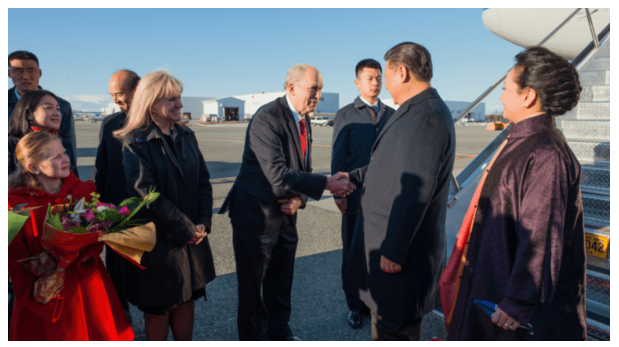
DURING BILL WALKER TALKS WITH CHINA, ALASKA STATE COMPUTERS ATTACKED BY CHINA UNIVERSITY
The Department of Justice said on Monday the China Ministry of State Security has used at least one fake think tank and U.S. universities to recruit and manage a network of spies in the United States that involve professors, researchers, and law enforcement.
“Over the past week, the Justice Department has taken several actions to disrupt criminal activity by individuals working on behalf of the government of the People’s Republic of China,” U.S. Attorney General Merrick Garland said.
In an indictment, the Justice Department accused Wang Lin and three others of systematic efforts to recruit professors at U.S. universities, as well as former federal law enforcement officials, a state homeland security official, and others, to spy on the U.S. on behalf of the Institute for International Studies at Ocean University of China, which is a fake think tank, and false front for intelligence operations.

Among the operations underway by the China spy network was an effort to force repatriation of Chinese political dissidents living in the United States.
Cases unveiled so far show “the threat the PRC (People’s Republic of China) government poses to our institutions and the rights of people in the United States,” said Assistant Attorney General Matthew G. Olsen of the Justice Department’s National Security Division.
Alaska had brushes with Chinese spying during the Walker Administration. The Chinese government, which signed loan agreements with former Gov. Bill Walker in 2017, would have established Alaska as a “debt trap” province of communist Chinese entities. China began spying on State of Alaska computers during Walker’s overtures to President Xi Jinping, as part of Walker’s quest to get financing for the Alaska Gasline.
During the 2017 Walker-China trade mission and negotiations, Alaska’s state government computers were targeted by China, both before and after Walker traveled to China to get investment agreements from entities owned by the communist government. The hackers were based at a university in Beijing, according to a cyber security firm.
“We also identified network reconnaissance activities being conducted from the same Tsinghua University infrastructure targeting many geopolitical organizations, including the State of Alaska Government, Alaska’s Department of Natural Resources, the United Nations office in Nairobi, and the Kenya Ports Authority. Additionally, we identified the targeted scanning of German automotive multinational Daimler AG that began a day after it cut its profit outlook for the year, citing the growing trade tensions between the U.S. and China. In several cases, these activities occurred during periods of Chinese dialogue for economic cooperation with these countries or organizations,” reported the cyber security company that uncovered the scheme.
Key findings from that security report concluded that Tsinghua University “engaged in network reconnaissance targeting organizations in Alaska, Kenya, Brazil, and Mongolia during times of economic dialogue or publicity around China’s investment in foreign infrastructure projects concerning China’s flagship Belt and Road Initiative (BRI). Further, the company reported that “The network reconnaissance activity against Alaskan organizations increased following the governor of Alaska’s trade delegation trip to China in late May.”
The communist Chinese use of think tanks and universities to steal American technology and innovation also has come through programs such as the Thousand Talents Program.
In 2020, director of the “talents” program was caught using approximately $4.1 million in grants from National Institutes of Health to develop China’s expertise in the areas of rheumatology and immunology. After being interviewed by the FBI, the Chinese scientist fled Columbus, Ohio, where he had been working at Ohio State University, and was arrested by federal agents in Anchorage, while trying to board a jet and escape back to China. Read more here.
The latest arrests of Chinese spies in the U.S. come at the same time that China President Xi Jinping has wrapped up the 20th Congress of the Chinese Communist Party and secured his third five-year term, consolidating power like no other Chinese president before him since Mao Zedong. Over the weekend, Xi forced the retirement of party members who were not considered loyal enough, and replaced them with handpicked members. He now controls the governing committee of the Communist Party and has few checks on his dictatorial powers.
While former Gov. Walker was making deals with Xi, the Chinese dictator was rolling out the forced repatriation program: Operation Fox Hunt, in which he targeted Chinese nationals to force them back to China, by kidnapping, if necessary.
Wang Lin, arrested last week by the Justice Department, had been part of Operation Fox Hunt from 1997 through at least 2018, according to Department of Justice court filings. He and another Chinese national were arrested Oct. 20.
“China describes [Operation] Fox Hunt as some kind of international anti-corruption campaign. It is not. Instead, Fox Hunt is a sweeping bid by Xi to target Chinese nationals who he sees as threats and who live outside of China, across the world. We’re talking about political rivals, dissidents, and critics seeking to expose China’s extensive human rights violations,” said FBI Director Christopher Wray in 2020.
“As these cases demonstrate, the government of China sought to interfere with the rights and freedoms of individuals in the United States and to undermine our judicial system that protects those rights. They did not succeed. The Justice Department will not tolerate attempts by any foreign power to undermine the Rule of Law upon which our democracy is based. We will continue to fiercely protect the rights guaranteed to everyone in our country. And we will defend the integrity of our institutions,” said Garland.
In one of the cases revealed in the indictments, Chinese operatives targeted a professor who was also a former law enforcement and homeland security official. The spies paid for the professor’s trips to China in 2008 and 2018, and attempted to get sensitive fingerprint technology and information from the professor.
“In three separate cases in the U.S. Attorneys’ Offices for the Eastern District of New York and the District of New Jersey, the Justice Department charged 13 individuals, including members of the People’s Republic of China (PRC) security and intelligence apparatus and their agents, for alleged efforts to unlawfully exert influence in the United States for the benefit of the government of the PRC,” the Justice Department wrote.
The indictment in New York included eight counts charging seven Chinese nationals, who of whom were arrest in New York, with participating in a scheme to cause the forced repatriation of a Chinese national residing in the United States. Other defendants remain at large.
In the District of New Jersey, another indictment charges four Chinese nationals, including three Ministry of State Security (MSS) intelligence officers, in connection with a long-running intelligence campaign targeting individuals in the United States to act as agents of the PRC.
“The actions announced today take place against a backdrop of malign activity from the government of the People’s Republic of China that includes espionage, attempts to disrupt our justice system, harassment of individuals, and ongoing efforts to steal sensitive U.S. technology,” said Deputy Attorney General Lisa O. Monaco.
“These indictments of PRC intelligence officers and government officials – for trying to obstruct a U.S. trial of a Chinese company, masquerading as university professors to steal sensitive information, and trying to strong-arm a victim into returning to China – again expose the PRC’s outrageous behavior within our own borders,” said FBI Director Wray.
Read the Department of Justice release here.