
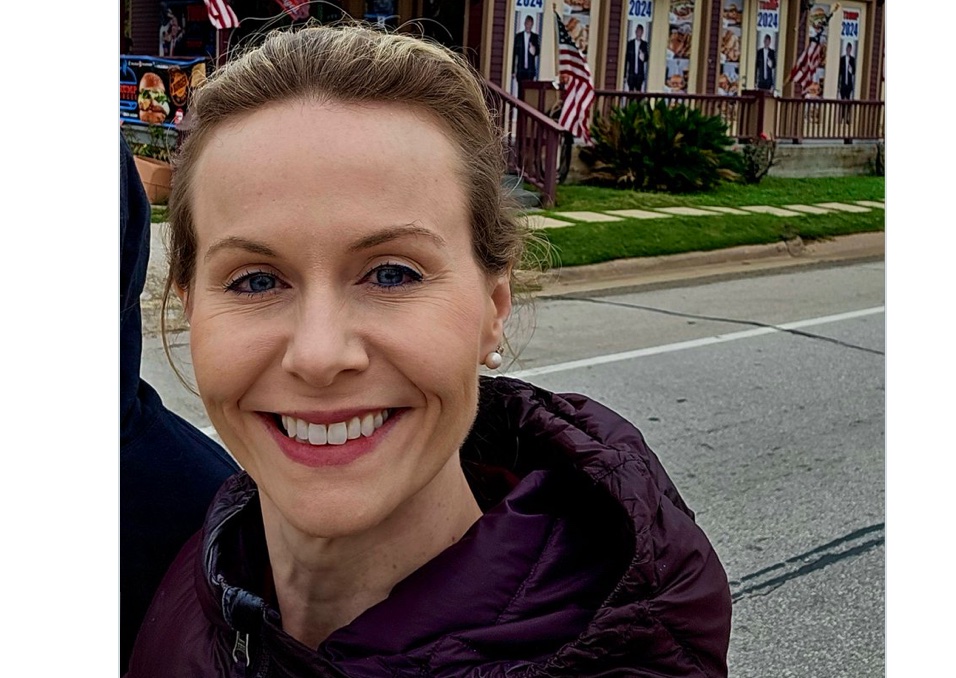
One of the big takeaways from the Alaska Public Offices Commission hearing on conservative activist Kelly Tshibaka’s free speech case came down to simple math when the commission met on Thursday.
Commission staff member Tom Lucas had evidently miscalculated the amount of fine the staff recommended against Tshibaka, and in the middle of the meeting said that instead of $16,400, he was recommending $23,700 as a fine for a couple of instances of what he and APOC staff says was illegal speech. APOC governs campaign finance matters for the State of Alaska, and enforces laws and regulations pertaining to financial disclosures and now, evidently, what people can say during public and private meetings.
Tshibaka, who lost to Sen. Lisa Murkowski in 2022’s senatorial election, founded a group called Preserve Democracy last December, and was a public speaker around the state and nation on the topic of transparent elections and the problems with ranked choice voting.
Election lawyer Scott Kendall, who is the architect of Alaska’s ranked choice voting system, filed numerous complaints on behalf of Alaskans for Better Elections, the group that advanced Ballot Measure 2 in 2020, against Tshibaka for speaking out against his election creation. All of the complaints were dismissed but one.
That one was heard on Thursday by the commission itself. The staff told the commission that Tshibaka and Preserve Democracy were acting as an independent expenditure group, since there was a petition being advanced by another group to repeal Ballot Measure 2.
The matter got tangled up as a couple of Democrat commissioners kept intermingling the dismissed complaint topics with the remaining complaint.
Tshibaka, through her lawyer Matt Singer, explained that she was being penalized because she opposes ranked choice voting and because she spoke out against it at events. Tshibaka said no such case would have been brought against her about the website had she not spoken against Ranked Choice Voting at events the Commission already has approved.
Singer emphasized that Tshibaka is willing to make a First Amendment case out of any adverse ruling against her, something that could end up going to the U.S. Supreme Court and could become costly for the state commission.
The commission is likely to rule on the matter before its January meeting.
A much more lively hearing was held to weigh the merits of Alaskans for Better Elections and its efforts to overturn Ballot Measure 2. That case was also brought by Alaskans for Better Elections against a group founded by Art Matthias, called Alaskans for Honest Elections. In the case, the lawyers for Alaskans for Better Elections accuse Matthias and his group of breaking various campaign laws and for using a church to funnel funds through to the Alaskans for Honest Elections group.
Alaskans for Better Elections is asking for a maximum fine for Alaskans for Honest Elections, which would be between $46,000 and $312,000, according to the group.


