

The number of students enrolled in Anchorage School District schools has decreased, according to the district’s updated enrollment figures as of Sept. 5. That includes correspondence school students who don’t use school buildings.
Superintendent Jharrett Bryantt announced in April that it’s past time to close some campuses and consolidate, as the working-age population of the city has declined by more than 17,000 residents, or 8.5% over the last decade, and the student enrollment has declined by nearly 10%. He said in the spring that he would gather community input and that decisions would have to be made this fall.
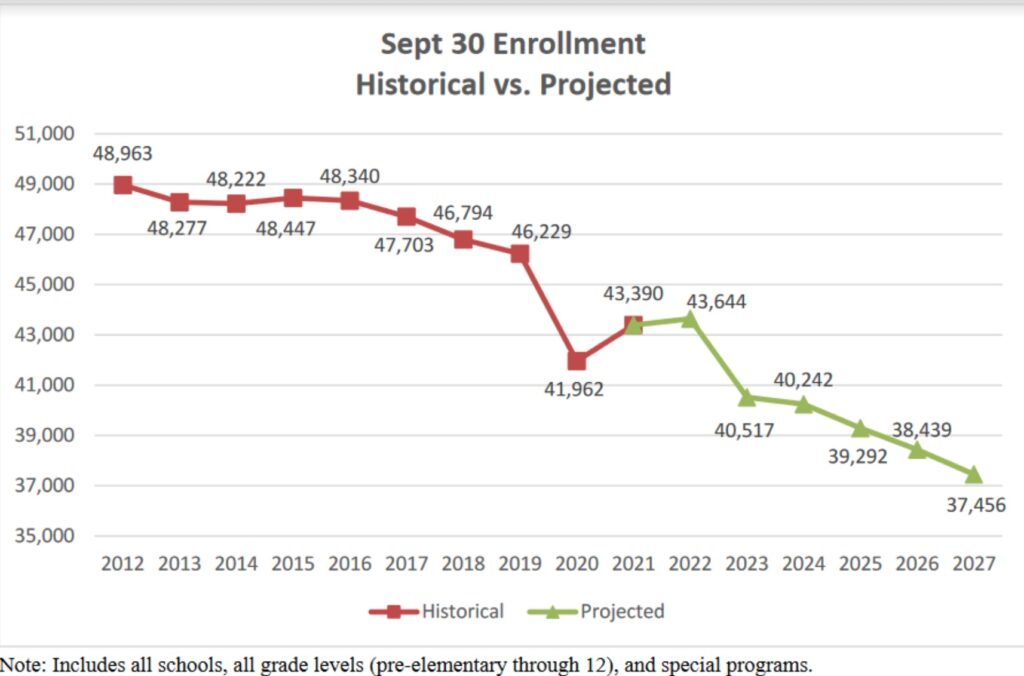
In 2002, 50,055 students attended Anchorage public schools. By 2010, the district had just under 50,000 students. Last year during the official count released in October, the enrollment had fallen to about 43,370 students.
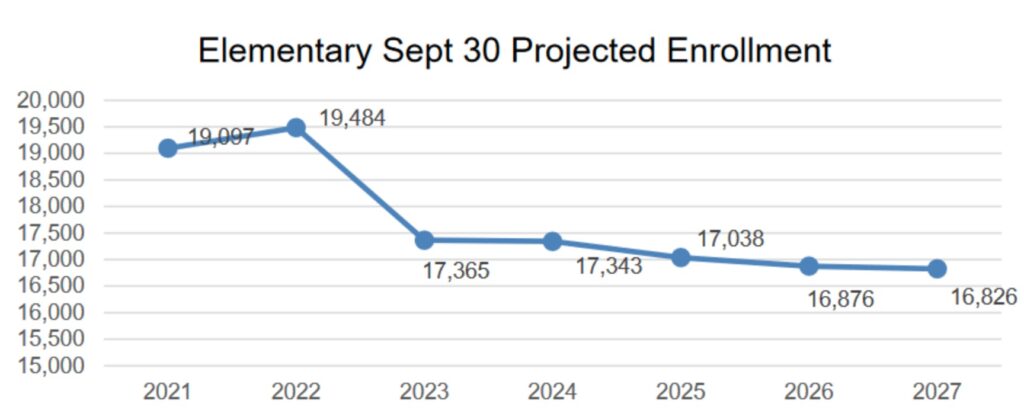
So far this year, the shrinkage appears to be continuing at to 42,353, with a further drop to 37,000 predicted by 2027.
This year’s enrollment number will not be official until October’s annual formal count.
On top of an outmigration problem balanced somewhat by an increase in the homeless population, birth rates in Anchorage have sagged.
In 2004, some 10,336 babies were born in Anchorage. In 2022, that dropped to 9,410 babies born. Granted, births in Anchorage may be from moms and dads in other parts of the state, but a drop is still relevant to school management and forecasting.
The disappearance of babies, while not appearing dramatic on the surface, is already the equivalent of three elementary schools.
The State of Alaska says the overall fertility rate in Anchorage has gone from 72.4 per 1,000 women in 2004 to 64.3 in 2021, the last year the state has published its estimates. That is more than an 11% drop in fertility.
However, in the discussion of population outmigration and student enrollment’s falling numbers, there are population collapse deniers.
The chairman of the Anchorage Assembly says “marginal loss of population in Anchorage is wholly driven by JBER personnel decisions. Otherwise, Anchorage is growing.”

Denial by city leaders doesn’t negate the fact that 70% of Alaska’s 30 boroughs and census areas lost population over recent years. Meanwhile, unlike what Constant supposes, Joint Base Elmendorf-Richardson has seen no significant force reductions, although the Obama Administration had planned for such reductions in 2014. The Obama military slashing plan for JBER was halted in large part by efforts of Sen. Dan Sullivan in 2016; he was elected to the U.S. Senate two years earlier and made protection of military strength in Alaska a priority.
Anchorage had nearly 294,000 people in 2010, and the latest estimate is 289,653. Current population estimates can be found at the State of Alaska website here.
Since Bryantt took over the schools in 2022, he has been trying to right-size the footprint of the campuses, but has been met with resistance. While in 2022 he said six elementary schools need to be closed, the board caved to complaints from the public and only agreed to close Abbott Elementary School. But in reality, Abbott Elementary is still a school district facility serving as Alaska Native Cultural Charter School.
Meanwhile, the MatSu School District to the immediate north of Anchorage has grown to 19,705 students.
Fairbanks has 12,331 enrolled, having lost 1,300 students since 2015.


