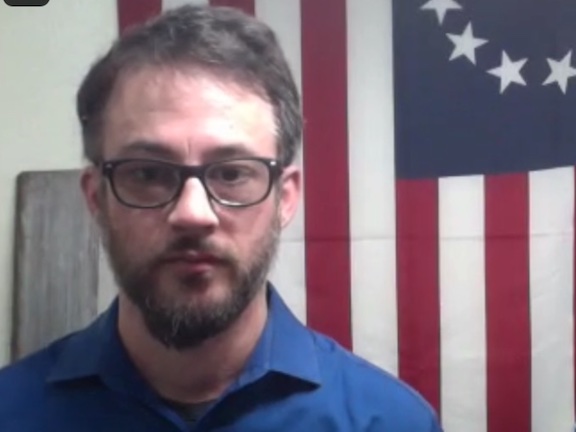
Anchorage School Board Chairwoman Margo Bellamy told Anchorage citizen Nial Williams that he was not allowed to videotape the meeting on Monday because doing so was bothering a person who was testifying.
The person, Sarah Davies, a staff member of Bartlett High School had approached the public podium to address the body when she said Williams videotaping was “an incredible distraction.”
Bellamy replied, “And I apologize for that.”
Bellamy then instructed Williams to stop videotaping the meeting. He asserted his constitutional rights and the First Amendment, but then was approached by a security guard who told him to stop, while Davies said that his videotaping was making her nervous. The security guard escorted him from the room.
At that point School Board member Dave Donley asked Bellamy what rule Williams had broken by videotaping the proceedings. She said there was no rule, but that he had made a member of the public uncomfortable.

Donley proceeded to argue that making someone uncomfortable was not grounds for violating the Constitution. He said that Williams had not disrupted the proceedings in any way and vigorously defended the public’s right to record public meetings.
School Board member Kelly Lessens interrupted, saying that there were children in the room, and therefore filming the room is inappropriate.
However, the entire room is filmed during the meetings by school district cameras and, in fact, security cameras are all over the education center facilities.
A dispute broke out on among Bellamy and Donley, who challenged her ruling, which is a procedural motion that requires a vote of the body.
Bellamy denied she had had Williams removed from the meeting, and did not call for a vote on the ruling she had made. Instead, she called for a five-minute recess to sort it out in private, a violation of the Open Meetings Act. The leftists on the Anchorage School Board went along with the violation, except Donley.
People videotaping public meetings is commonplace in this era and Bellamy has not prevented others from videotaping the meetings. She singled out Williams. Without citizens videotaping the meetings, the public has little reasonable access because the school board has limited the number of people it allows in its meetings and asserts the public can watch the meetings on YouTube. The official tape of the meeting on YouTube makes it difficult to see what is going on in the meeting, because the set-up favors a still photo of the agenda and a very small, blurry screen of the room, with little of the proceedings actually shown.
Williams told Must Read Alaska that the woman testifying was not the subject of his video. He maintained a distance from her and was seated most of the time in one of the seats provided to the public. He was recording elected officials and the paid functionaries who work for them in the school district, who he believes will eventually require Covid vaccinations of children attending public schools.
He also occasionally pans the entire room with his camera so that later he can prove who was at a meeting who may have witnessed a constitutional violation.
Williams is on a mission to defend the U.S. Constitution and has been thrown out of school board and Anchorage Assembly meetings when he has become passionate about what he believes are illegal proceedings. But in this instance, Williams was not disrupting the meeting, and was just quietly recording it.
According to the Reporters Committee on Freedom of the Press, “Although audio and video recording and photographing of public meetings is customarily done, the state OMA [Open Meetings Act] does not address this issue. If this issue arises, the press should argue there is a legal right to photograph or record such meetings, either implicit in the OMA, or arising from the common law or constitution.”
The Municipal Research and Services Center, a nonprofit organization that helps local governments across Washington State better serve their communities by providing legal and policy guidance on any topic, classifies people like Williams as “auditors” of government.
“If the behavior of an auditor interferes with the operation of government or the ability of other members of the public to use a public facility, an auditor may be removed from public property they would otherwise be entitled to be in. See State v. Blair, 65 Wash. App. 64 (1992),” the organization advises.
“Note that such a disruption would have to consist of more than the mere act of recording. In order to be lawfully removed the auditor’s actions must make it impossible for city business to continue in an orderly fashion. Profane or abusive language doesn’t create a sufficient disruption by itself, either—only if such language qualifies as a physical threat or “fighting words” (words that inflict injury themselves or tend to incite an immediate breach of the peace) or if the act (not just the content) of speaking itself disrupts city business, is there cause for members of the public to be removed,” MRSC says.
“Ultimately, if an auditor doesn’t run afoul of these boundaries, the best advice for local government staff and elected officials is to ignore the auditors and not engage with them except to conduct business. Otherwise, a confrontation with an auditor may lead to a public allegation of a “violation” of their constitutional rights, both in the press and online, and perhaps even to a court challenge that the jurisdiction has attempted to violate the public’s constitutional rights,” the group says.