
Because some members of the Anchorage Assembly believe traffic laws are disproportionately enforced against minorities, especially “Black and “Latine/x” and low income people, the Assembly is considering a new set of ordinances to allow for some types of jaywalking and new laws allowing bike riders, scooters, and others to ignore traffic signals, not wear helmets, or have lamp equipment when using roadways.
Assembly members Karen Bronga, Daniel Volland, and Anna Brawley introduced AO No. 2023-65(S) in May, and have had a public hearing and a separate work session on it, during which the Anchorage chief of police once again pointed out to the Assembly that they did not consult the police department on the ordinance prior to introducing it.
The Anchorage Assembly meeting is Tuesday, Aug. 8, at 5 pm in the meeting room at the Loussac Library ground floor. The entire agenda is at this link.

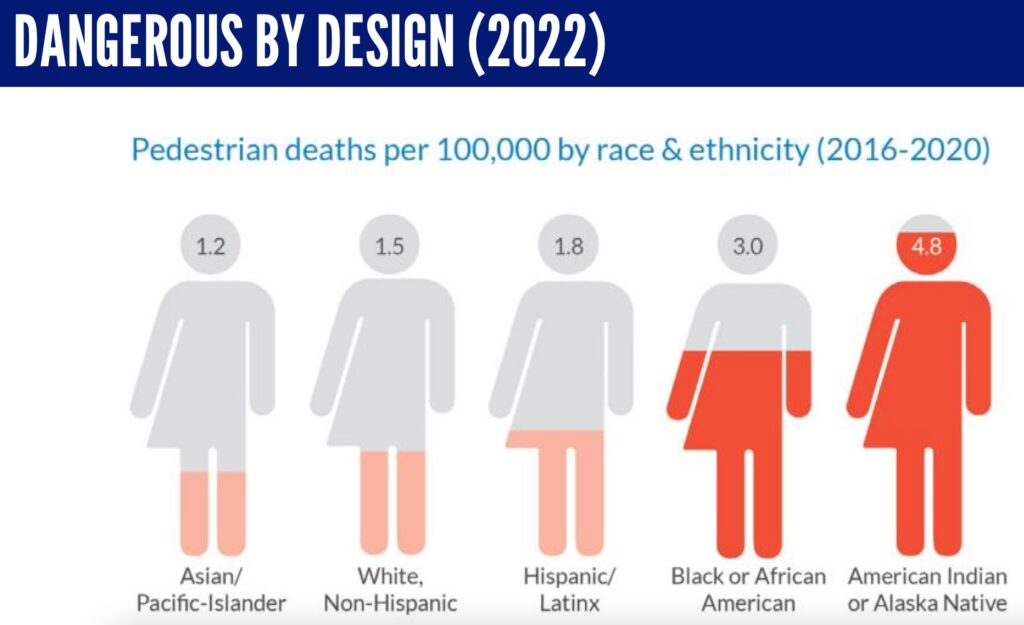
The ordinance says that between 2015 and 2019, the per capita fatality rate in the U.S. for Black pedestrians was more than double the rate for white pedestrians, and for Indigenous pedestrians was more than four times as high as for white pedestrians.
According to the group’s pamphlet, this is racist and “dangerous by design.”
The proposed law has something modeled after the “Idaho Stop,” which has been adopted in several states, a law that allows bicyclists to treat a stop sign as a yield sign, and a red light as a stop sign.
According to the new proposed rules of the road, the Assembly would create something called an “Anchorage Stop,” which allows more types of non-vehicles to roll through intersections if no oncoming traffic is coming. The roll-through law would extend to skaters, skateboarders, wheelchair users, skiers, and scooter riders.
During the May 23 the three Assembly members introduced the ordinance as a way to promote “safety, equity and access to infrastructure for bicyclists and vulnerable road users.”
“As proposed, the ordinance implements recommendations from the National Association of City Transportation Officials (NACTO) to amend local laws that criminalize bicycle use. We aim to improve active transportation networks, so that all residents travelling without a car can arrive at their destination safely,” said Assemblyman Daniel Volland in a statement.
The ordinance proposes changes to Title 9 – Vehicles and Traffic in Anchorage Municipal Code (AMC) which impact the safety of vulnerable road users, including:
- Establish new terminology: “Vulnerable Road User,” to include pedestrians, wheelchair users, bicyclists, scooters, etc.
- Legalize behaviors to allow bicycle users to use roadways differently than cars and other vehicles.
- Legalize the “Idaho Stop,” in which bicyclists are allowed to yield rather than stop at stop signs, and the “Dead-Red,” which allows bicycles to proceed through a red stop light if the light doesn’t change after two minutes.
- Expand the restrictions on what modes of transportation are allowed in a bike lane so that any vulnerable road user other than people walking may use a bike lane, such as wheelchairs, e-scooters, skateboards.
- Add definitions for “Protected Bicycle Lanes,” “Cycle Tracks,” and “Buffered Bicycle Lanes” so that future investments into safe active transportation infrastructure, increasingly common in other cities, have clear design parameters.
- Add a design feature to new projects to include additional signage that reminds drivers of an existing rule for drivers to give vulnerable road users 3 feet of space.
- Eliminate municipal fines for bike-related citations, including riding without a lamp, without a bell, without a helmet, and without a valid bicycle registration.
“Across the country, bike laws are disproportionately enforced against people of color and low-income people riding bikes, especially where bike-friendly infrastructure is lacking,” said Assemblywoman Brawley in a statement. “While protective equipment, like helmets and bells, can prevent serious injury, it is unnecessary and ineffective to maintain fines that financially penalize users.”
The ordinance may be read at this link.