By Samuel A. Schilling, President of the Alaska Outdoor Access Alliance (AOAA)
The Alaska Outdoor Alliance recently published Nearly 8 Million Visits, highlighting new federal recreation-visitation data for Alaska. The article reports approximately 7.85 million visits to federally administered lands and waters during fiscal year 2024, along with approximately 16.7 million recorded activity participations.
The numbers are significant, and the article appropriately acknowledges several important limitations: visits are not unique individuals, activities can overlap, agency reporting methods vary, some activities are not recorded, and the figures are not an economic-impact analysis.
Those limitations matter.
At first glance, the activity totals can make motorized use appear to represent only a small portion of Alaska’s outdoor landscape. OHV use, for example, is shown at approximately 85,000 participations, or roughly 0.5 percent of reported activity. But the data do not establish that only 0.5 percent of recreation depends upon motorized access.
The federal report identifies broad activities. It does not fully identify the transportation that made those activities possible, nor does it show how much hunting, fishing, trapping, camping, sightseeing, gathering, and other activity may depend upon ATVs, snowmachines, motorboats, aircraft, four-wheel-drive vehicles, or other motorized means.
That missing context matters when recreation statistics begin influencing decisions about Alaska’s public lands.
The activity is not always the means of access
One of the biggest problems with broad recreation statistics is that they often tell us what activity a person was doing, but not how that person reached or carried out that activity.
An Alaska resident may be counted as hunting even though the trip depended on an ATV. A trapper may be counted under trapping while using a snowmachine. A fisherman may be counted under fishing while relying on a motorboat. A camper may be counted under camping even though a UTV or four-wheel-drive vehicle provided the practical access.
In those cases, the motorized vehicle is not necessarily the recreation itself. It is the transportation supporting another activity.
Our comprehensive assessment describes this as utilitarian motorized use—motorized transportation used for access, hauling, retrieval, safety, or support of another activity rather than operation of the machine being the primary recreation.
The current data do not connect the same outing to its primary activity, transportation mode, function of the machine, and land being used. As a result, someone can remain visible statistically as a hunter, fisherman, trapper, camper, or sightseer while the motorized transportation supporting that activity is not separately visible as motorized use.
That is why the reported 0.5 percent OHV share should not be interpreted to mean that only 0.5 percent of federal recreation depended upon motorized access. It shows only the share of reported activity participations specifically placed in the OHV use category. Those are two very different things.
Sightseeing is not a transportation classification
The same problem appears at the other end of the activity table. Sightseeing represents approximately 43.5 percent of reported activity participation, while hiking, walking, and running account for another 18.1 percent.
But sightseeing tells us what someone was doing, not how they got there. A person may view scenery or wildlife from a vehicle, vessel, aircraft, bus, developed facility, motorized route, or hiking trail. Camping, fishing, hunting, and nature study can likewise involve multiple forms of transportation.
Much of the activity table therefore cannot be cleanly divided into a large “nonmotorized” majority and a small “motorized” minority. The transportation component is simply unresolved.
There is also an important difference between statewide federal visitation and use of a particular land-management system. BLM accounted for approximately 809,910 of the nearly eight million reported federal visits, about 10.3 percent of the total. The statewide figures therefore cannot, by themselves, establish how people access BLM lands or whether a particular BLM route or area should be managed as motorized or nonmotorized.
The economic picture looks very different
Participation counts do not measure economic contribution. The Bureau of Economic Analysis estimates that Alaska outdoor recreation generated approximately $3.8 billion in value added during 2024. That total extends well beyond the individual recreation activities shown in the chart below.
BEA separates the economy into conventional outdoor-recreation activities, other outdoor recreation, and a much larger supporting economy that includes travel, transportation, lodging, food, construction, and government activity.
Approximately $468.8 million of the total is attributed to BEA’s conventional outdoor-recreation activities. We focus first on this portion because it is where BEA identifies individual activities such as Motorcycling/ATVing, RVing, recreational flying, hunting, boating and fishing, hiking, and snow activities.
The remaining outdoor-recreation economy is not being excluded from consideration. It falls within BEA’s other and supporting outdoor-recreation categories, but the available data do not provide a reliable way to divide those dollars between motorized and nonmotorized users without introducing additional assumptions or risking double counting.
The first chart below shows the $468.8 million conventional-recreation portion using the activity categories published in BEA’s Alaska table.
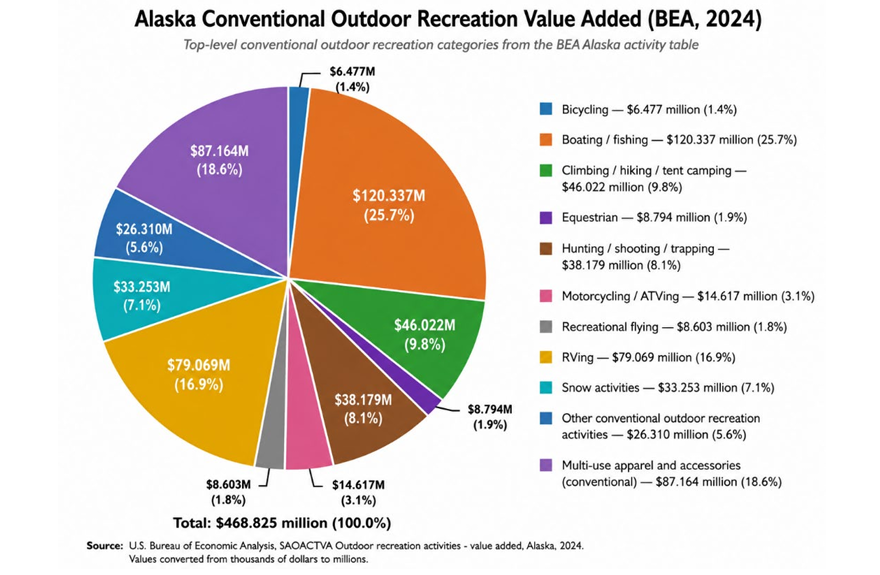
Viewed strictly by activity label, Motorcycling/ATVing accounts for $14.6 million, or about 3.1 percent of conventional outdoor-recreation value added.
Motorcycling/ATVing is not the only BEA category associated with motorized recreation. BEA separately reports $79.1 million for RVing and $8.6 million for recreational flying. For purposes of this assessment, those three published rows are grouped together as direct or primarily motorized, totaling approximately $102.3 million, or 21.8 percent of conventional outdoor recreation value added.
The underlying dollar values are published by BEA; the combined motorized grouping is an analytical classification used in this assessment.
The second chart reorganizes the same $468.8 million BEA total according to what the underlying activity categories actually tell us about transportation.
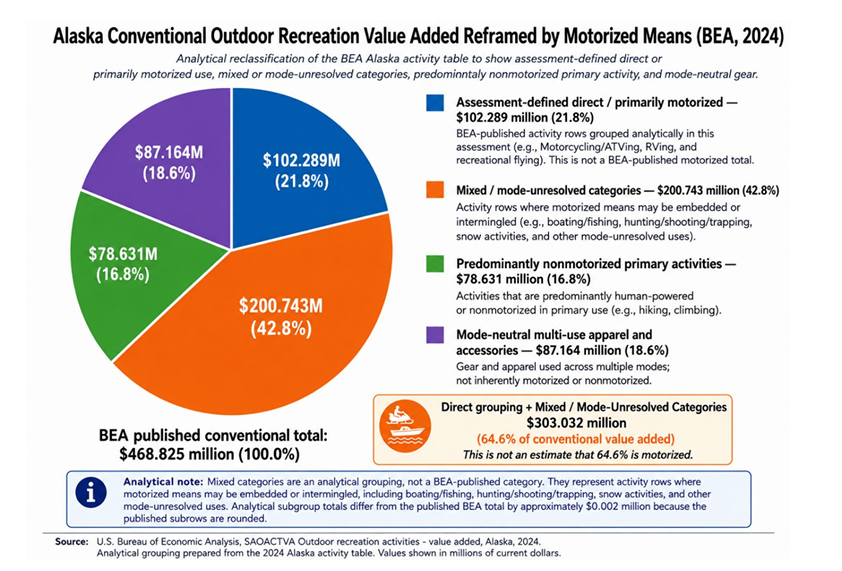
This comparison reveals the larger issue. Under this assessment’s classification:
- Approximately 21.8 percent is grouped as direct or primarily motorized.
- Another 42.8 percent falls within mixed or mode-unresolved activities where motorized means may be embedded but cannot be isolated from the BEA table alone.
- The remaining conventional value consists of activities classified as predominantly nonmotorized primary activities and multi-use equipment that cannot reasonably be assigned to either side.
The mixed portion should not be treated as entirely motorized. But it should not automatically be treated as nonmotorized either. BEA’s own table illustrates why:
- Boating and fishing contain several different forms of activity, including canoeing and kayaking, fishing apart from boating, sailing, and other boating.
- Snowmobiling is included within BEA’s broader “Other snow activities” category alongside dog mushing, sleighing, snowshoeing, and snow tubing.
- Hunting, shooting, and trapping are reported economically, but the table does not identify what transportation was used to reach or conduct those activities.
That is the distinction these two charts are intended to show.
The $14.6 million Motorcycling/ATVing row is not a measure of Alaska’s entire motorized outdoor-recreation economy. For purposes of this assessment, the Motorcycling/ATVing, RVing, and recreational-flying rows are grouped as direct or primarily motorized, totaling approximately $102.3 million. Beyond that assessment-defined grouping lies a substantial portion of conventional economic activity for which the motorized component remains unresolved.
It would be incorrect to assign all of that unresolved value to motorized users. It would be equally incorrect to assign it all to the nonmotorized side. The BEA data do not support either extreme.
Estimating the unresolved motorized share
Because BEA does not publish a definitive motorized-versus-nonmotorized split within its conventional outdoor-recreation activities, our assessment tested how much of the unresolved portion could plausibly be connected to motorized means.
The analysis begins with the directly identifiable motorized categories and then applies disclosed low, central, and high assumptions to the mixed or mode-unresolved components within boating and fishing, hunting and trapping, shooting and archery, snow activities, other air and land activities, and other water activities.
That analysis produced a motorized-linked range of approximately 35.8 to 52.4 percent of BEA’s $468.8 million conventional outdoor-recreation value added, with a central scenario of approximately 44.3 percent.
That range is not an official BEA statistic. It does not mean that 44 percent of BLM visitors are motorized, nor does it mean that 44 percent of Alaska’s entire outdoor-recreation economy is motorized.
What it demonstrates is that the motorized component embedded within BEA’s mixed conventional-recreation categories may be substantial, and that looking only at the $14.6 million Motorcycling/ATVing row can materially understate the economic role of motorized means.
Just as importantly, this model does not attempt to divide Alaska’s much larger supporting outdoor-recreation economy between motorized and nonmotorized users. BEA reports approximately $2.73 billion in supporting outdoor-recreation value that includes travel, transportation, lodging, food, shopping, construction, and government activity. Motorized users clearly contribute to that supporting economy, but the available BEA data do not provide a reliable way to assign those dollars back to individual recreation modes without introducing additional assumptions or risking double counting.
For that reason, the 35.8 to 52.4 percent range should be understood only as an estimate within the conventional-recreation portion of the BEA data, not as a ceiling on the role motorized means may play across Alaska’s full $3.8 billion outdoor-recreation economy.
A smaller count can still represent a major economic interest
The purpose of this analysis is not to claim that one motorized user is more important than one nonmotorized user. Alaskans should not be valued according to the price of their equipment or the amount they spend during an outing. The point is that participation share and economic share are not the same thing.
A lower-volume activity may generate substantial spending on vehicles, fuel, trailers, repairs, maintenance, transportation, guides, lodging, food, equipment, and rural services. A higher-volume activity may involve far less spending per participation.
Therefore, a small-looking OHV percentage cannot be used as a proxy for the motorized community’s economic contribution. It also cannot be used as a proxy for cultural importance, transportation need, traditional access, or the number of other activities dependent upon motorized means.
The existing datasets do not support a precise statement that one motorized person equals a fixed number of nonmotorized people. They do not consistently identify unique individuals, repeat visits, complete trip spending, transportation modes, or the jurisdiction where the outing occurred.
What the evidence does establish is that participation counts and economic value measure fundamentally different things. The existing datasets therefore do not support using a small OHV activity-participation percentage as a proxy for the economic contribution associated with motorized recreation and access.
That is the perspective missing when recreation is presented primarily through headcounts.
Why the incomplete picture matters
The Alaska Outdoor Alliance article states that the federal data can help inform decisions involving trails, public access, transportation, maintenance, staffing, facilities, and stewardship. That is exactly why the limitations must be understood.
A statistic initially published as an activity estimate can later appear in agency presentations, planning documents, public comments, grant applications, and legislative discussions. As the number is repeated, its original limitations may be forgotten.
The reported 0.5 percent OHV figure could eventually be presented as evidence that motorized users are an insignificant minority. Large sightseeing and walking figures could be presented as evidence of overwhelming nonmotorized demand. Those impressions could influence which routes are maintained, which trail systems are funded, which activities are prioritized, and which lands are proposed for motorized restrictions or nonmotorized designations.
An incomplete statistical picture does not have to contain inaccurate numbers to influence public policy. A number may be technically accurate within its narrow definition while still being used to support a conclusion it was never designed to prove.
The result can be a public record in which the motorized community appears smaller, less economically significant, and less connected to other forms of recreation than the available data can actually establish. That is potentially detrimental not only to recreational riders but also to hunters, anglers, trappers, campers, gatherers, cabin users, and ordinary residents who rely on motorized transportation for practical access.
This is about balance, not opposition
This is not an argument against hiking, bicycling, skiing, paddling, walking, or other nonmotorized recreation. Alaska should provide meaningful opportunities for all of those activities.
The concern is that the growth of nonmotorized recreation should not require the motorized community’s cultural, economic, and practical role to be minimized.
Motorized transportation is part of Alaska’s identity because Alaska is different from most of the country. Vast areas have little or no ordinary road access. Travel and transportation are integral to a wide range of activities occurring on Alaska’s public lands.
In that setting, an ATV, snowmachine, boat, or aircraft is often not simply a recreational luxury. It is access infrastructure. It connects people to hunting areas, fishing waters, traplines, cabins, camps, remote property, gathering locations, and communities.
A statistical system that identifies the destination activity but does not identify the supporting transportation can obscure that relationship in the statistical record.
Alaska needs the full story
Before recreation statistics are used to support land designations, route restrictions, access changes, or major funding decisions, agencies should examine the complete outing. That means identifying:
- the primary purpose of the trip
- every transportation mode used
- the function of each motorized vehicle
- the land jurisdictions crossed
- the frequency and distance of use
- the economic activity associated with the trip
Those variables would distinguish an ATV ride taken purely for recreation from an ATV trip supporting a hunt. They would distinguish an activity reached entirely on foot from one made possible by a motorized route. They would also separate broad statewide tourism and visitation figures from the actual transportation needs of people using a particular BLM area.
The Alaska Outdoor Alliance article provides one part of Alaska’s recreation story. It shows that Alaska’s federally administered lands and waters receive millions of visits and support a wide range of activities. But it does not show the full extent to which those activities depend upon motorized transportation. It does not measure the economic importance of different users. It does not establish a motorized-versus-nonmotorized split. And it should not be treated as a management verdict on which forms of access Alaska should preserve.
Users whose activities depend on motorized access do not disappear simply because a statistical table records the activity without identifying the transportation that made it possible. The public record, and the public-land decisions built upon it, should reflect the complete reality.
Counting visits is not counting value. Counting the activity is not counting the access. And an incomplete count should never become the justification for restricting a use it did not fully measure.
Further reading and sources
Samuel A. Schilling is President of the Alaska Outdoor Access Association, a statewide coalition dedicated to protecting and preserving public access to Alaska’s lands and waters.