
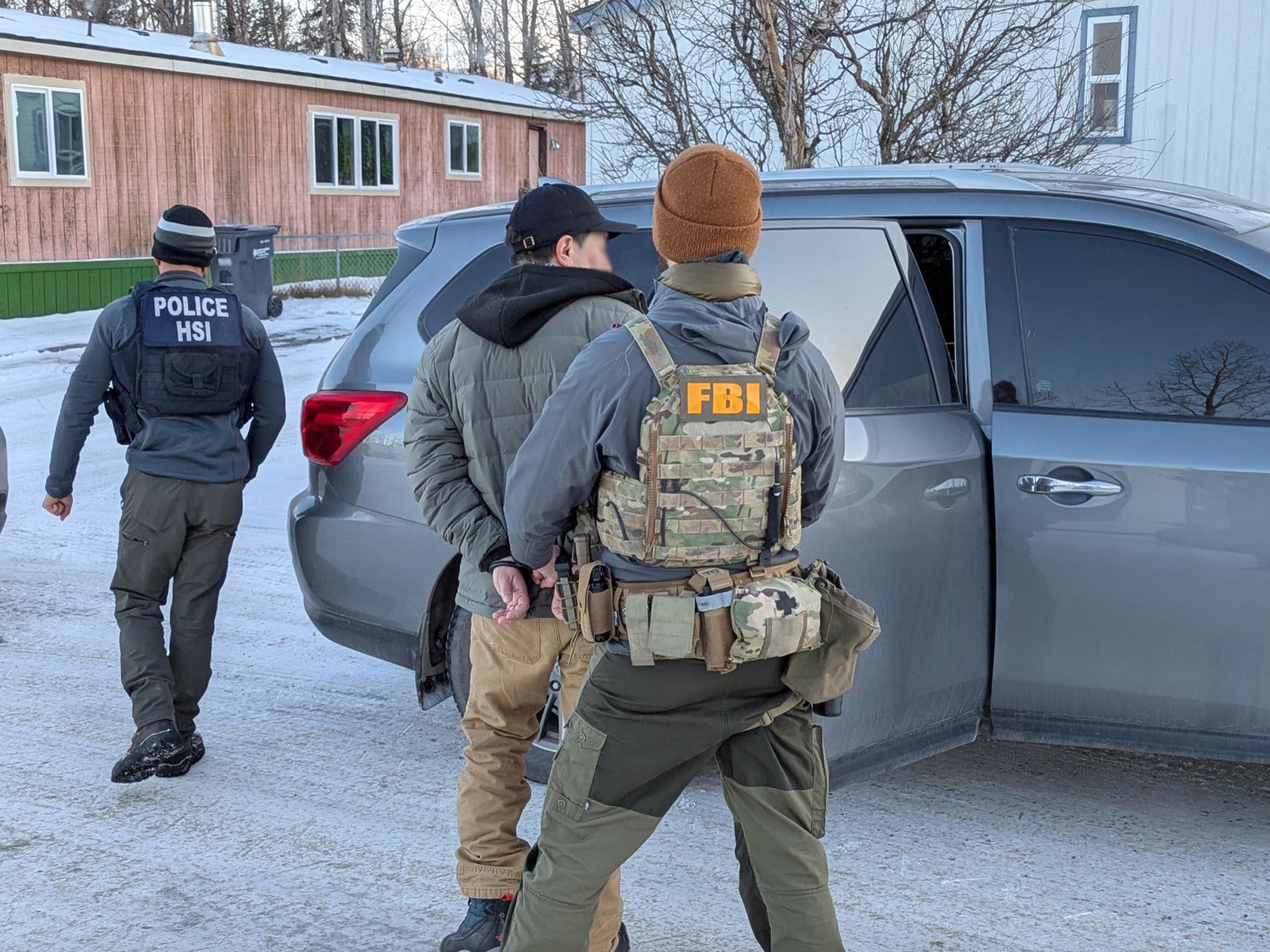
The Anchorage FBI says it is cooperating with other federal agencies to round up illegal aliens in Alaska and deport them.
At 4:12 p.m. on Monday, the Anchorage FBI posted on Facebook “The #FBI Anchorage Field Office, along with our Department of Justice (DOJ) partners, is supporting the Department of Homeland Security (DHS) with their immigration enforcement efforts in #Alaska.” This is in direct response to President Donald Trump’s order to secure the borders and clean up the cartels and violent crime across America.
Then at 4:37 p.m., the Anchorage School superintendent released an announcement saying the Anchorage schools will not only not cooperate with federal authorities, they won’t even allow them on campus. In essence, Superintendent Jharrett Bryantt was saying Anchorage schools are sanctuaries for illegal immigrants.
Superintendent Bryantt said the federal agents would have to have a warrant, and even if they did, he would have the warrant reviewed by district attorneys before deciding if they were valid and whether federal immigration agents could come onto any school grounds.
In his explanation, Bryantt cited a federal law, to which he gave a novel interpretation.
The law, called the Family Educational Rights and Privacy Act (FERPA) “protects your child’s privacy by prohibiting ASD from sharing student-specific information with anyone other than the student’s parents or legal guardians, except in specific situations such as when required by a judicial warrant or court order,” Bryantt wrote.
But FERPA wasn’t intended to protect illegal aliens and criminals.
According to the Department of Education, it’s to protect a student’s education records from being shared without parents’ permission (or the student’s permission once he or she turns 18). The law says nothing about the students’ immigration status.
“The Family Educational Rights and Privacy Act (FERPA) is a federal law that affords parents the right to have access to their children’s education records, the right to seek to have the records amended, and the right to have some control over the disclosure of personally identifiable information from the education records,” the federal government explains.
In the Frequently Asked Questions section of the FERPA explanation, the Department of Education gives examples that specifically say that “law enforcement records” are not education records.
Here are examples of what the law covers and does not cover taken directly from the U.S. Department of Education:
No. Under FERPA, a student may not use his or her right to opt out of directory information disclosures to prevent school officials from identifying the student by name or disclosing the student’s electronic identifier or institutional e-mail address in class.
No, a school is required to honor the eligible student’s request to opt out of the disclosure of directory information made while the student was in attendance, unless the student rescinds the opt out request.
Are law enforcement records considered education records?
“Law enforcement unit records” (i.e., records created by the law enforcement unit, created for a law enforcement purpose, and maintained by the law enforcement unit) are not “education records” subject to the privacy protections of FERPA. As such, the law enforcement unit may refuse to provide a parent or eligible student with an opportunity to inspect and review law enforcement unit records, and it may disclose law enforcement unit records to third parties without the parent or eligible student’s prior written consent. However, education records, or personally identifiable information from education records, which the school shares with the law enforcement unit, do not lose their protected status as education records just because they are shared with the law enforcement unit.
The Frequently Asked Questions section also makes it clear that FERPA applies to records maintained by the school, not personal observations of school officials:
Are there any limitations to sharing information based on personal knowledge or observations?
FERPA applies to the disclosure of personally identifiable information (PII) from education records that are maintained by the school. Therefore, FERPA does not prohibit a school official from releasing information about a student that was obtained through the school official’s personal knowledge or observation unless that knowledge is obtained through his or her official role in making a determination maintained in an education records about the student. For example, under FERPA a principal or other school official who took official action to suspend a student may not disclose that information, absent consent or an exception under § 99.31 that permits the disclosure.
The notice from the FBI and the notice from the school superintendent, coming just 15 minutes apart, raise questions about whether Bryantt was in fact engaged in a rapid push back exercise against the federal government. Bryantt may have brought unnecessary attention to himself now that he has declared Anchorage schools to be off limits for federal law enforcement, effectively creating sanctuary campuses, where federal immigration laws do not apply.
Anchorage School District is one of the most diverse in the nation, where more than 90 languages are supposedly spoken.


