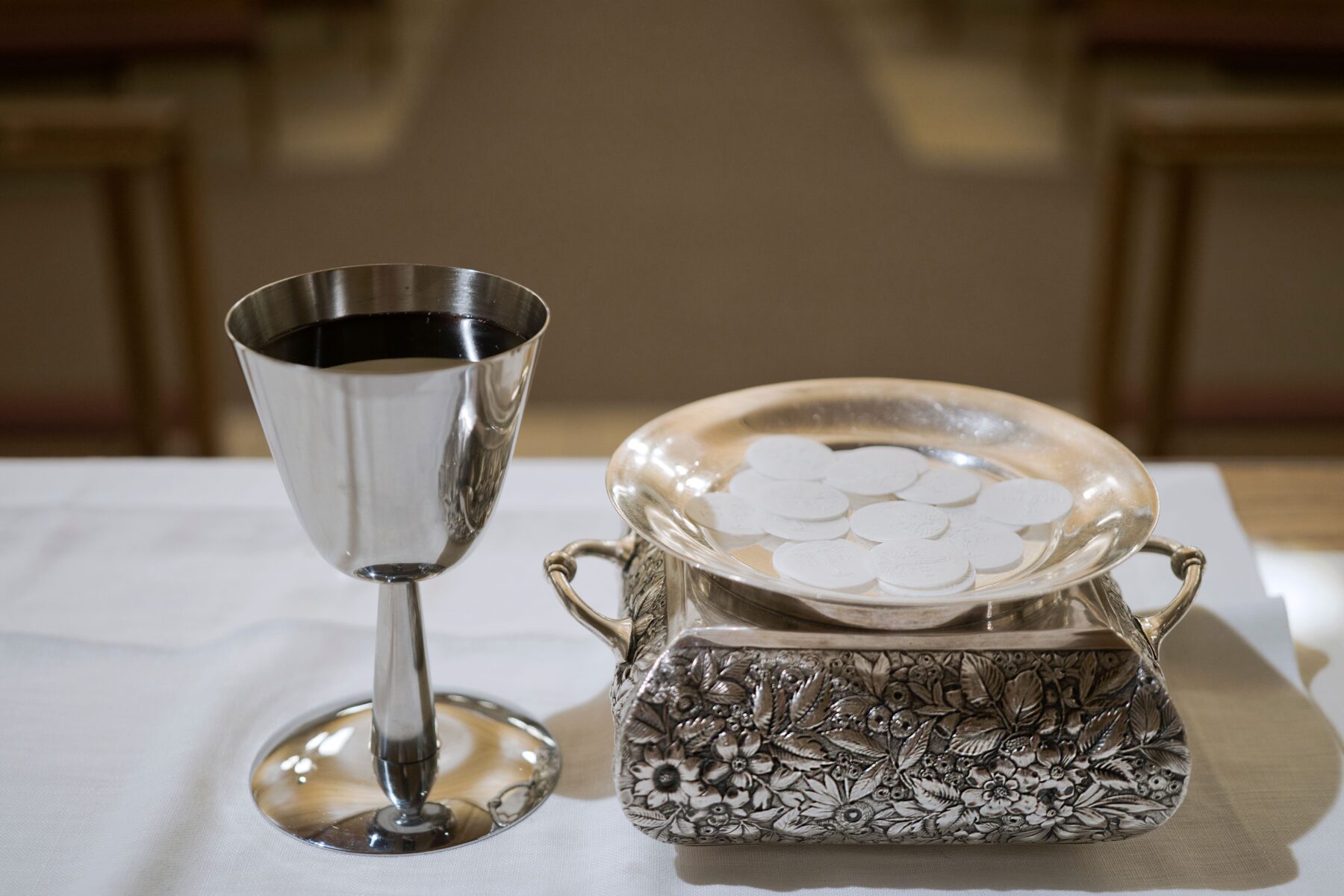
A view of Heaven is, at its heart, a view of perfect thanksgiving. The Mass, offered as Christ prescribed, lifts the veil and discloses the heavenly banquet, and it is called the Eucharist precisely because the word means thanksgiving. The Greek eucharistia comes from the verb eucharistein, which recalls the Jewish blessings that proclaimed God’s works of creation, redemption, and sanctification (Catholic Church, 2000, para. 1328). The Catechism teaches that “the Eucharist is a sacrifice of thanksgiving to the Father, a blessing by which the Church expresses her gratitude to God for all his benefits, for all that he has accomplished through creation, redemption, and sanctification. Eucharist means first of all ‘thanksgiving’” (Catholic Church, 2000, para. 1360). Even the Requiem I recently attended at Holy Family Parish, sung beautifully by the schola while six beeswax candles flickered and incense filled the sanctuary, was not only a plea for the faithful departed but the Church’s supreme act of gratitude offered in the midst of sorrow.

The Church has never confined thanksgiving to days when life is easy. St. Paul commands, “Give thanks in all circumstances; for this is the will of God in Christ Jesus for you” (Revised Standard Version, Second Catholic Edition, 2006, 1 Thess. 5:18). St. John Chrysostom, who described the sanctuary filled with angels when the Lord is immolated upon the altar (John Chrysostom, ca. 388/1889b, 6.4), lived this command to the end. Exiled and dying on the road, he spoke his last recorded words: “Glory to God for all things” (Palladius, ca. 408/1921). He taught that when suffering presses hard through illness, slander, or loss, the temptation is to blaspheme, yet the proper response is the opposite, for “there is nothing so good as thanksgiving; even as there is nothing worse than blasphemy” (John Chrysostom, 387/1889a, Hom. 1). In the dark and dismal hour of a Requiem, when the senses are aroused toward the unveiling of the banquet beyond the veil of death, the Church does exactly this. She does not cease giving thanks; she intensifies it, because the Presence upon the altar is the same Christ who conquered death and who now intercedes for the living and the dead.
St. Thomas Aquinas, the Angelic Doctor, explains that thanksgiving corresponds to the favor received; therefore, the greater the gift, the greater the debt of gratitude. He notes that the penitent is bound to give thanks in a particular way, for what he receives is more gratuitous, namely grace instead of the punishment deserved (Thomas Aquinas, 1265–1274/1947, II-II, q. 106, a. 2). A homily on John 6 traditionally attributed to Aquinas, drawing on the Gloss (Glossa Ordinaria), the standard medieval commentary on Scripture, observes that Christ Himself, “having given thanks” when He multiplied the loaves, taught us to thank God for three kinds of benefits, which are corporeal (the gifts of nature and daily bread), spiritual (sanctifying grace and the food of the Eucharist), and eternal (liberation from death and the inheritance of the saints) (Thomas Aquinas, attributed, 1873). In the Mass these three converge. The beeswax candles and the rising incense are corporeal signs that accompany the spiritual gift of Christ’s Body and Blood, which in turn is the pledge of eternal life. The Requiem, offered for those who have passed through the veil, is the Church’s most concentrated thanksgiving for the hope that does not disappoint.
Nothing is too small to be included. Every breath, every heartbeat, every millisecond of the life still granted is itself a blessing bestowed by the Creator. St. Augustine confessed that we can never sufficiently thank God that we are, that we live, and that we have mind and reason by which to seek Him (Augustine, 426/2021, p. 72). He closes The City of God by declaring that nothing will give more joy to the heavenly City than the song of the grace of Christ, by whose blood we are redeemed, and he teaches that even the memory of past evils, once redeemed, becomes matter for praise (Augustine, 426/2021, pp. 318–319). In the Confessions he prays, “I will love Thee, O Lord, and thank Thee and confess unto Thy name because you have forgiven me these great sins and these evil doings of mine” (Augustine, ca. 400/1963, p. 35). On earth that same movement begins in every instant. The human race, collectively, holds an innumerable series of such opportunities. Each life, each moment of consciousness, each act of worship provides an opportunity to acknowledge God’s beneficence, majesty, grace, and love. The Mass gathers those scattered moments into one act. Each time the priest elevates the Host, the candles illuminate the altar, the lingering aroma of incense fills the holy space, the vestments and linens adorn the eternal banquet, and the schola lifts the senses of the entire assembly, joined with the multitude of angels and saints in the thanksgiving that never ceases in heaven.
Even when the world seems dark, the liturgy refuses to lose sight of this. The Preface of the Mass declares that it is “truly right and just, our duty and our salvation, always and everywhere to give you thanks” (Catholic Church, 2011). Always and everywhere includes the hour of mourning, the day of illness, the year of trial. The incense rising around the altar is the symbol of prayer, the chant of the schola continues the song of the redeemed, the Real Presence lifts the veil so that the heavenly banquet is no longer merely future. In that eternal moment made present, the Church does not forget the smallest blessings: the breath that still continues, the heart that still beats, and the chance, however brief, to join the unending chorus. To cease giving thanks would be to turn away from the very Face that has been unveiled. The Doctors and Fathers therefore urge us never to stop, for the gift is greater than we can measure, the opportunity is given in every millisecond, and the perfect thanksgiving is already offered in the Sacrifice that unites earth to heaven. St. John Vianney, the Curé of Ars, captured this with a priest’s wonder when he said, “How beautiful it is! After the Consecration, the good God is there as He is in heaven. If man well understood this mystery, he would die of love. God spares us because of our weakness” (Monnin, 1865, p. 75). This Thanksgiving, whatever the world sets before our senses, let us rise above it and do what is truly right and just, giving thanks always and everywhere to the God of all goodness.
Sources
- Augustine. (1963). The confessions of St. Augustine (R. Warner, Trans.). Signet Classic. (Original work written ca. 400)
- Augustine. (2021). The city of God (W. Babcock & R. Coleman, Trans.). Ignatius Press. (Original work written 426)
- Catholic Church. (2000). Catechism of the Catholic Church (2nd ed.). Libreria Editrice Vaticana.
- Catholic Church. (2011). The Roman Missal (3rd typical ed.; International Commission on English in the Liturgy, Trans.). United States Conference of Catholic Bishops.
- The Holy Bible: Revised Standard Version, Second Catholic Edition. (2006). Ignatius Press.
- John Chrysostom. (1889a). Homilies on the statues (W. R. W. Stephens, Trans.). In P. Schaff (Ed.), Nicene and post-Nicene fathers, first series (Vol. 9). Christian Literature Publishing. (Original work delivered 387)
- John Chrysostom. (1889b). On the priesthood (W. R. W. Stephens, Trans.). In P. Schaff (Ed.), Nicene and post-Nicene fathers, first series (Vol. 9). Christian Literature Publishing. (Original work written ca. 388)
- Monnin, A. (1865). The spirit of the Curé of Ars (J. E. Bowden, Ed. & Trans.). Burns, Lambert & Oates.
- Palladius. (1921). The dialogue of Palladius concerning the life of Chrysostom (H. Moore, Trans.). SPCK. (Original work written ca. 408)
- Thomas Aquinas. (1947). Summa theologica (Fathers of the English Dominican Province, Trans.). Benziger Bros. (Original work written 1265–1274)
- Thomas Aquinas (Attributed). (1873). Ninety-nine homilies of S. Thomas Aquinas upon the epistles and gospels (J. M. Ashley, Trans.).