
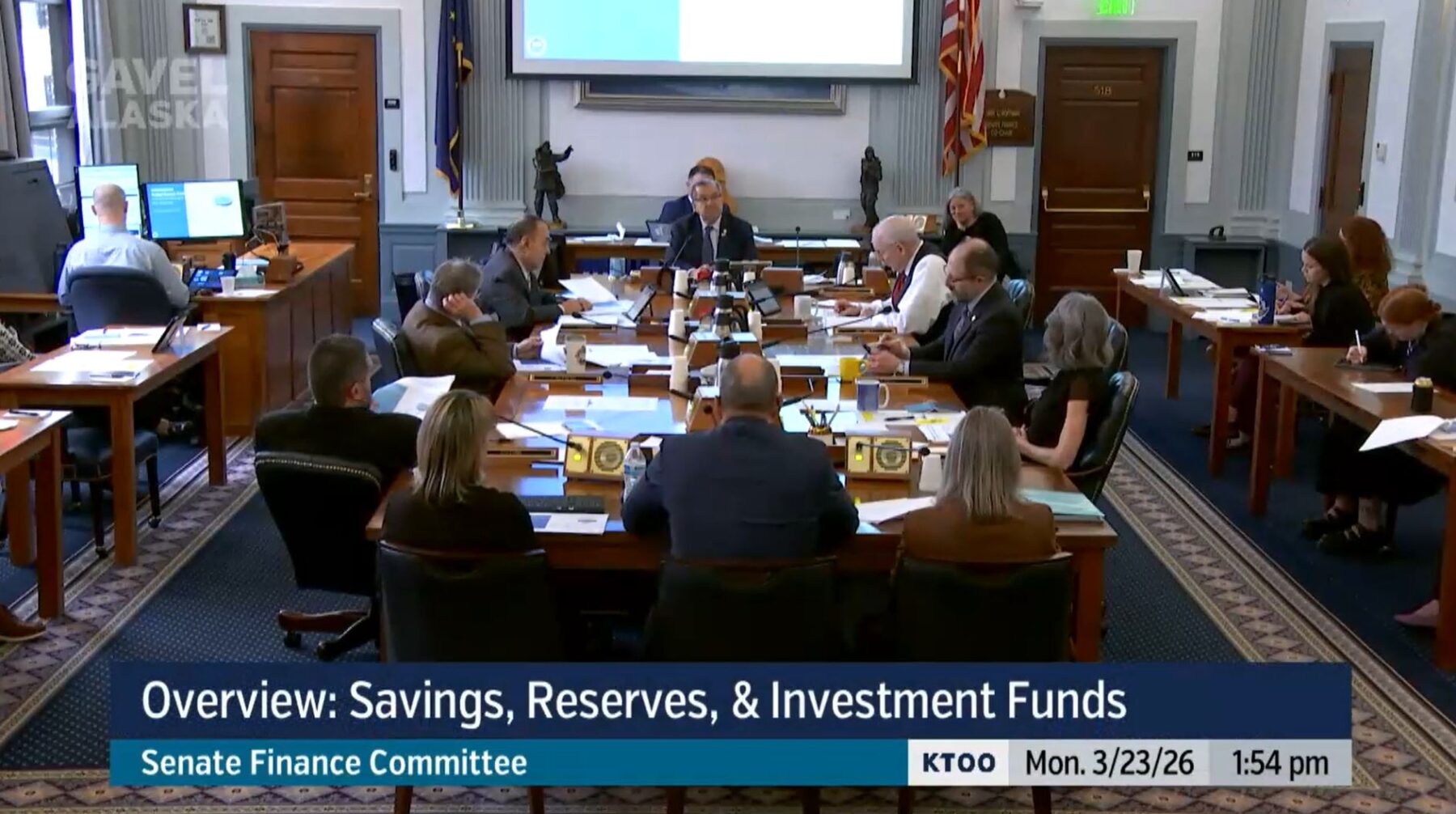
The Senate Finance Committee received a detailed briefing from the Department of Revenue’s Treasury Division on cash flow operations, investment strategies, and fund performance across state reserves and retirement systems. Presenters Pam Leary, Treasury Director, and Zach Hanna, Chief Investment Officer, outlined how the division’s 40 professionals manage nearly $60 billion in assets through four specialized sections—portfolio management, accounting, compliance, and cash operations—while maintaining liquidity to pay state bills without disruption.
Ms. Leary described cash management as one of the state’s most critical central functions, processing thousands of daily transactions from taxes, federal reimbursements, and reserves. The team coordinates closely with the Alaska Permanent Fund Corporation to schedule Earnings Reserve draws, ensuring the general fund balance stays above the $400 million threshold for five consecutive days before borrowing from reserves. “We have been averaging at a higher balance,” she noted, crediting improved timing coordination that has kept operations smooth over recent years. Sen. Jesse Kiehl (D-Juneau) questioned whether this threshold remains adequate given budget growth, but Leary confirmed it is currently sufficient. Sen. Lyman Hoffman (D-Bethel) highlighted Alaska’s unique revenue volatility, suggesting larger buffers may still be prudent compared to peer states.
Investment performance drew positive attention. Hanna explained the formal State Investment Review process, where recommendations are vetted for legal compliance and best practices. Despite recent market cycles—from near-zero rates to inflation and rate hikes—the Treasury delivered strong results. Overall returns across managed funds reached 12.9% for 2025, generating $6.7 billion in total gains. State funds alone added $658 million to the balance sheet. Retirement systems ranked in the top third of peers, producing $2 billion in excess returns over the past decade and reducing state contributions.
The Constitutional Budget Reserve Fund (CBRF), the state’s primary reserve, remained fully invested in cash equivalents to prioritize liquidity and principal protection. Its $2.9 billion balance produced a 4.48% return, 20 basis points above benchmark, adding $127 million in gains. Hanna noted the conservative stance reflects an uncertain time horizon, though elevated cash yields provided solid returns. Sen. Bert Stedman (R-Sitka) flagged the Digital Bridge matter for future review post-audit, but the committee acknowledged funds had been returned to the main CBR account.
GeFONSI pooled accounts, holding $3.4 billion as of June 2025, showed solid performance. GeFONSI-1 returned 4.71% and GeFONSI-2 5.93%, each 30 basis points over benchmark, generating $172 million combined. The Public School Trust Fund reached peak assets of $911 million after a 17.07% return, adding roughly $141 million in gains and compounding at 8.6% over ten years. It contributed $35 million to K-12 funding in FY2025, with similar amounts projected forward. Hanna reiterated the fund’s high-risk profile to support up to 5% spending while aiming for inflation-proofing.
The Alaska Higher Education Investment Fund faced scrutiny after a $130 million transfer reduced its balance. Pre-transfer spending exceeded $30 million annually at earning capacity; post-reduction sustainability concerns prompted discussion of potential recapitalization. Hanna stressed the fund’s 7% statutory draw lacks smoothing or inflation-proofing, unlike the Public School Trust.
Defined benefit plans (PERS/TRS) earned 10.11% in FY2025, with long-term returns of 8.51% over 40 years exceeding the 8.17% actuarial assumption. Ten-year performance stood at 9%, 23 basis points above benchmark. Participant-directed plans, now $12 billion, benefited from low-cost target date funds (12 basis points average fee, bottom decile versus peers). 90% of new contributions flow to these defaults, with over 60% of assets in target date or balanced funds. Hanna highlighted 15-year weighted returns around 10.3% for defined contribution systems.
Sen. Stedman praised the Supplemental Benefit System (SBS) as a “best kept state secret,” noting typical 25-year participant balances of $800,000–$1 million. Hanna committed to providing weighted average SBS returns, confirming the program’s strong long-term impact. Resilience discussions addressed market cycles, with defined benefit plans emphasizing diversification to handle 5% net outflows (rising in downturns) while defined contribution plans leverage long horizons and sticky defaults.
Sen. Hoffman closed by noting the Power Cost Equalization program is thriving at the Permanent Fund Corporation. The committee’s next meeting is scheduled for March 24 at 9:00 a.m.


