
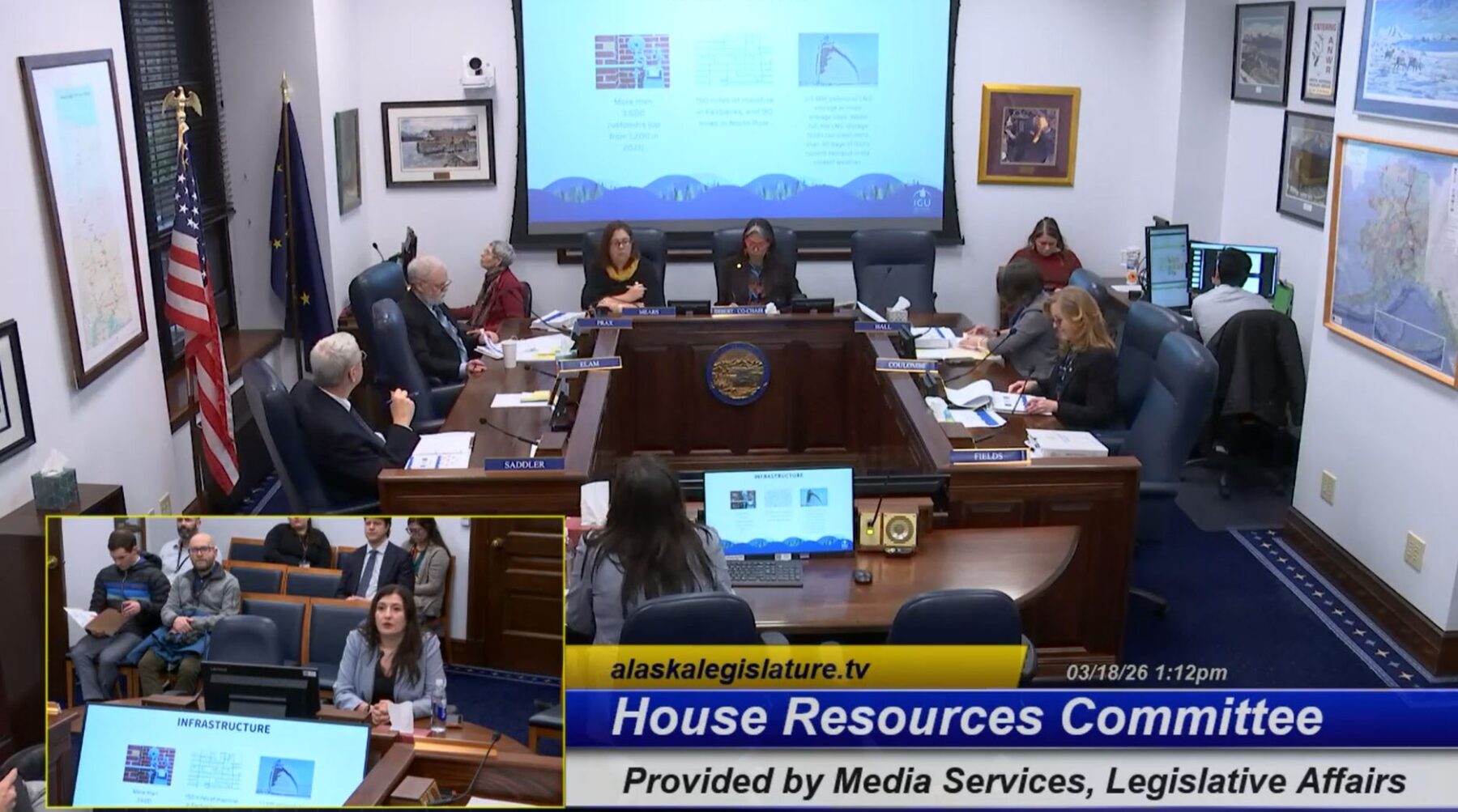
The House Resources Committee received a detailed briefing from Interior Gas Utility (IGU) on its operations, supply transition, customer growth, and infrastructure challenges. The presentation underscored IGU’s role as a municipally owned utility serving the greater Fairbanks area, including military installations, while highlighting conservative themes of fiscal independence, cost control for residents, and strategic planning to deliver low-cost, clean-burning natural gas without imposing undue burdens on ratepayers or taxpayers.
Elena Sudduth, general manager IGU, described IGU as an instrumentality of the Fairbanks North Star Borough (FNSB) but financially separate, with revenue derived solely from customer rates and eligible grants tied to municipal ownership. “We are owned by FNSB, but we do not share funds between the utility and the borough,” she emphasized. Serving approximately 3,600 customers across two independent distribution systems—one in Fairbanks and one in North Pole—IGU operates about 150 miles of mainline in Fairbanks and 90 miles in North Pole. Storage capacity totals 5.5 million gallons of LNG across three facilities, providing more than 30 days of supply at design demand during peak winter conditions.
The utility’s mission remains clear: deliver affordable natural gas to the largest possible number of customers as quickly as possible in a region burdened by some of the nation’s highest energy costs. Sudduth highlighted rapid growth—from roughly 1,200 customers in 2021 to over 3,600 today—demonstrating successful expansion while maintaining system reliability. “Connecting them is a big goal of the utility,” she noted regarding the Fairbanks and North Pole systems, adding that the interconnection project is shovel-ready and funding applications are underway. Committee members expressed interest in build-out costs, with a general ballpark estimate of $350,000 per mile provided; IGU committed to supplying a precise total for full expansion.
A major operational milestone was the transition from Cook Inlet LNG to North Slope supply. IGU received its first North Slope delivery in October 2025, with sustained volumes beginning in December. “This is, in our opinion, a historical moment,” Sudduth stated—the first use of North Slope natural gas outside the Slope to meet Fairbanks needs. The Harvest Midstream facility near Deadhorse produces roughly three times the output of IGU’s former Big Lake (Titan) facility, now mothballed as a contingency. Sudduth confirmed two separate 20-year contracts: gas supply from Hilcorp North Slope LLC and liquefaction services from Harvest Midstream, with year one commencing July 1, 2026. Current annual usage stands at approximately 1.5 billion cubic feet (BCF), well within the facility’s 4.5 BCF design capacity, with provisions for additional trains scaling potential output to 13.5 BCF.
Rep. Dan Saddler (R-Eagle River) probed contract risks in light of potential Alaska LNG pipeline progress. Sudduth responded thoughtfully, framing the arrangements as prudent planning rather than concern. She cited four factors: the necessity of LNG for supply security where underground storage is unavailable; LNG’s widespread use for peak shaving; potential to redirect volumes to underserved Interior projects; and alignment with Wood Mackenzie projections of 11 BCF total Interior demand versus IGU’s 3 BCF maximum commitment. “Planning, not concern,” she summarized, reinforcing a measured approach to long-term energy security.
Energy cost comparisons drew attention. IGU’s residential tariff sits just under $25 per MCF—roughly double Southcentral rates due to full end-to-end handling—but remains consistently cheaper than delivered heating oil on an equivalent energy basis. Conversion barriers emerged as a key challenge. Burner change-outs average $7,500 (with ~$3,500 assistance carrying deed restrictions prohibiting future solid-fuel devices), while new boilers range $20,000–$30,000 (assistance ~$9,100). Current EPA-funded programs through the Fairbanks North Star Borough target air-quality improvements but do not cover full costs and impose property-level restrictions. IGU expressed interest in alternative income-verified assistance pathways without such deed restrictions, potentially supported by legislative grants.
Penetration rates stand at approximately 35% among premises with mainline access in Fairbanks and 15% in North Pole. Rep. Julie Coulombe (R-Anchorage) inquired about historic Cook Inlet logistics and current sourcing; Sudduth confirmed full transition to North Slope supply, with brief dual sourcing during commissioning. Military base service readiness was affirmed: IGU stands prepared to serve Fort Wainwright and Eielson AFB, leveraging excess capacity and contractual flexibility.
Legislative priorities outlined by IGU included strong support for the Alaska LNG project, sensitivity to Fairbanks costs (including spur-line tariffs), advocacy for a pooled in-state tariff charging uniform rates to all users, measures to reduce conversion costs, capital funding for mainline extensions, and increased Dalton Highway maintenance for reliable LNG trucking. Rep. Coulombe sought clarification on tariff structure; Sudduth confirmed current planning contemplates a spur-specific approach but expressed preference for pooling to ensure equity.
Rep. Mike Prax (R-North Pole) explored replicability of the Talkeetna small-scale LNG model and coordination with DOT on road projects. Sudduth affirmed interest in replicating vertical tank systems for remote or low-density areas and confirmed ongoing dialogue with DOT and municipalities whenever roads are opened. “We are included on distribution information and often ask to be included in the project,” she noted. Prax suggested aligning future appropriations with specific road upgrades (e.g., Holmes Road, Dennis Road, Blacklow Hill) and evaluating pipe versus micro-system trade-offs based on density.
Financial health and regulatory status drew scrutiny. Sudduth explained IGU’s non-economic regulation by the Regulatory Commission of Alaska (beyond CPCN issuance), with the board approving budgets. Depreciation and amortization are not recovered in rates, which can make financials appear negative on first glance; adjusted, IGU meets its 1.35 debt coverage ratio on a $10 million bond, alongside a $139 million AIDEA loan and a small commercial building loan. Rep. Saddler confirmed the mothballed Titan facility carries minimal expenses during deferment, providing valuable contingency without immediate ratepayer burden.
PILT discussions with the borough were noted as outside IGU’s purview, though coordination on spur-line and gas-line costs continues. Rep. Maxine Dibert (D-Fairbanks) acknowledged ongoing talks with mayors regarding AKLNG and suggested a potential committee site visit to Interior facilities.
The committee took the presentation under advisement, with follow-up actions including detailed cost estimates, contract summaries, seasonal trucking schedules, and tariff modeling comparisons.
Challenges remain—conversion costs, tariff design, and coordination with larger projects—but IGU’s measured approach demonstrates responsible stewardship of public resources in a high-cost region.


