
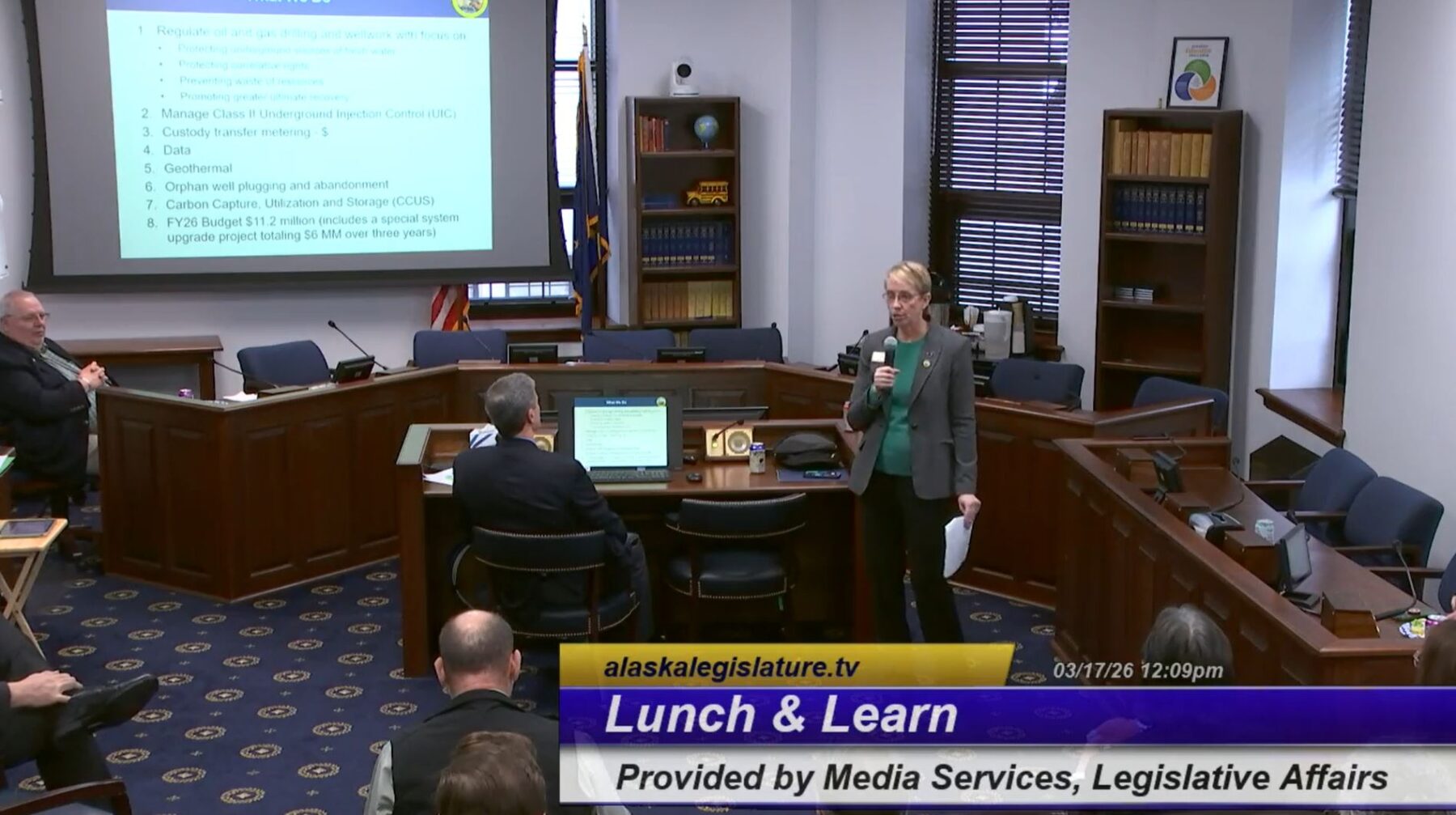
The Alaska Oil and Gas Conservation Commission (AOGCC) hosted a lunchtime briefing for legislators Tuesday, outlining its independent, quasi-judicial role in preventing waste, protecting groundwater, and maximizing long-term recovery of oil, gas, and geothermal resources while upholding correlative rights of owners. Commissioners emphasized engineering, geology, and legal oversight free from policy or politics, highlighting industry-funded operations that ensure accountability without drawing on the state general fund.
Sen. Mike Cronk (R-Tok) introduced the three commissioners: Chair Thomas McKay, a 45-year petroleum engineer and former House member; Jessie Chmielowski, petroleum engineering commissioner with 27 years in Alaska operations; and Greg Wilson, geology commissioner with 31 years across major producers and recipient of the Marilyn Crockett Lifetime Achievement Award. Chmielowski set the historical stage with a 1901 Spindletop photo, illustrating early “first-come, first-served” chaos that wasted reservoir pressure and ignored owner rights. She credited President Theodore Roosevelt’s conservation movement and the 1935 Interstate Oil and Gas Compact for establishing state commissions like AOGCC.
Chmielowski described the agency’s structure: commissioners appointed by the governor for staggered six-year terms, decisions made by quorum of at least two, and independence from gubernatorial direction. Staff engineers and geologists review every drilling permit and sundry application to verify compliance with statutes. Groundwater protection remains paramount through proper surface casing, cementing, and injection-order reviews—especially critical on the Kenai Peninsula near drinking-water wells. Correlative rights enforcement requires setbacks or public hearings for boundary wells to ensure equitable recovery. Waste prevention spans subsurface reservoir management via conservation and injection orders and surface flaring minimization, with monthly reports required.
The commission maintains primacy over EPA Class II injection wells, funded partly by a $160,000 annual federal grant, and oversees fiscal meters that determine royalty payments. It serves as a vast public data repository via its website and “Data Miner” tool, housing scanned well files while safeguarding confidential records. Geothermal regulation falls under its mission, with potential involvement in Aleutian power projects. Since 2021, AOGCC has received over $53 million in federal Infrastructure Investment and Jobs Act funds to plug orphan wells, contracted through ASRC.
Commissioner Wilson reviewed 2025 drilling: 133 wells total, predominantly North Slope producers (73) and service wells (31), with only five exploratory wells statewide. Development trends show Hilcorp’s rising activity offsetting modest declines elsewhere. Using Milne Point as a case study, Wilson illustrated technological progress: BP drilled 355 wells totaling 2.9 million linear feet to reach 50,000 barrels per day; Hilcorp achieved similar output with 183 horizontal wells totaling 2.3 million feet—roughly 80% of the footage—by targeting the shallower Schrader Bluff formation. “It just shows the step change in technology with those horizontal wells,” Wilson noted.
Alaska’s production history spans nearly 70 years, peaking above 2 million barrels per day in 1988 before long decline, briefly plateauing with Alpine field startup around 2000. Wilson highlighted Department of Revenue forecasts showing renewed growth from Pikka (online 2026) and Willow (late decade), reversing the slope and extending Trans-Alaska Pipeline System viability by sustaining legacy-field flow rates. Challenges include orphan and idle wells—addressed through bonding incentives and federal plugging funds—and aging brownfields. North Slope permafrost thaw causes subsidence risking well integrity; Cook Inlet platforms require full well plugging before decommissioning. Wilson praised major operators’ annual monitoring meetings with AOGCC.
The commission’s $11.2 million FY26 budget derives almost entirely from a regulatory cost charge levied on operators proportional to produced and injected volumes, supplemented by federal grants. Eight field inspectors, averaging 28 years’ experience, conduct over 6,000 inspections annually, witnessing critical procedures such as blowout preventer and mechanical integrity tests.
An upgrade to the Risk-Based Data Management System (RBDMS), funded incrementally by operators, will modernize electronic permitting with a map-based interface. Chmielowski confirmed 2015 gas offtake orders for Prudhoe Bay and Point Thomson remain valid for proposed pipeline needs, though gas requires carbon-dioxide separation and reinjection—another AOGCC oversight area.
Following HB 50, the commission developed over 100 pages of Class VI carbon-storage regulations, formally adopted earlier this month after public comment. They will become law in April 2026, enabling an EPA primacy application. Commissioner McKay, newest public member since January, underscored focus on well control, safety, equipment, and crew training: “The last thing that we ever want to see is a big problem or a big incident.”
Legislators asked about orphan wells (approximately 44 on the list, seven plugged in south-central Alaska), bonding (updated from inadequate $200,000 statewide to tiered system topping $30 million for majors), federal-land jurisdiction (AOGCC authority applies everywhere), and correlative-rights hearings for boundary wells. Chmielowski explained the collaborative, quorum-based decision process and staff expertise supporting commissioners.
With new fields poised to bolster production and pipeline longevity, AOGCC’s transparent, data-driven approach positions Alaska to sustain its resource base responsibly for decades ahead.


