Women in power asserted themselves this week on issues of words and wardrobe.
Secretary of the Interior Deb Haaland on Friday ordered a ban of the word “squaw,” which is an Algonquin word that simply means “woman,” from all federal lands.
Haaland, as an agent of the federal government, declared “squaw” to be a derogatory term that was inappropriate to use to name geological features. There are more than 650 place names that use the word, such as Squaw Mountain, Squaw Valley, and Squaw Creek. She appointed a task force to find replacement names.
“Racist terms have no place in our vernacular or on our federal lands. Our nation’s lands and waters should be places to celebrate the outdoors and our shared cultural heritage — not to perpetuate the legacies of oppression,” Haaland said in a news release.
“The term has historically been used as an offensive ethnic, racial, and sexist slur, particularly for Indigenous women,” the news release said.

The newly created Derogatory Geographic Names Task Force will include representatives from federal land management agencies, as well as diversity, equity, and inclusion experts from the federal agency. The order requires that the task force engage in Tribal consultation and consider public feedback on all proposed name changes.
Secretarial Order 3405 creates a Federal Advisory Committee to broadly solicit, review, and recommend changes to other derogatory geographic and federal land unit names. The Advisory Committee on Reconciliation in Place Names will include representation from Indian tribes, tribal and Native Hawaiian organizations, civil rights, anthropology, and history experts, and members of the general public. It will establish a process to solicit and assist with proposals to the secretary to change derogatory names, and will include engagement with tribes, state and local governments, and the public.
Some states have passed legislation prohibiting the use of the word “squaw” in place names, including Montana, Oregon, Maine, and Minnesota. Squaw Valley Ski Resort officially changed its name to Tahoe Palisades in September.
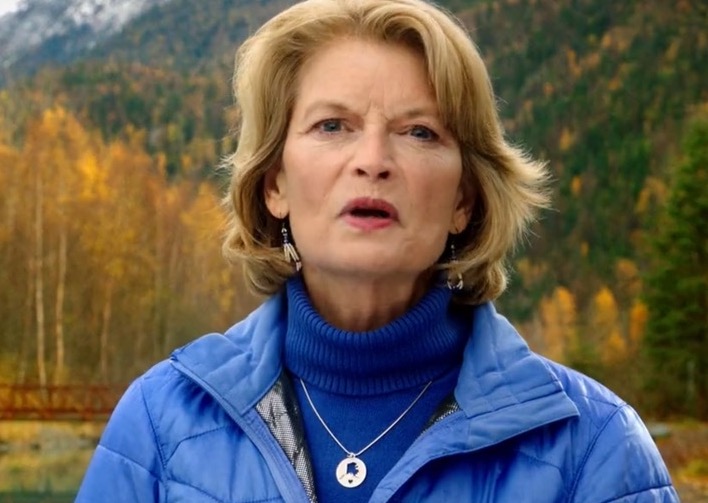
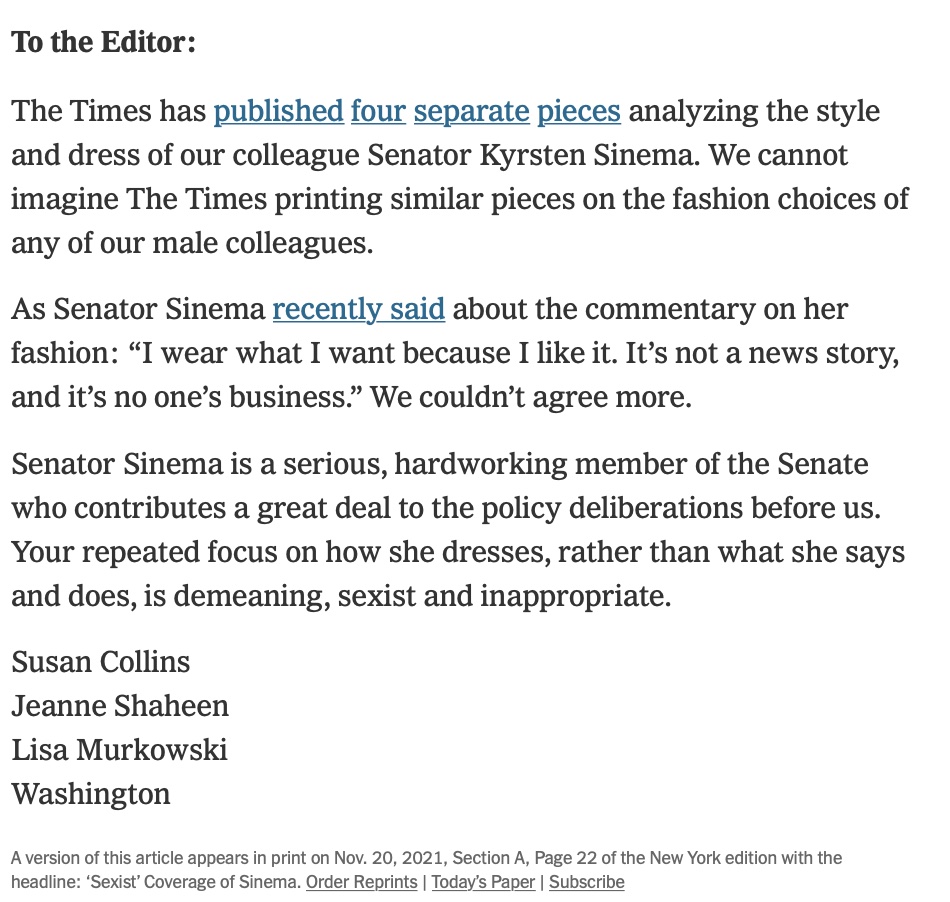
Meanwhile, Alaska Sen. Lisa Murkowski and two other women senators had a letter published in the New York Times on Nov. 20, in which they criticized the newspaper for focusing too much on the wardrobe of Sen. Kyrsten Sinema, a Democrat from Arizona who has some of the more flashy, form-fitting, and colorful attire in Congress. The letter was also signed by Jeanne Shaheen, a Democrat senator from New Hampshire and Susan Collins, a Republican from Maine.
Vanessa Friedman, a writer for the New York Times, wrote a defense in 2017 about why writing about the wardrobe of powerful people is of interest. In her column, she wrote:
“Every garment — a tie, a dress, a pair of socks or shoes — is a communication device of varying power and clarity, and we choose how to use those tools to sway those looking at us. After all, since long before Queen Elizabeth I whitened her face and exaggerated her ruff to transform herself into a living myth, leaders have been using clothes to influence opinion. For all of us, what we choose to wear in the morning telegraphs a message about who we are; and for those in the public eye, this effect is simply multiplied a hundredfold (or more).
“Is it sillier to acknowledge the strategy behind appearance, or to pretend such influences don’t exist? It may be embarrassing to recognize that what someone wears can affect your judgment, but it does: leather leggings and sneakers can make a member of the establishment seem accessibly cool; a red tie taps into memories of Morning in America; rolled-up shirt sleeves indicate hard work. At the very least, wardrobe choices can subconsciously make you relate to public figures in a more personal way, which could then tempt you to give them the benefit of the doubt when it comes to motivations and policy making — or they may alienate you entirely.
“Barack and Michelle Obama were masters of the sartorial statement, and a wave of politicians who have come since, including Justin Trudeau and Emmanuel Macron and their wives, have learned from the Obamas’ example: strategically abandoning their ties on occasion; daring to wear “Star Wars” socks; promoting homegrown designers. Donald Trump, with his hair and his tan and his devotion to the overlong tie and boxy suit, uses his style to weave a different story. But, in the current White House, it is Melania whose clothes may be the most telling. Not because she is a woman, but because since the election she has rarely spoken, retreating to her penthouse in New York and emerging last week on the global stage in a series of strict, battle-ready outfits.
“It’s not that what she wears matters more than world peace or freedom of the press or trade policy or any piece of legislation — of course not. And The Times covers those issues with dedication. But one kind of analysis does not obviate the other, and can, in fact, elucidate it. We scour her wardrobe for clues as to who she is as a person and how she sees her role; where her values lie and how she will represent the country on the world stage. Where her husband’s (perhaps unstated) priorities lie. The vehicles may be superficial. But they are also broadly accessible, and that makes them powerful. And power is a subject I don’t think any of us would dismiss.