

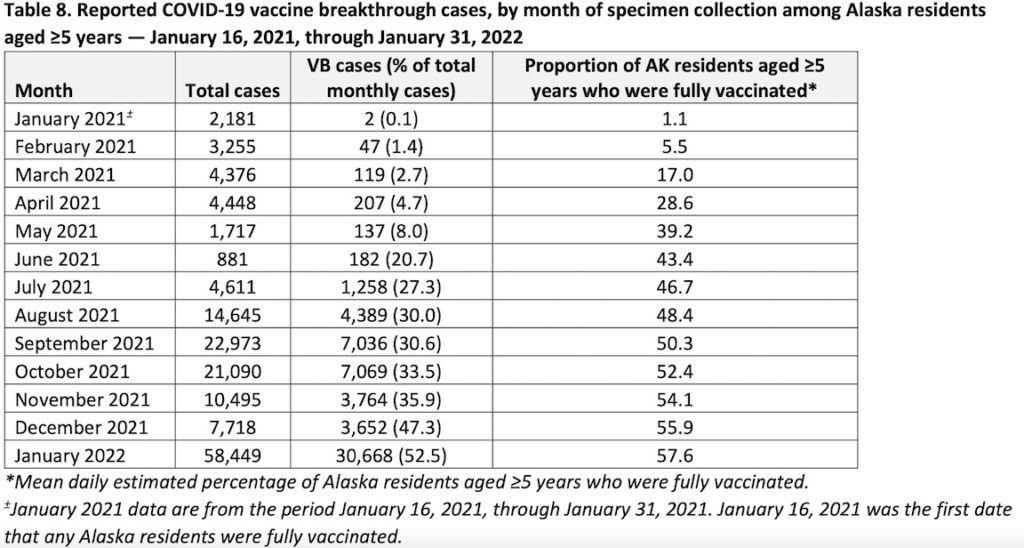
In 2021, Covid vaccinations were all the rage across the country. That year, Alaskans were hounded to get fully vaccinated, yet the number of vaccine breakthrough cases kept rising. In fact, the higher the rate of vaccinations, the higher the rate of the Covid virus finding a way around the vaccine to infect people.
According to the latest report from the Department of Health and Social Services, 58,531 Covid-19 cases were documented among Alaska residents in January, 2022. That was the highest rate of infection yet in the state, since the virus arrived in March of 2020, and the Omicron variant was to blame.
Of those, 30,668 were among vaccinated individuals. An additional 7,234 cases occurred among Alaska residents who were considered partially vaccinated.
In January, more than 57 percent of Alaskans were vaccinated for Covid, and more than 52 percent of breakthrough cases were among the vaccinated. The reports by the DHSS are released monthly, but typically lag by three months.
Covid-19 vaccines were administered on a very limited basis in Alaska in mid-December of 2020. Mostly health care workers and first responders were allowed to receive the vaccine. Next came the elderly and medically fragile. By March 2021, all persons who lived or worked in Alaska over the age of 16 became eligible for vaccination, and it was widely available. After the Pfizer/BioNTech vaccine was authorized for youth over age 12, eligibility expanded in May of 2021. In November of 2021, the vaccination was authorized for children between the ages of 5 and 11. Also in 2021, booster shots were recommended and available by September for those who had previously been considered fully vaccinated.
The department says prior infection provides some protection for about six months.
“While reinfections with SARS-CoV-2 are known to occur, they can be difficult to diagnose due to a lack of a widely accepted definition. Observational studies have found that prior infection with SARS-CoV-2 confers substantial partial protection against reinfection with Delta and prior circulating variants for at least 6 months. The extent to which prior infection confers protection against infection with the Omicron variant is still being investigated. There is evidence that even in persons with a history of SARS-CoV-2 infection, vaccination provides an added layer of protection,” the state Department of Health and Social Services noted in its report.
In most cases, people who had breakthrough cases either didn’t have symptoms or had mild symptoms like sniffles and sore throats, and their sickness was of a shorter duration. The vaccination, while not providing complete protection against the virus, may have reduced the severity for those who were exposed.
For comparison, in Oregon during the week of Jan. 2–8, the state reported 45,334 cases of Covid-19. Some 33,363 of those (73.6%) were among unvaccinated and 11,971 (26.4%) were vaccine breakthrough cases.


