During the Yom Kippur War war between Arabs and Israel in 1973, the Organization of Petroleum Exporting Countries imposed an oil embargo against the United States in retaliation for the U.S. decision to supply the Israeli military.
It was 50 years ago this month, when President Richard Nixon asked Congress for $2.2 billion in emergency aid for Israel. The ensuing embargo ended U.S. oil imports from OPEC nations, and world oil prices began to destabilize.
The price of oil nearly quadrupled, going from $2.90 a barrel before the embargo to $11.65 by January 1974. The United States also had its first fuel shortage since World War II, and rationing was imposed by the federal government, along with lower speed limits to reduce consumption.
In an essay reflecting on the oil shortage of 1973, and the ensuing inflation, the Federal Reserve wrote, “Ultimately, the oil crisis of 1973 and the accompanying inflation was a result of many factors culminating in a perfect economic storm. The oil embargo of 1973 was just one of many complicating factors that led U.S. policymakers to overestimate our national potential and to underestimate their own role in the broad inflation that occurred throughout the 1970s.”

Arthur Burns, who was the chairman of the Federal Reserve at the time, said that the manipulation of oil prices and supplies by OPEC (then called OPEAC) came at a time when prices for industrial commodities were already rising at a rate of 10% annually, and many major industrial materials were scarce in the United States, which had gotten itself into a position of not being able to increase the amount of oil to the market in response to the oil embargo. Inflation skyrocketed.
OPEC had enormous power in the 1970s, which ended up being one of the most convincing reasons the Trans Alaska Pipeline System was approved by Congress.
That vote to allow the pipeline came in July 1973, with the Senate voting to end a three-year fight by environmentalists to stop the pipeline. That is when Vice President Spiro Agnew cast his first deciding vote — and the Trans Alaska Pipeline was approved.
On Nov. 7, Nixon announced Project Independence to promote domestic energy independence. There had to be a better path forward.
The embargo ended in March 1974, after some members of OPEC had decided enough was enough. But the higher prices created by the OPEC oil embargo remained.
The parallels between 1973 and 2023 — a 50-year timespan — are similar but different.
Today, as war between Israel and her enemies is once again threatening to destabilize markets, the energy policy that the Biden White House has enacted, and the Bidenomic economic policies that has driven inflation have left America in a tough position to quickly respond to changing markets.
Also, the Strategic Petroleum Reserve is now down to 351 million barrels, a drop of 14% since last year.
The SPR was established by President Gerald Ford two years after the embargo, when he signed the Energy Policy and Conservation Act on Dec. 22, 1975, setting for a U.S. policy to have a reserve of up to one billion barrels of petroleum.
The reserve, stable for generations, has been continually drained by the Biden Administration since 2021 to prop up the economy and keep fuel prices down. By the summer of 2022, however, the national average cost of gas was $5.02 per gallon, having increased over 132% since Biden took office in 2021, when it was $2.16 per gallon.
Although Hamas came on the scene later, in 1987, as a growth of the Muslim Brotherhood, it is committed to armed resistance against Israel and the creation of an Islamic Palestinian State where Israel now exists and has existed since first recognized as a country in 1948, as a place where Jews could live in peace. Hamas is now the point of the spear for what has been described as a war on the Jews.
Other global conditions have also changed in the 50 years since the OPEC oil embargo and the 75 years since Israel was first recognized as a country. China is a growing military power, and has just moved six warships into the Mediterranean Sea. Iran, once oppressed by the Soviet Union, is now an ally of Russia and is a sponsor of terrorism.
In addition, there’s a war that developed when Russia invaded Ukraine one year after Biden took office. The United States has spent over $75 billion defending Ukraine — all of the spending is borrowed money from primarily Japan, China, and other bond-holders.
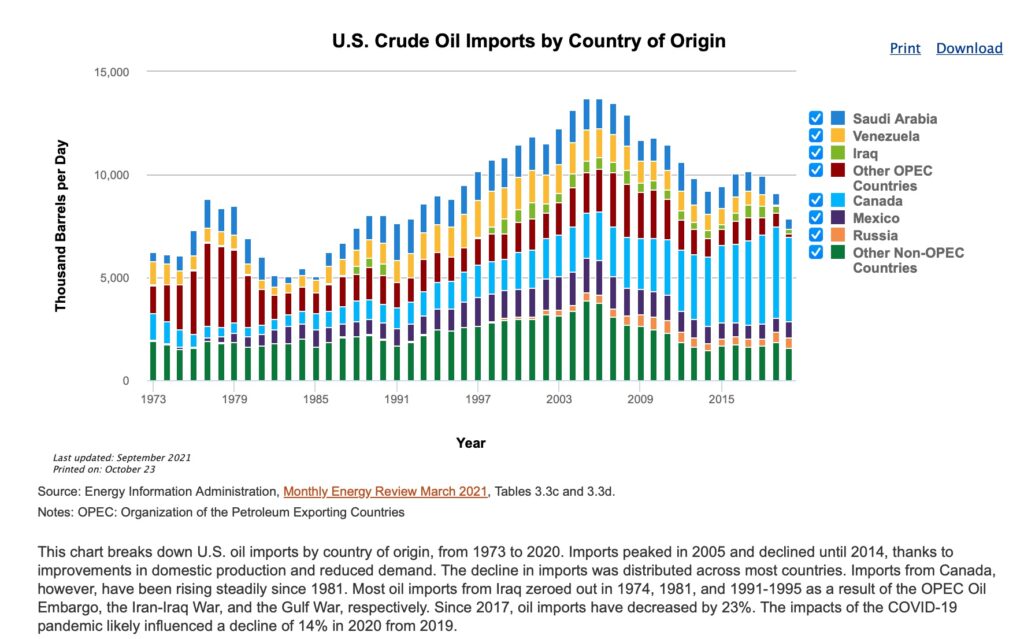
Now, while the Biden Administration cuts off domestic production in Alaska, the United States is getting more of its oil from Canada than it did leading up to the oil embargo of 1973. The top five oil importers include:
- Canada 52%
- Mexico 10%
- Saudi Arabia 7%
- Iraq 4%
- Colombia 3%
Read more about the oil embargo of 1973-74 at the State Department’s history page.