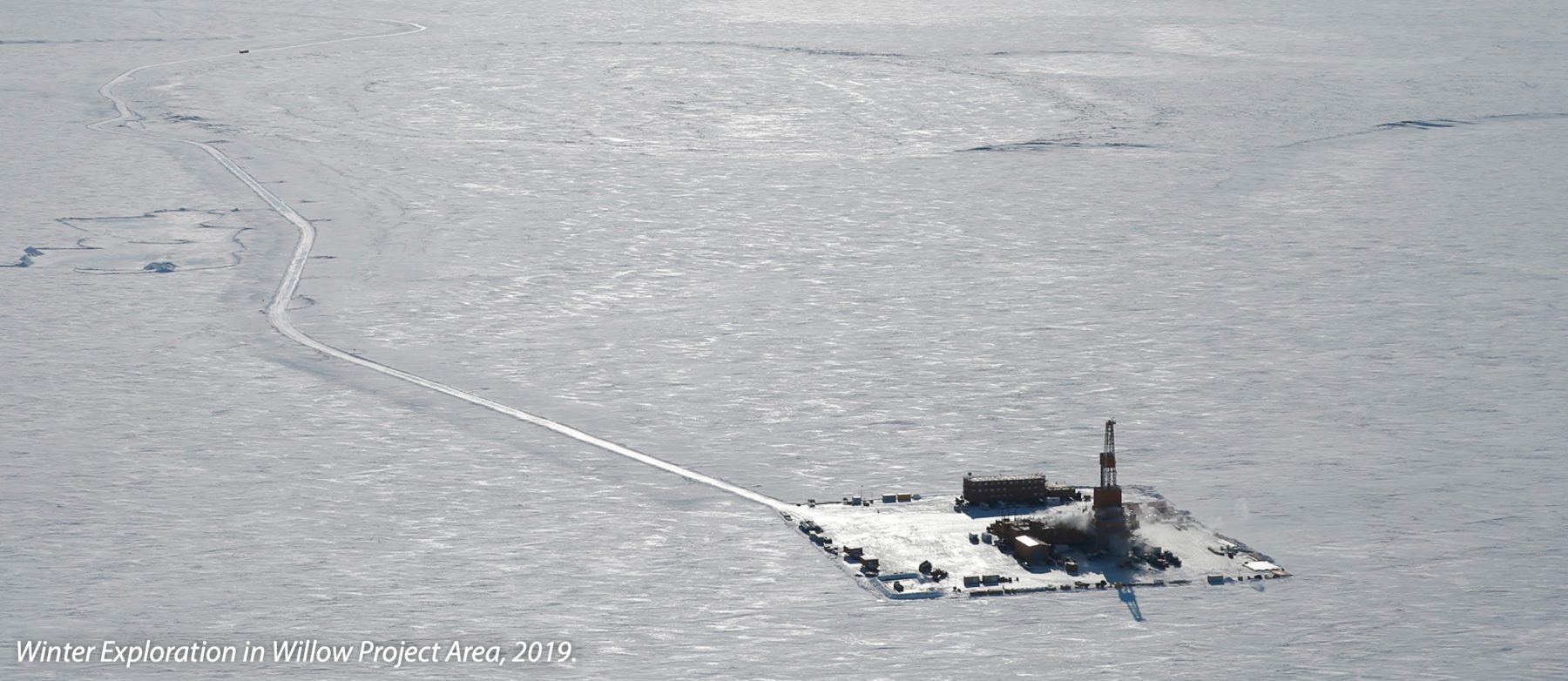
As expected, the Biden Administration issued a decision to reapprove ConocoPhillips’ Willow Project at the edge of Alaska’s National Petroleum Reserve. The administration also said on Sunday it will put strict limits on what cannot be done further in Alaska’s oilfields.
“The Interior Department also announced that it is preparing new rules to provide maximum protection to millions of acres of lands in the western Arctic, inducing the area around Teshekpuk Lake, a vital home to caribou and other wildlife that are central to Alaska Native communities’ traditional way of life. The actions announced today build on the president’s record of having conserved more lands and water in his first two years than any president since John F. Kennedy,” the news release says from the Department of Interior.
The decision on Willow was leaked to Bloomberg News on Friday. The White House lied to the public later on Friday and said a decision had not been made, but by Sunday all the reporters had their own sources confirming that the project indeed had a go-ahead with three drilling pads.

By Monday, Willow was not even on the front pages of any major news website. The world had moved on from train derailments, to Willow, and now to a chaos around the banking system. Willow was old news, a perfectly executed rollout of news that the White House wanted to avoid.
No longer in control of the narrative, environmentalists still decried the decision, saying that Willow will be catastrophic for the environment because the petroleum from the field will emit 284 million metric tons of carbon dioxide over its 30-year lifetime. That is 9.45 million tons per year.
To put it in perspective, the world’s volcanoes and fissures emit up to 540 million metric tons per year and while global energy-related CO2 emissions exceed 33 billion metric tons per year, according to the International Energy Agency. Willow represents a tiny fraction of the CO2 emissions from human and other sources, such as decaying old-growth forests.
But Willow was, for months, the poster-child climate-change cause for environmentalists who needed something to fight after having been successful in shutting down the Pebble Mine.
“Biden approved Willow knowing full well that it’ll cause massive and irreversible destruction, which is appalling,” said Kristen Monsell, a senior attorney at the Center for Biological Diversity. “People and wildlife will suffer, and extracting and burning more fossil fuel will warm the climate even faster. Biden has no excuse for letting this project go forward in any form. New Arctic drilling makes no sense, and we’ll fight hard to keep ConocoPhillips from breaking ground.”
At its peak production, Willow may provide 180,000 barrels per day of product. In 2019, Texas produced 5,070,450 barrels per day, more than twice the entire Gulf of Mexico production. New Mexico produced 1.4 million barrels per day. Alaska now only produces less than 500,000 barrels per day, primarily due to the war on Alaska by environmentalists.
ConocoPhillips Alaska said it has completed extensive preparations with key contractors and expects to immediately initiate gravel road construction activities. The company continues to review the record of decision and will advance internal approval processes towards a final investment decision.
“This was the right decision for Alaska and our nation,” said Ryan Lance, ConocoPhillips chairman and chief executive officer. “Willow fits within the Biden Administration’s priorities on environmental and social justice, facilitating the energy transition and enhancing our energy security, all while creating good union jobs and providing benefits to Alaska Native communities.”
Willow is designed to support and coexist with subsistence activities with many mitigation measures built into the project design, the company said.
“We are truly grateful for the steadfast support from Alaska’s Congressional Delegation – Senators Lisa Murkowski and Dan Sullivan and Representative Mary Peltola – Alaska Native communities, the state legislature and organized labor groups,” Lance said. “We also thank our employees and the contractor community, who dedicated years to designing a project that will provide reliable energy while adhering to the highest environmental standards.”
Located in the National Petroleum Reserve in Alaska, the project is expected to deliver between $8 billion to $17 billion in new revenue for the federal government, the state of Alaska and North Slope Borough communities. Willow will be built using materials primarily made and sourced in the U.S. and has the potential to create over 2,500 construction jobs and approximately 300 long-term jobs.
Alaska’s delegation issued statements:
“Today’s Record of Decision (ROD) on the Willow Project is critically important for Alaska’s economy, good-paying jobs for our families, and the future prosperity of our state,” Sen. Dan Sullivan said. “This decision is also crucial for our national security and environment. Producing much-needed American energy in Alaska with the world’s highest environmental standards and lowest emissions enhances the global environment. I can’t thank enough all of the Alaskans who got involved in this fight, including our state legislators, union leaders, industry, university and business officials, and thousands of others from diverse backgrounds who came together to promote a brighter future for Alaska. In particular, I’d like to commend the Alaskans who live on the North Slope, whose ancestors have inhabited the lands closest to this project for thousands of years, and who bravely spoke out—even as far-left, Lower 48, eco-colonialist NGOs continued their efforts to silence Alaska Native voices.”
“We finally did it, Willow is finally reapproved, and we can almost literally feel Alaska’s future brightening because of it. After years of relentless advocacy, we are now on the cusp of creating thousands of new jobs, generating billions of dollars in new revenues, improving quality of life on the North Slope and across our state, and adding vital energy to TAPS to fuel the nation and the world,” said Sen. Lisa Murkowski. “This was Alaska at its very best, with ConocoPhillips, Alaska Native leaders, labor leaders, our unanimous State Legislature, and so many more joining with the delegation to do everything we could to make this happen. I thank the administration for listening to Alaskans, rejecting false claims meant to sink this project, and having the courage to make the right decision on Willow.”
“Today, the people of Alaska were heard,” said Rep. Mary Peltola. “After years of consistent, determined advocacy for this project, from people all across the state and from every walk of life, the Willow Project is finally moving forward. I would like to thank the President and his administration for listening to the voices of Alaskans when it mattered most. I would also like to thank Senators Murkowski and Sullivan, and most importantly, our entire movement of Alaska Natives, laborers, state legislators, and everyday Alaskans who never gave up on this goal. Now, it’s on us here in Alaska to make sure that we make the best of this opportunity—that we use the revenues and jobs and economic opportunity from this project to make investments in the future of Alaska. We need to build up our schools, our housing stock, our rural Internet and electric grids, and more, in order to make this a truly 21st-century economy. We can make Alaska a national and global example of what an energy bridge to the future truly looks like, and I am looking forward to meeting this challenge.”
The Department of the Interior’s Record of Decision for the Willow Project is here.